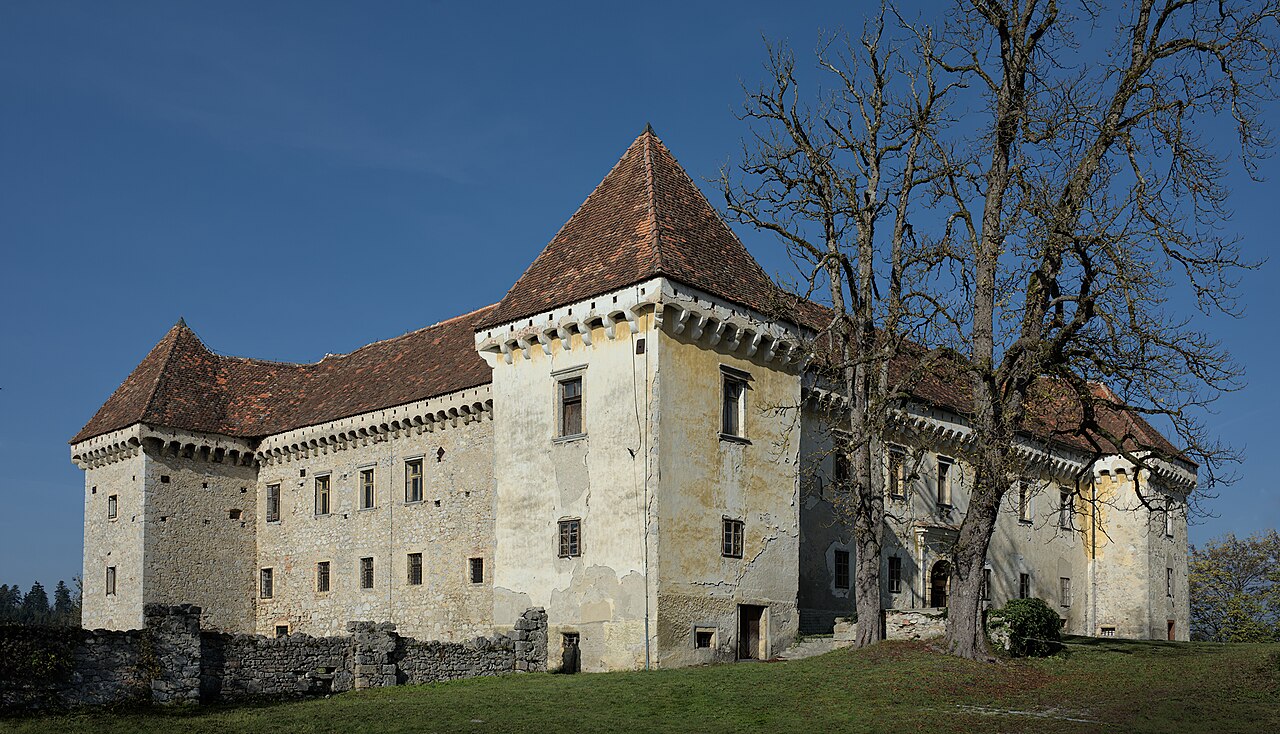
Little Castle
Little Castle (Mali grad) in Kamnik, Slovenia, is a significant medieval fortification whose origins trace back to the 11th or early 12th century. Strategically positioned above a narrow passage near an important trail, the castle served as a defensive stronghold overseeing key routes through the region. The site holds substantial historical and architectural value, especially due to the presence of the Romanesque chapel of St. Eligius, one of the oldest and most important medieval monuments in Slovenia and among the earliest of its kind in Europe.
Historical background and strategic importance
The castle was first documented in 1202, although archaeological and architectural evidence confirms its establishment predates this mention, likely constructed around c. 1200. Its location was chosen for its tactical advantage, overseeing a narrow passage that was part of a vital trade and travel route. This positioning allowed control over movement through the valley and provided a defensible position against potential invaders.
During the High Medieval period, the castle was a center of local power and defense. However, it suffered significant damage at the end of the 13th century when a fire devastated the structure. The northeast section of the castle was demolished and never rebuilt, marking a decline in its military importance.
Further destruction occurred following the earthquake of 1511, which led to the dismantling of much of the remaining castle in the 16th century. Today, only fragments of the original fortifications survive, alongside the chapel which remains the most prominent structure on the site.
Architectural features of the chapel of St. Eligius
The Romanesque chapel of St. Eligius is the centerpiece of Little Castle and a rare example of early medieval ecclesiastical architecture in the region. Built between the 11th and 15th centuries, the chapel exhibits a blend of architectural styles due to various phases of construction and renovation.
Original construction and layout
The earliest part of the chapel is the crypt and presbytery, originally dedicated to St. Margaret, constructed around 1100. This lower chapel forms the foundation of the present-day structure. The addition of the nave displaced the original Romanesque portal, which features a characteristic lunette, a semicircular decorative element above the doorway.
Later additions and stylistic changes
In the 13th century, a second floor was added to the chapel, dedicated to Bartholomew the Apostle. This upper chapel was enhanced with a Gothic vault constructed after 1470, reflecting the architectural transition from Romanesque to Gothic styles.
The lower chapel was rededicated to St. Eligius and underwent decorative updates in the late 18th century, including frescoes by Janez Potočnik painted after 1771. Around 1700, the entire chapel was remodeled in the Baroque style, which introduced new artistic elements while preserving traces of earlier Gothic and Romanesque frescoes.
Defensive structures and archaeological findings
Although much of the castle was lost, remnants of the defensive walls and a recently restored defensive tower remain visible. These fortifications highlight the castle's military role during the medieval period. Archaeological evidence also suggests that the site was a cultic center even before Antiquity, indicating a long history of human activity and spiritual significance.
Artistic and cultural significance
The fresco paintings inside the chapel are among the most exquisite medieval artworks in Slovenia. The wooden ceiling and the surviving frescoes provide valuable insight into the religious art and architectural techniques of the time. The chapel's layered history, combining Romanesque, Gothic, and Baroque elements, makes it a unique monument reflecting the evolving styles and religious practices over several centuries.
Visiting Little Castle today
Visitors to Little Castle can explore the chapel and the surviving defensive structures, gaining perspective on medieval life and architecture in Slovenia. The site offers a tangible connection to the region's past, with its well-preserved chapel serving as a focal point for cultural heritage. The castle's elevated position also provides scenic views of Kamnik and its surroundings.
Frequently asked questions (FAQ)
- When was Little Castle in Kamnik built?
- Little Castle was constructed around the 11th or early 12th century, with its first recorded mention in 1202.
- What architectural styles are visible in the chapel of St. Eligius?
- The chapel features a blend of Romanesque, Gothic, and Baroque styles due to its construction and renovations spanning from the 11th to the 18th centuries.
- Can visitors see the defensive structures of Little Castle?
- Yes, remnants of the defensive walls and a restored defensive tower are still visible and accessible to visitors.
- What is significant about the frescoes inside the chapel?
- The frescoes, including those by Janez Potočnik, are important medieval artworks that showcase religious art evolution in Slovenia.
- Is Little Castle accessible to the public?
- Little Castle is open to visitors, offering insight into medieval architecture and history, along with scenic views of Kamnik.
Information
Loading map...
Visitor reviews
No reviews yet. Been here? Write the first review and help other travelers!
Write the first reviewVisited this castle? Share your experience
Your review helps other travelers and adds first-hand knowledge to our encyclopedia.