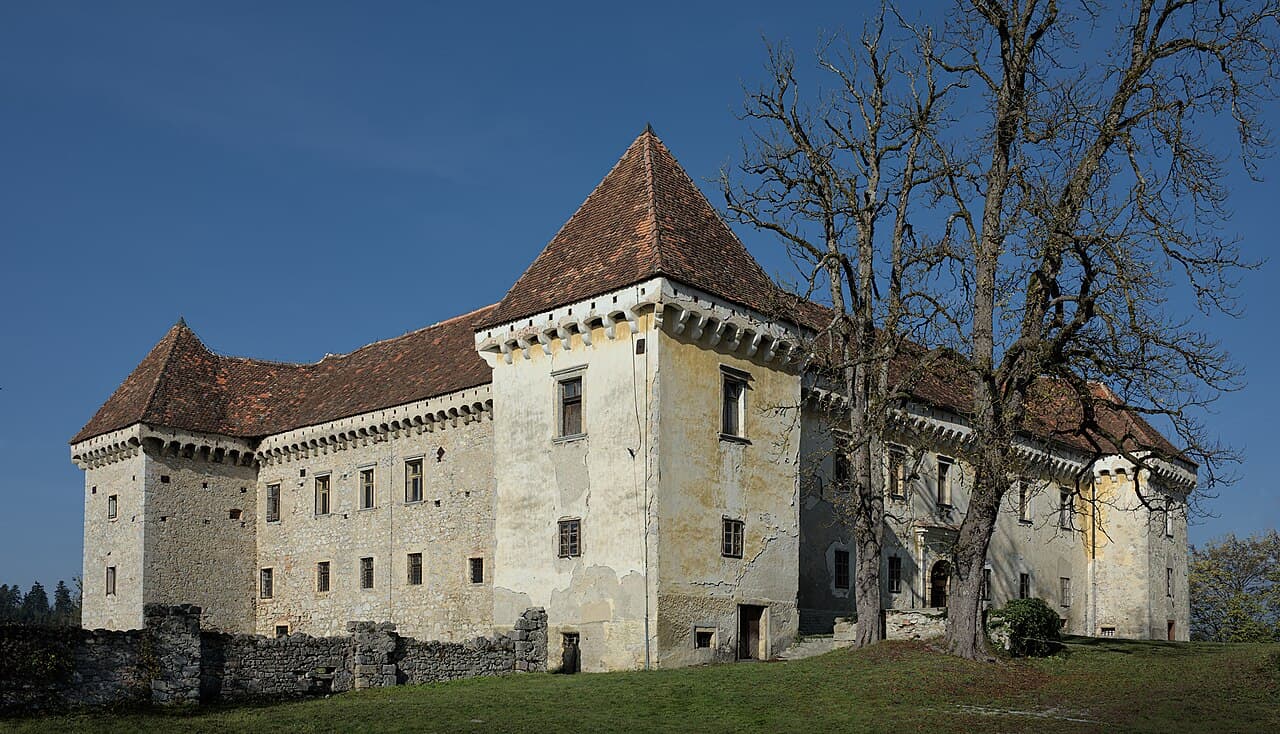
Krumperk Castle
Krumperk Castle stands as a notable example of a hill castle in Gorjuša, near Domžale in central Slovenia. Its origins trace back to the late 13th century, when it was likely constructed by the noble family Rabensberg from Koprivnik. The castle's early history is intertwined with the noble house of Kreutberg, with the first documented mention in 1338 under the possession of Herkules of Krumperk. Over the centuries, the castle changed hands among prominent noble families, reflecting the shifting political and social landscape of the region.
Historical development and ownership
The castle's early references under names like Turn Chraw-perg and variants such as Thurn unter Kreutberg or Thurn zu Kreutberg indicate some historical ambiguity, possibly conflating it with the nearby ruins of Koprivnik (Rabensberg) Castle near Moravče. By the 15th century, ownership passed to the house of Rusbach, who sold it in 1410 to Engelhand Zellenperger. The Zellenperger family retained it until their male line ended in the late 16th century, at which point the castle was inherited by the older branch of the Rauber family. The Raubers were a significant noble family in Carniola during the 15th and 16th centuries and were later elevated to barons. One of their most famous members, Adam von Rauber, is noted for his participation in the Battle of Sisak.
At its peak, the Krumperk lordship included several settlements such as Dob, Ihan, Krtina, Brezovica, and Studenec. The Rauber family undertook significant reconstruction in 1580, replacing the older medieval structures with the current castle building, reflecting the architectural trends of the period.
Following the extinction of the Rauber male line, the castle passed through various owners, including the Rasp family in 1631, the counts Thurn-Valsassina, and later the barons Rechbach in the 19th century. In 1928, the estate was sold to Stanka Pogačnik, a landowner from Ruše near Maribor.
Architectural features and style
The current structure of Krumperk Castle dates mainly from the late 16th century, showcasing Renaissance architectural elements typical of the period. The castle is characterized by its robust defensive walls, towers, and a well-planned courtyard. The Rauber family's reconstruction introduced more comfortable residential quarters while maintaining the castle's defensive capabilities.
While the original medieval fortress likely had more austere features, the Renaissance rebuild incorporated larger windows, ornamental stonework, and more refined interior spaces. The castle's position on a hill provided strategic advantages, overseeing the surrounding landscape and controlling access routes.
20th-century history and current condition
During the 20th century, Krumperk Castle underwent significant changes. After World War II, the castle was nationalized by the communist authorities, who stripped it of its original furnishings. It was repurposed as a sanatorium for wounded military officers, reflecting the post-war social policies.
In 1953, the castle was transferred to the Municipality of Domžale and converted into apartment housing, which led to alterations that affected its historical integrity. Later, in 1985, the property was divided; the castle itself came under the ownership of Agrokombinat, while the surrounding estate was managed by the Biotechnical Faculty of the University of Ljubljana, which established an equestrian center on the grounds.
Currently, Krumperk Castle is in a fairly poor state of repair and is the subject of ongoing denationalization proceedings. Its preservation status highlights the challenges of maintaining historical monuments amid changing political and economic circumstances.
Cultural significance and heritage
Krumperk Castle holds an important place in Slovenian cultural heritage, representing the evolution of noble residences from medieval fortifications to Renaissance estates. Its association with notable families like the Raubers and connections to historical figures such as Johann Weikhard von Valvasor, a renowned historian and the son of the last Baron Rauber's daughter, add to its historical value.
The castle's architectural transformations reflect broader European trends in castle design, transitioning from purely defensive structures to more comfortable and representative noble homes. Its location in central Slovenia situates it within a network of castles that illustrate the region's feudal and aristocratic history.
Visitor information and accessibility
While Krumperk Castle is not currently fully restored or open as a tourist attraction, its historical significance makes it a point of interest for scholars and enthusiasts of medieval and Renaissance architecture. Visitors interested in Slovenian castle heritage may explore the surrounding area and nearby towns such as Domžale for additional cultural experiences.
Efforts to preserve and restore the castle continue to be important for maintaining this link to Slovenia's noble past and architectural history.
Frequently asked questions (FAQ)
- When was Krumperk Castle originally built?
- Krumperk Castle was probably built in the late 13th century by the noble family Rabensberg from Koprivnik.
- What architectural style characterizes Krumperk Castle?
- The castle mainly reflects Renaissance architectural elements introduced during the late 16th-century reconstruction by the Rauber family.
- Who were some notable owners of Krumperk Castle?
- Notable owners include the noble families Rabensberg, Kreutberg, Rusbach, Zellenperger, Rauber, Rasp, Thurn-Valsassina, and Rechbach.
- What is the current condition of Krumperk Castle?
- The castle is in a fairly poor state of repair and is partially preserved, undergoing denationalization proceedings.
- Is Krumperk Castle open to the public?
- Krumperk Castle is not fully restored or officially open as a tourist attraction, but the surrounding area can be explored by visitors interested in Slovenian heritage.
Photo gallery

Photo by This Photo was taken by Miha Peče. Feel free to use my photos, but please mention me as the author. I would much appreciate if you send me an email [email protected] or write on my talk page, for my information. Please do not upload an edited image here without consulting me. I would like to make corrections only at my own source to ensure that the changes improve the image and are preserved.Otherwise you may upload an edited image with a new name. Please use one of the templates derivative or extract.•CC BY-SA 4.0
Information
Loading map...
Visitor reviews
No reviews yet. Been here? Write the first review and help other travelers!
Write the first reviewVisited this castle? Share your experience
Your review helps other travelers and adds first-hand knowledge to our encyclopedia.



