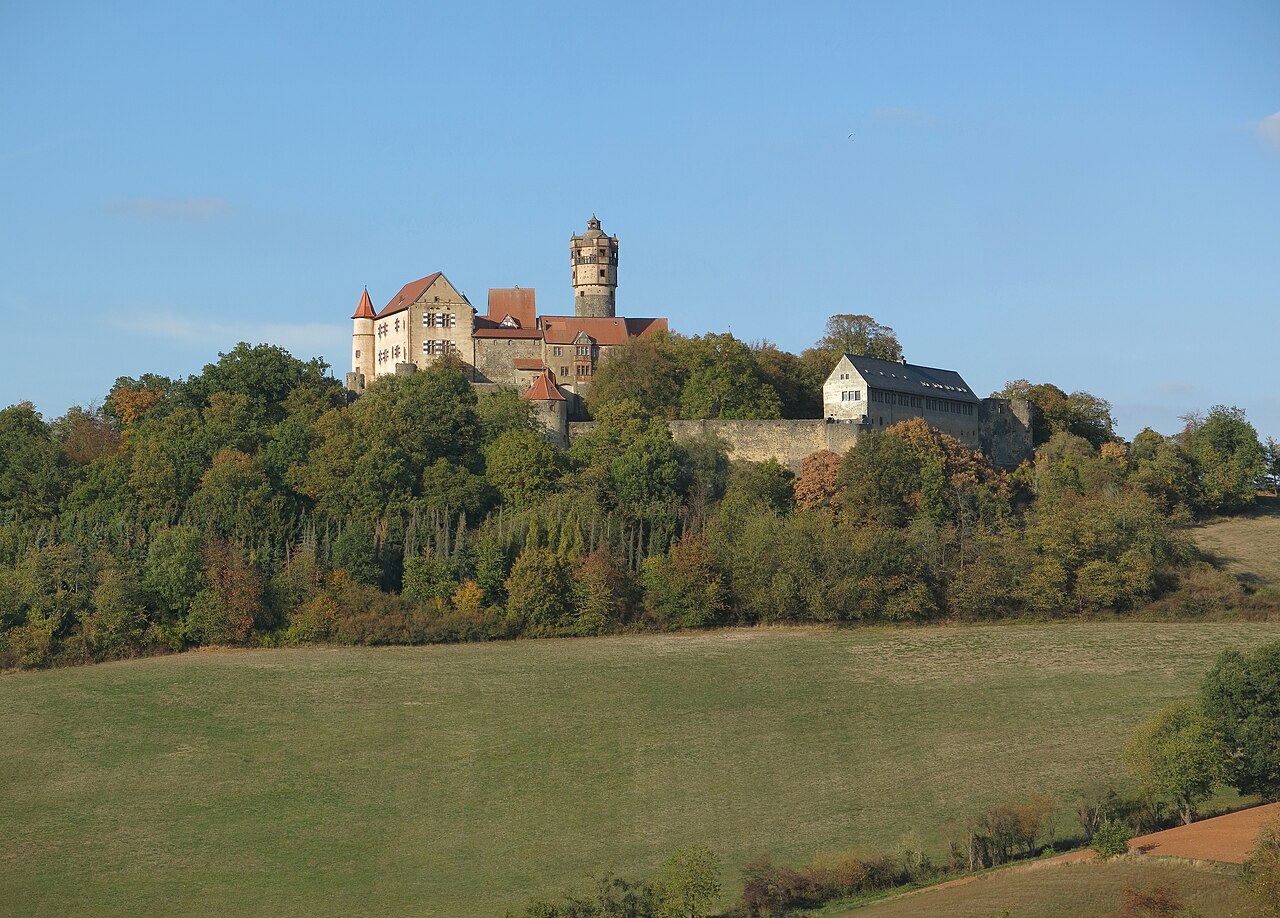
Lissberg Castle
Lissberg Castle is a notable example of a 12th-century hill castle located in the municipality of Ortenberg, Germany. Perched atop a volcanic cone rising from an ancient crater, the castle commands a strategic vantage point over the surrounding landscape, a typical feature of medieval fortifications designed for both defense and surveillance. The castle's origins trace back to the noble family known as the Herren von Liebesberg, who are first recorded in 1222 and are credited with its initial construction.
Historical background and ownership transitions
The castle's history reflects the turbulent political landscape of the region during the Middle Ages. The original Lißberg family line ended in 1396 with the death of Friedrich von Lißberg. Subsequently, ownership passed to his brother-in-law, Johann von Rodenstein, who adopted the combined name von Rodenstein und Lißberg, signifying the union of two noble houses and the continuity of the castle's legacy.
In 1415, the fortress was seized by force by Counts Johann II and Gottfried IX of Ziegenhain, marking a significant shift in regional power. Just three years later, in 1418, they sold half of their share to Landgrave Ludwig I of Hesse, indicating the castle's growing importance within the territorial ambitions of the Landgraviate of Hesse. The death of Johann II in 1450, the last Count of Ziegenhain, resulted in the full transfer of control to Hesse, consolidating the castle's status within the Landgraviate.
The castle's administrative affiliation changed again during the Hessian partition of 1604, when it became part of the Landgraviate of Hesse-Darmstadt. This transition reflected the broader territorial reorganizations occurring in the Holy Roman Empire during the early modern period.
Architectural features and defensive structures
Bergfried and main tower
The most prominent surviving architectural feature of Lissberg Castle is its round bergfried, a central defensive tower that stands approximately 27 meters tall with a diameter of 9 meters. The tower's walls are notably thick, measuring around 3.5 meters, constructed from robust stone masonry typical of medieval military architecture. The bergfried is capped with a traditional conical roof, which adds to its imposing silhouette.
Originally, the bergfried's entrance was located about 9 meters above ground level, accessible only by a drawbridge connecting it to the adjacent residential building. This elevated entrance was a common defensive feature designed to prevent easy access by attackers. After the collapse of the residential building around 1824, an external staircase was added in 1865 to allow direct access to the tower, which today serves as a lookout point upon arrangement.
Shield wall and zwinger
On the northeast side of the castle stands a substantial shield wall, approximately 3 meters thick, which was a critical defensive barrier protecting the inner castle precincts. This wall terminates near the entrance to the zwinger, or outer ward, an enclosed area that historically provided an additional layer of defense.
The zwinger was protected by a moat and a drawbridge until the 18th century, underscoring the castle's continued military relevance well into the early modern period. The moat and zwinger arrangement exemplify typical medieval defensive strategies aimed at delaying or repelling attackers.
Courtyards and ancillary buildings
Beyond the zwinger lies a large southern forecourt, which historically housed essential functional buildings such as a tithe barn and various storage facilities. These structures supported the castle’s logistical needs, including the collection and storage of agricultural produce and supplies.
The inner courtyard of the castle is roughly trapezoidal and was accessed through a gate leading from the forecourt. While most of the residential and auxiliary buildings have not survived, their former locations are marked by ruins and archaeological traces. The site of the original main residential building is now occupied by a modern community hall, linking the castle’s historical footprint with contemporary communal use.
Cultural significance and modern use
In recent centuries, Lissberg Castle transitioned from a military and administrative center to a site of community and cultural activities. The deterioration and eventual loss of the original residential buildings led to the construction of a community hall on the site, which today serves as a venue for local events.
The castle grounds host medieval-themed markets, private celebrations, and youth camps, fostering a connection between the region’s rich medieval heritage and present-day cultural life. This adaptive reuse highlights the castle’s enduring significance as a landmark and cultural asset within the Ortenberg municipality.
Location and natural setting
Lissberg Castle’s siting on a volcanic cone provides it with a commanding view and natural defensive advantage. This geological feature not only enhanced the castle’s military utility but also contributes to its scenic and historical appeal today.
The castle’s hilltop position is characteristic of hill castles built during the High Medieval period, combining natural topography with man-made fortifications to create formidable strongholds.
Frequently asked questions (FAQ)
- How do I get to Lissberg Castle?
- Lissberg Castle is located in Ortenberg, Hesse, Germany. Visitors can reach the site by car or local public transport to Ortenberg, followed by a hike up the hill where the castle stands.
- What is the best time to visit Lissberg Castle?
- The best time to visit Lissberg Castle is during the warmer months from late spring to early autumn when the weather is pleasant for exploring the hilltop grounds and enjoying outdoor events.
- Can I enter the bergfried tower at Lissberg Castle?
- Access to the bergfried tower is possible by arrangement. Visitors interested in climbing the tower for panoramic views should check with local authorities or visitor centers for access details.
- What remains of Lissberg Castle can I see today?
- Today, visitors can see the well-preserved round bergfried, parts of the shield wall, the outer ward or zwinger, and the castle's inner courtyard. The original residential buildings no longer survive but the community hall marks their former location.
- Is there an entrance fee to visit Lissberg Castle?
- Currently, there is no regular entrance fee for visiting the castle grounds. However, special events or guided tours may have associated charges.
Information
Loading map...
Visitor reviews
No reviews yet. Been here? Write the first review and help other travelers!
Write the first reviewVisited this castle? Share your experience
Your review helps other travelers and adds first-hand knowledge to our encyclopedia.