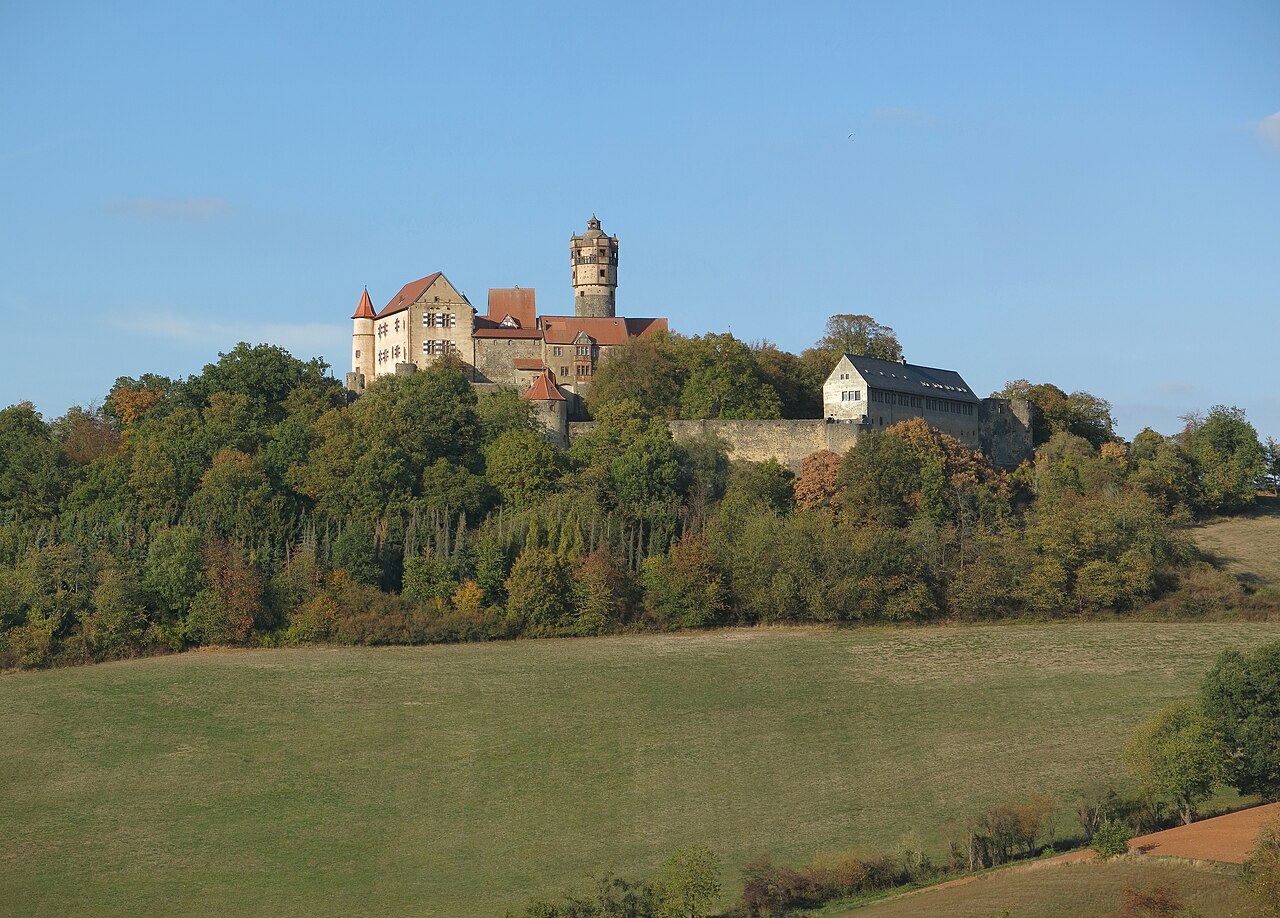
Burg Staden
Burg Staden is a remarkable example of a medieval water castle located on a river island at the northern edge of Staden, a district in the municipality of Florstadt, Germany. This fortress, with origins dating back to the 12th century, showcases the evolution of castle architecture and aristocratic residence through the centuries. Its unique setting surrounded by water and its well-preserved structures make it a significant cultural heritage site in the region.
Historical background and ownership lineage
The earliest documented mention of Burg Staden dates to 1156, when a nobleman named Wortwin granted the castle as a fief to the Fulda monastery. It is believed that Wortwin may be identical to an Ortwin referenced in earlier documents from 1133 to 1145, potentially the brother of Gerlach of Büdingen. By 1233, the castle had passed into the hands of Gerlach of Büdingen and his relatives Heinrich and Gerlach of Isenburg, who were ancestors of the Counts of Isenburg. This transition marked the beginning of the castle's association with prominent noble families in the region.
Following the extinction of the Büdingen family line, Burg Staden became part of the Isenburg-Limburg estate. Johann I of Limburg was a key figure during this period, securing town rights for Staden in 1304 and renewing the Fulda monastery’s fief in 1308, thereby reinforcing both the civic status of the town and the feudal ties of the castle. These developments highlight the castle's role not only as a military stronghold but also as a center of local governance and administration.
In 1405, ownership changed hands when Johann II of Isenburg-Limburg sold the castle to several noble families, leading to the establishment of a Ganerbschaft—a joint ownership arrangement involving 19 co-owners. These families cooperated under a Burgfrieden (castle peace) agreement to govern and maintain the property collectively. Among the subsequent partial owners were the Burgraviate of Friedberg, the Löw von Steinfurth family, and the Counts of Isenburg-Büdingen, illustrating the complex feudal and familial networks that shaped the castle's history.
Architectural evolution and renaissance additions
The Renaissance period brought significant construction activity within the castle grounds. In 1574, a prominent stone building known today as Schloss Ysenburg was erected inside the outer bailey, likely commissioned by the Ganerbschaft. This three-story structure is notable for its stepped gables, a characteristic feature of Renaissance architecture that adds decorative rhythm to the roofline. The upper floors exhibit plastered half-timbering, combining traditional timber framing with plaster infill, which reflects the architectural trends of the period.
The palace includes a round stair tower providing access to the upper floors, situated beside a portal bearing the construction date. A two-story entrance annex with a small footbridge connects to the southern side of the palace. Heraldic decorations on the entrance display the coats of arms of the Carben and Wolfskehl zu Vetzberg families, signifying their historical association with the estate and adding a layer of aristocratic symbolism to the architecture.
Fortifications and structural features
The core of Burg Staden, known as the Kernburg, is situated on meadowland at the northern edge of the site and retains sections of its medieval ring wall made from rusticated ashlar or Buckelquader. This masonry technique involves large stone blocks with deliberately roughened surfaces, providing both strength and a distinctive textured appearance typical of high medieval fortifications.
One of the castle’s towers in this area has been reconstructed in modern times and repurposed as an electrical transformer station, illustrating adaptive reuse of historic structures. The outer bailey is connected to the rest of the castle by an access road passing through a preserved gate tower that spans the Nidda river via a bridge.
West of this bridge and the palace stands a massive former gate tower featuring a pointed arch. Originally built in a shell form—a structural technique where walls curve inward like a shell providing strength with thinner material—this tower was converted in the 16th century into a residential tower. Evidence of this conversion includes a fireplace on the first upper floor. Defensive features remain visible on the tower’s fourth floor, such as keyhole-shaped embrasures and slit-shaped windows facing both outward and inward, designed for defense and ventilation.
Later history and present-day use
By the 18th century, the castle complex saw further developments with the Löw von Steinfurth family constructing a separate palace outside the original castle grounds in 1746. The entire estate came fully under the control of the Isenburg-Büdingen family in 1788, at which point the name Schloss Ysenburg became commonly used for the site. Many medieval fortifications had by then fallen into disrepair or were dismantled.
During the 19th century, parts of the outer bailey grounds were leased and operated as an agricultural estate from 1852. Today, the outer bailey functions as a manor farm, blending historic architecture with ongoing agricultural use. Since 1949, Schloss Ysenburg has housed a hotel and café within its Renaissance building, adapting the historic noble residence for modern hospitality while preserving its architectural heritage.
Cultural significance and visitor experience
Burg Staden stands as a testament to the layered history of medieval and Renaissance aristocratic life in Germany. Its combination of a fortified medieval core with Renaissance residential architecture offers visitors a unique glimpse into the evolution of castle design and function over several centuries. The castle's location on a river island enhances its picturesque setting and defensive advantages, characteristic of water castles.
Visitors to the site can appreciate the preserved ring walls, the Renaissance Schloss Ysenburg with its distinctive stepped gables and heraldic decorations, and the historic gate towers that illustrate the transition from military fortress to noble residence. The integration of the castle with a working manor farm and hospitality services provides a vibrant connection between past and present, making Burg Staden a significant cultural landmark in the Hesse region.
Frequently asked questions (FAQ)
- How do I get to Burg Staden and what are the best transport options?
- Burg Staden is located in Florstadt, Hesse, Germany. The best way to reach the castle is by car or local public transport to Florstadt, followed by a short walk to the river island where the castle stands. Parking is available nearby, and local buses connect Florstadt with surrounding towns.
- What are the visiting hours and ticket prices for Burg Staden?
- Since Burg Staden operates partly as a hotel and café, visiting hours may vary. It is recommended to check in advance for public access times. Entry to the castle grounds is generally free, but guided tours or special events may require tickets.
- What architectural styles are represented at Burg Staden?
- Burg Staden features a mix of architectural styles including medieval fortifications with rusticated ashlar masonry and Renaissance elements such as stepped gables and plastered half-timbering in Schloss Ysenburg. This blend reflects the castle's long history and evolving functions.
- Is Burg Staden accessible for visitors with mobility issues?
- Due to the historic nature of the castle and its location on a river island, accessibility may be limited in some areas. Visitors with mobility issues are advised to contact the site in advance to inquire about available accommodations and access routes.
- What is the historical significance of the Ganerbschaft at Burg Staden?
- The Ganerbschaft was a unique joint ownership arrangement involving 19 noble families who cooperated under a castle peace agreement to manage Burg Staden collectively. This system exemplifies medieval feudal cooperation and shared governance of aristocratic estates.
Information
Website
Visit websiteSources & official resources
Verify the information above using these authoritative references.
Loading map...
Visitor reviews
No reviews yet. Been here? Write the first review and help other travelers!
Write the first reviewVisited this castle? Share your experience
Your review helps other travelers and adds first-hand knowledge to our encyclopedia.