Lincoln Castle
Lincoln Castle stands as one of the most significant and well-preserved Norman castles in England. Constructed in the late 11th century by William the Conqueror on the site of the Roman fortress known as Lindum Colonia, the castle occupies a commanding position on Castle Hill in the historic city of Lincoln. This hill castle is renowned for its unique architectural feature of having two mottes, a rare design shared only with Lewes Castle in Sussex, making it an exceptional example of medieval military architecture.
The castle's strategic location atop a hill overlooking the city and surrounding countryside provided a formidable defensive advantage. Visitors today can walk along the extensive Norman curtain walls, which offer panoramic views of the castle complex, the adjacent Lincoln Cathedral, and the cityscape below. The walls themselves incorporate sections of ancient Roman masonry, showcasing the site's long history of military significance.
Historical context and military significance
The site of Lincoln Castle has been a focal point of military activity since Roman times. Before the castle's construction, the area hosted a Roman fortress and possibly an earlier Saxon fortification. Following the Norman Conquest of England in 1066, William the Conqueror ordered the construction of the castle in 1068 to consolidate Norman control over the region.
Throughout the 12th and 13th centuries, Lincoln Castle played a pivotal role in English history. It was the site of two major battles during the period of civil unrest known as The Anarchy and the First Barons' War. The First Battle of Lincoln in 1141 resulted in the capture of King Stephen, while the Second Battle of Lincoln in 1217 was a decisive conflict during the First Barons' War. These events underscore the castle's importance as a military stronghold and political symbol.
The castle was associated with prominent medieval figures, including Ranulf de Gernon, Earl of Chester, who is credited with constructing the Lucy Tower, named after his mother, Lucy of Bolingbroke. Ownership of Lincoln Castle passed through several noble families, including the Earls of Chester and the Earls and later Dukes of Lancaster. In 1399, it reverted to royal possession under King Henry IV and remained Crown property until 1832, when it was sold to local magistrates, marking a transition to civic control.
Architectural features and defensive structures
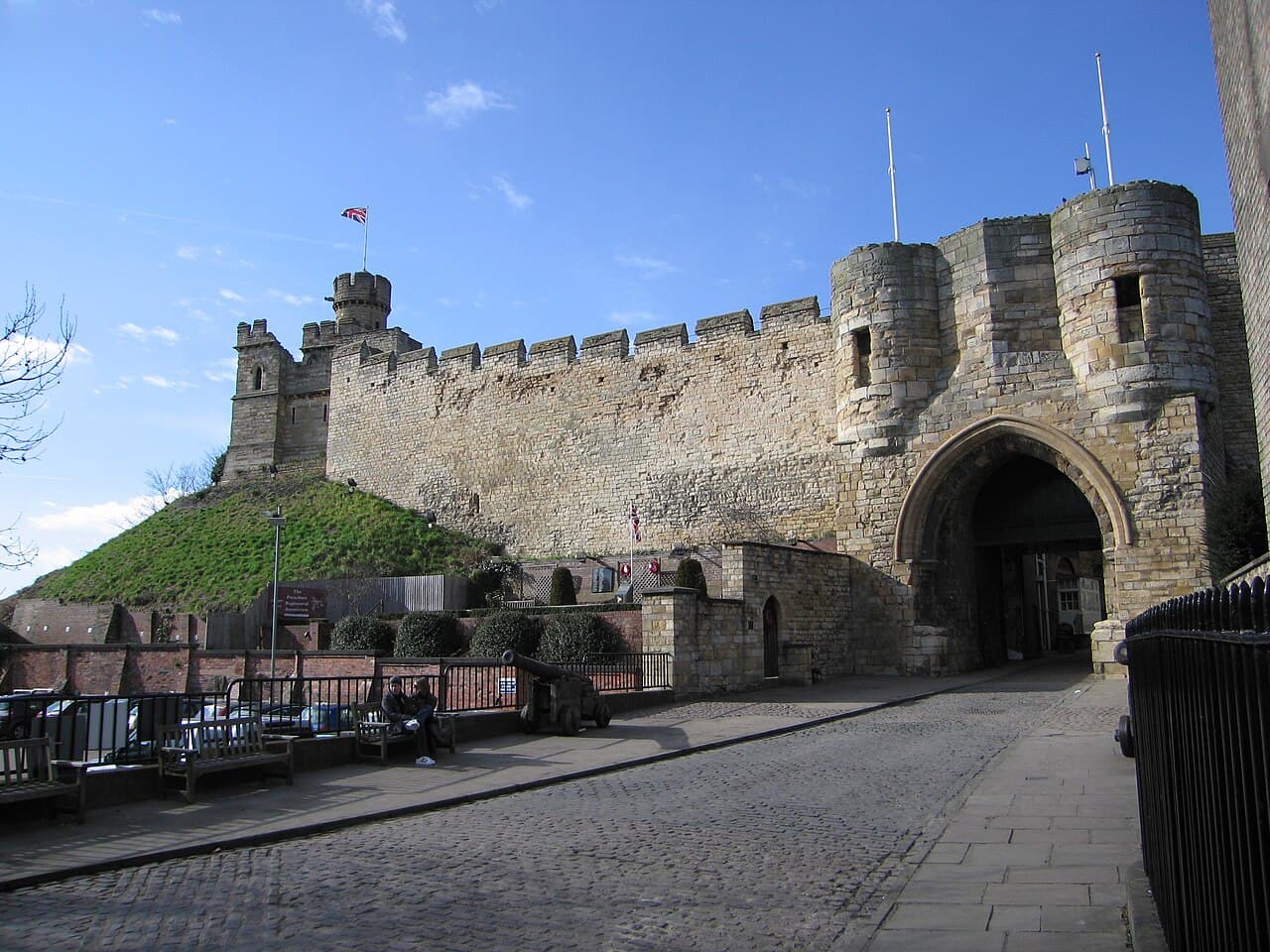
Lincoln Castle's most distinctive architectural characteristic is its two earthen mottes, which flank the southern side of the castle. The larger southwest motte supports the polygonal Lucy Tower, originally a two-story structure, now partially ruined but still imposing. The southeast motte is crowned by the Observatory Tower, a square tower dating from the 14th century, later enhanced with a Victorian turret.
The castle is enclosed by a robust stone curtain wall built before 1115, which is surrounded by a dry moat on all sides except the south. The defensive perimeter includes the horseshoe-shaped Cobb Hall protecting the northeast corner and a Norman gatehouse tower over the West Gate, also known as the Sally Port. The East Gate features a 14th-century arch flanked by gate towers and the remains of a barbican, a fortified outpost that provided additional defense against attackers.
The walls incorporate reused Roman masonry, including sections of Roman gates and walls. Excavations in the 19th century uncovered the Roman west gate, which was subsequently reburied to prevent deterioration. This blending of Roman and Norman architecture illustrates the continuity of fortification on the site over centuries.
Prison and court buildings
Within the castle walls are two significant prison blocks: an 18th-century T-shaped building and a mid-19th-century prison that includes a small wing for female inmates. The castle served as a prison from medieval times until 1878, with executions carried out on its walls until 1868. The prison chapel is architecturally notable for its design that enforced the separate system of confinement, isolating prisoners during worship through enclosed individual seating.
Additionally, a courthouse constructed in the 1820s remains in use today as Lincoln Crown Court, making Lincoln Castle one of the few castles in England still functioning in a judicial capacity. This continuity of use highlights the castle's enduring role in law and order.
Cultural heritage and archaeological discoveries
Lincoln Castle is home to one of the four surviving original copies of the Magna Carta issued in 1215, a document foundational to the development of constitutional law. The Magna Carta housed at Lincoln Castle has been exhibited internationally, emphasizing the castle's global historical significance.
Archaeological excavations in the 21st century revealed remains of a late Saxon church dating to around 900 AD, along with burials that may include the 8th-century Saxon king Blaccca of Lindsey. These findings deepen the understanding of the site's long occupation and its importance before the Norman period.
The castle grounds also feature remnants of Lincoln's Eleanor cross, an oriel window relocated from Sutton Hall incorporated into the main gate, and a bust of King George III taken from the Dunston Pillar. The castle's defensive earthworks once extended beyond the walls, including medieval earth banks to the west and the now-demolished Thorngate Castle near the river, which was part of the city's defenses.
Modern restoration and public access
Between 2012 and 2015, the Lincoln Castle Revealed project undertook extensive restoration of the castle's walls, towers, and prison buildings. This initiative created modern exhibition spaces to display the Magna Carta and the Forest Charter, enhancing the visitor experience.
Today, Lincoln Castle is open to the public as a museum and heritage site. Visitors can explore the castle's extensive fortifications, prison buildings, and courtrooms, gaining insight into its multifaceted history. The castle's well-preserved state, combined with its unique architectural features and rich historical associations, make it a must-visit destination for those interested in medieval history and Norman architecture.
Frequently asked questions (FAQ)
- What are the opening hours of Lincoln Castle?
- Lincoln Castle is typically open from 10 AM to 5 PM daily, with extended hours during the summer months. It's advisable to check the official website for any seasonal variations or special events that may affect opening times.
- How do I get to Lincoln Castle?
- Lincoln Castle is located in the heart of Lincoln, easily accessible by public transport. Visitors can use the train service to Lincoln Station, which is a short walk from the castle, or take advantage of local bus routes that service the area.
- What is the historical significance of Lincoln Castle?
- Lincoln Castle dates back to 1068 and was built by William the Conqueror, making it a key site in England's medieval history. It played a vital role in the defense of the city and has witnessed many significant events, including the signing of the Magna Carta.
- Can I bring my dog to Lincoln Castle?
- While dogs are not allowed inside the castle grounds, they are welcome in the castle's outdoor areas as long as they are kept on a lead. There are also designated pet-friendly spaces where visitors can enjoy the views with their furry companions.
- Is it possible to take guided tours of Lincoln Castle?
- Yes, guided tours are available at Lincoln Castle, offering visitors an in-depth look at its history and architecture. These tours are led by knowledgeable guides who share fascinating stories and insights about the castle's past.
- When is the best time to visit Lincoln Castle?
- The best time to visit Lincoln Castle is during the spring and summer months when the weather is pleasant and the gardens are in full bloom. However, visiting during the off-peak seasons can also provide a quieter experience with fewer crowds.
- What are the ticket prices for Lincoln Castle?
- Ticket prices for Lincoln Castle vary, with discounts available for children, students, and seniors. It's recommended to purchase tickets online in advance for the best rates and to avoid queues at the entrance.
- Are there any nearby attractions to Lincoln Castle?
- Yes, nearby attractions include the stunning Lincoln Cathedral, which is just a short walk away, and the historic Bailgate area filled with shops and cafes. The picturesque Steep Hill, leading up to the castle, is also worth exploring for its charming scenery.
- Is Lincoln Castle accessible for people with disabilities?
- Lincoln Castle is committed to being accessible for all visitors, with wheelchair access available to the main areas of the castle. There are also accessible facilities and staff on hand to assist those who may need help during their visit.
Photo gallery

Information
Website
Visit websiteSources & official resources
Verify the information above using these authoritative references.
Loading map...
Visitor reviews
No reviews yet. Been here? Write the first review and help other travelers!
Write the first reviewVisited this castle? Share your experience
Your review helps other travelers and adds first-hand knowledge to our encyclopedia.