Liechtenstein Castle
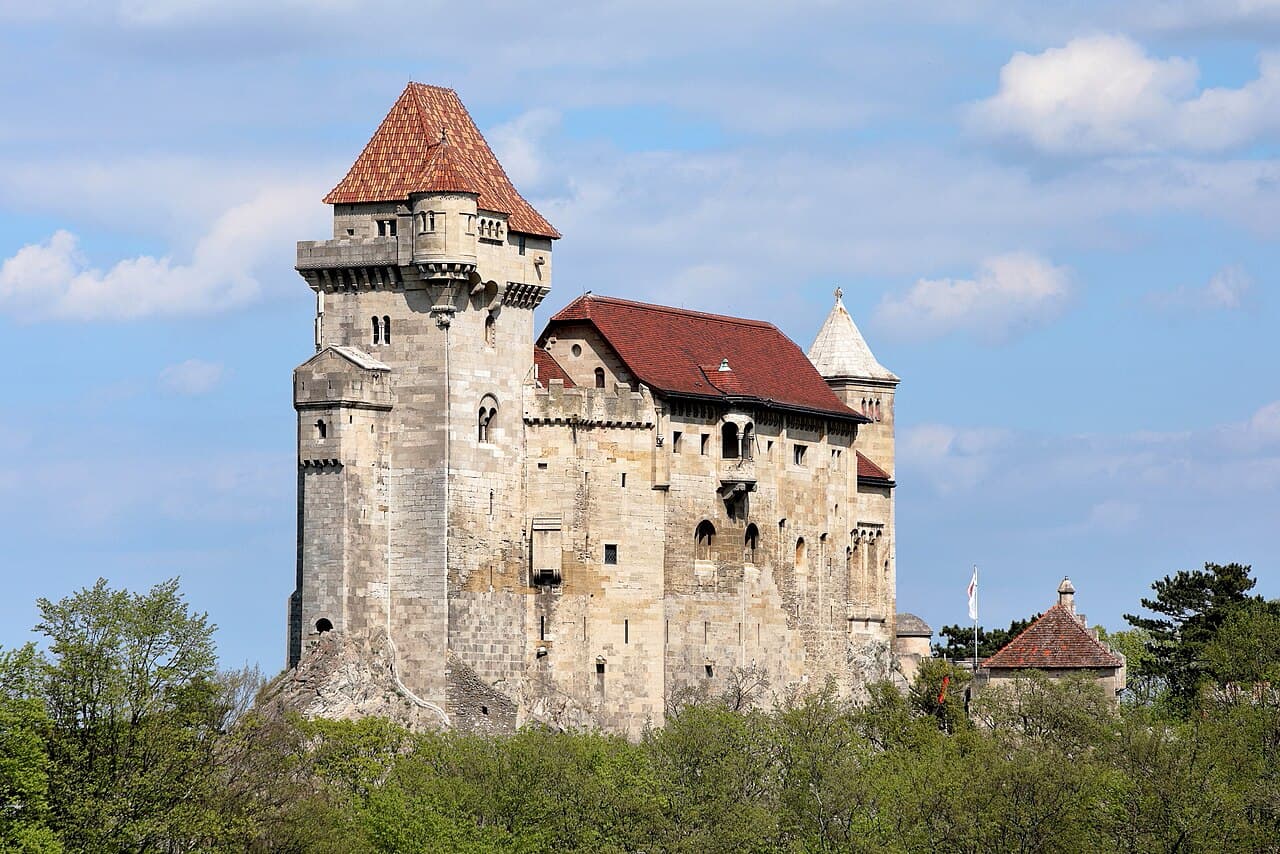
Liechtenstein Castle is a striking hill castle perched on a rocky ridge at the edge of the Viennese Forest near Maria Enzersdorf, Lower Austria. Originally constructed in the 12th century, this fortress has witnessed centuries of history, from medieval noble ownership to Ottoman sieges and 19th-century romantic restoration. The castle’s name, meaning "bright stone," is the origin of the House of Liechtenstein, which ruled the principality of Liechtenstein and maintained ownership of the castle at various points in history.
The castle’s strategic location on a hilltop approximately 300 meters above sea level allowed it to serve as an important defensive stronghold along the eastern frontier of the Vienna Woods. Its initial purpose was to protect the region from invasions, particularly from Hungarian forces in the medieval period. The earliest documented reference to the castle dates back to 1330, although its founding is attributed to Hugo I between 1122 and 1136, who took his family name from the castle itself.
Medieval origins and historical significance
Constructed during the high medieval period, Liechtenstein Castle originally served as a fortified residence and military outpost. Its ownership shifted among several prominent noble families after the 13th century, including the Walsee, Stadeck, Cilli, and Khevenhüller families. These transitions reflect the castle’s importance within the feudal power structures of the region.
The fortress endured significant damage during the turbulent 15th and 16th centuries. Notably, it was attacked by Hungarian forces around 1480 and suffered destruction during the two major Ottoman sieges of Vienna in 1529 and 1683. After the second siege, the castle was left in ruins and abandoned for over a century.
19th-century restoration and romantic revival
In 1808, Prince Johann I of Liechtenstein reacquired the castle and initiated a comprehensive restoration project. The castle was rebuilt in a neo-Romanesque architectural style, reflecting the 19th-century romantic fascination with medieval history and aesthetics. This restoration included the addition of an English landscape park surrounding the castle, featuring artificial ruins designed to enhance the picturesque and romantic atmosphere of the site.
Further restoration efforts were undertaken by architects Carl Gangolf Kayser and Humbert Walcher von Moltheim later in the 19th century. Their work preserved many medieval elements while adapting the castle for ceremonial and cultural functions rather than as a permanent residence. The castle’s silhouette was enhanced by the addition of gabled roofs, a modern stair tower, and neo-Romanesque details such as twin windows and a steep roof on the bergfried (keep).
Architectural features and layout
Fortified core and main structures
The castle’s core is a three-story elongated building shaped to fit the narrow rocky ridge. It is primarily constructed from dark Gutenstein limestone, Reichenhall rauhwacke, and Steinalm limestone using ashlar masonry, which involves carefully cut stone blocks for a refined finish.
A prominent feature is the five-story bergfried, with its lower levels dating to the early 13th century. This keep includes narrow slit windows typical of Romanesque military architecture. Around 1900, neo-Romanesque elements such as twin windows and a steep roof were added, enhancing its vertical emphasis. The bergfried houses Lower Austria’s first brick museum, exhibiting medieval and early modern artworks including 13th-century northern Italian lion sculptures and 15th-century Gothic reliefs.
Chapel and religious elements
On the northeast side stands a tall gate tower with a nearly square plan topped by a stone pyramidal roof and cross. Beneath it lies a Romanesque chapel apse dedicated to Saint Pancras. The chapel, dating from circa 1170-1180, features a rectangular hall with a semicircular apse, decorated with half-columns, cube-shaped capitals, and ornamental friezes with round arches and tooth-like patterns.
The chapel’s interior preserves a 14th-century carved wooden gallery railing of Italian origin and a 15th-century Venetian Gothic limestone relief depicting the Man of Sorrows. This blend of Romanesque architecture and later Gothic art highlights the castle’s evolving religious and cultural significance.
Residential and defensive structures
Adjacent to the chapel is the former residential tower, also from the late 12th century, featuring slit windows and original masonry in its cistern basement. A narrow, three-story defensive gallery runs along the north side, now serving as a corridor connecting the palas. This gallery contains a high-quality 15th-century marble relief of Saint Jerome.
The palas or great hall includes a basement partly carved into the rock, housing a medieval kitchen with vaulted sections and a fireplace. The upper floors feature a neo-Romanesque wooden barrel vault with ornamental carvings and numerous northern Italian reliefs from the 13th to 15th centuries, depicting religious figures such as the Madonna, Saints Pantaleon and Michael, and griffins.
Outer bailey and fortifications
South of the main castle lies a long, nearly rectangular outer bailey with curtain walls reinforced in the 14th and 16th centuries. These walls feature battlements, arrow slits, keyhole-shaped openings for shooting, and machicolations—openings in the walls for dropping projectiles on attackers.
The main entrance on the west side is a Gothic pointed-arch portal with a projecting battlemented gallery from the 16th century. A second gatehouse on the east side, mainly dating from the 15th and 16th centuries, was reconstructed around 1900.
Modern history and cultural use
Liechtenstein Castle suffered damage during World War II and the subsequent Soviet occupation. Restoration took place between 1949 and 1953, after which the castle served various public functions including a youth center and wine museum.
Since 2007, the castle has been managed by the Liechtenstein estate administration and reopened to the public in 2010. It has hosted cultural events such as the Nestroy Theatre Festival, held annually during summer months until 2012, which celebrated Austrian playwright Johann Nestroy.
The castle is surrounded by a historic English landscape park created in the early 19th century, which includes artificial ruins and related romantic structures. Nearby stands a 19th-century Schloss Liechtenstein, built as a summer residence on the site of a former manor, complementing the historic hilltop fortress.
Frequently asked questions (FAQ)
- What is the historical significance of Liechtenstein Castle?
- Liechtenstein Castle, built in the 12th century, is a prime example of medieval architecture and has played a pivotal role in the region's history. It served as a residence for the noble Liechtenstein family and is a testament to their influence in Austria. The castle has undergone several renovations, preserving its historical essence while showcasing its architectural evolution over the centuries.
- When was Liechtenstein Castle built?
- Construction of Liechtenstein Castle began in the early 12th century, with its first recorded mention dating back to 1136. Over the years, it has seen various modifications and restorations, particularly in the 19th century when it was transformed into a romantic castle. This blend of history and architecture makes it a fascinating site for visitors.
- Can I visit Liechtenstein Castle?
- Yes, Liechtenstein Castle is open to visitors, allowing you to explore its rich history and stunning architecture. Guided tours are available, offering insights into the castle’s past and its significance in the region. It’s recommended to check the official website for the latest visiting hours and any special events.
- What are the opening hours for Liechtenstein Castle?
- Liechtenstein Castle typically opens to visitors from March to November, with specific hours varying by season. Generally, the castle is open from 10 AM to 5 PM on weekdays and weekends. To ensure a smooth visit, it's best to confirm the hours ahead of your trip as they may change due to special events or holidays.
- Is it possible to access Liechtenstein Castle by public transport?
- Yes, Liechtenstein Castle is accessible by public transport, making it convenient for visitors. You can take a train or bus to the nearest station and then enjoy a short walk to the castle. Detailed directions can be found on the castle's official website or local transport services.
- What is the best time to visit Liechtenstein Castle?
- The best time to visit Liechtenstein Castle is during the spring and early autumn months when the weather is mild and the surrounding landscapes are in full bloom. These seasons also attract fewer tourists, allowing for a more intimate experience. Additionally, special events and guided tours are often scheduled during these times, enhancing your visit.
- What nearby attractions can I explore while visiting Liechtenstein Castle?
- While visiting Liechtenstein Castle, you can explore several nearby attractions, including the picturesque town of Maria Enzersdorf and the scenic Lainzer Tiergarten. These sites offer beautiful walking trails and opportunities to enjoy nature. Additionally, the city of Vienna is just a short drive away, rich in history and culture.
- How much do tickets cost for Liechtenstein Castle?
- Ticket prices for Liechtenstein Castle vary, with discounts available for children, students, and seniors. Generally, adult tickets are reasonably priced and provide access to both the castle and guided tours. It's advisable to check the official website for the most current pricing and any special offers.
Photo gallery

Information
Website
Visit websiteSources & official resources
Verify the information above using these authoritative references.
Loading map...
Visitor reviews
No reviews yet. Been here? Write the first review and help other travelers!
Write the first reviewVisited this castle? Share your experience
Your review helps other travelers and adds first-hand knowledge to our encyclopedia.