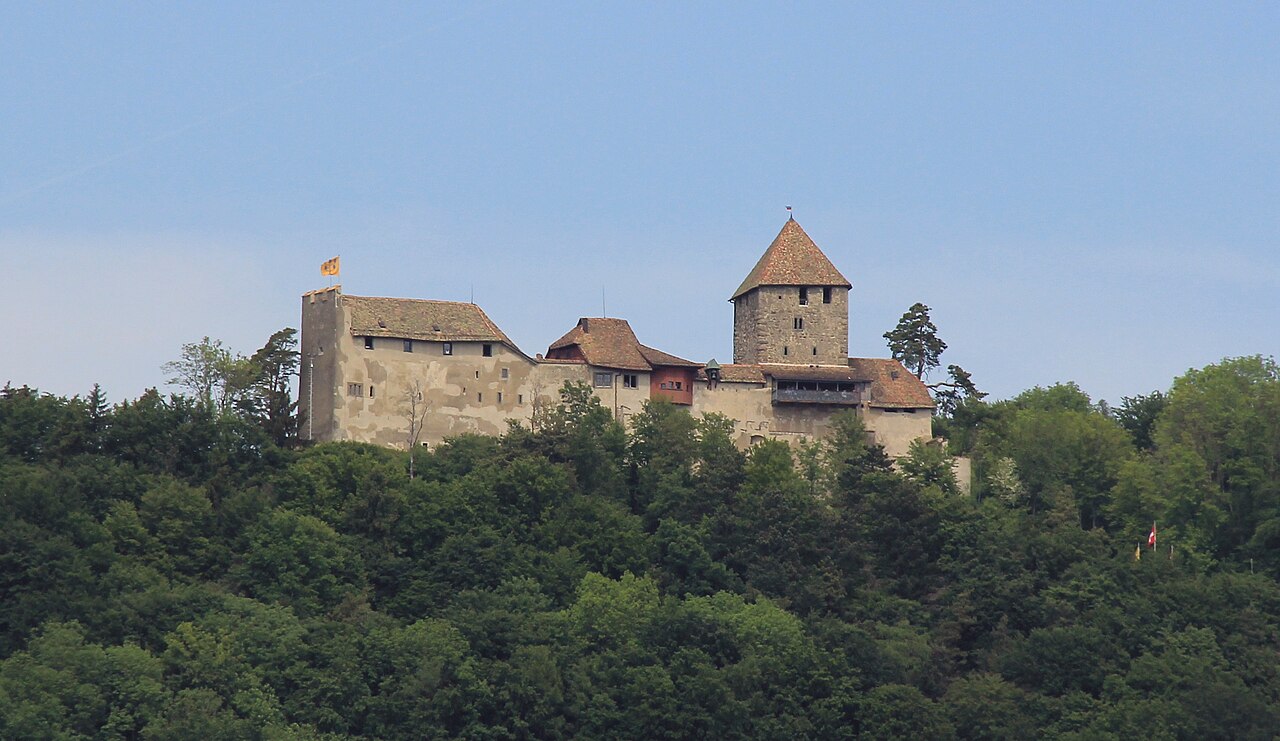
Liebenfels Castle
Liebenfels Castle stands as a significant example of a high medieval hill castle in the Swiss canton of Thurgau, located near the village of Herdern within the municipality of Lanzenneunforn. First documented in 1254, the castle was originally built and owned by the noble Liebenfels family, who served as ministeriales to the powerful Bishops of Konstanz. The castle's strategic position atop a hill provided defensive advantages and oversight of the surrounding lands, including the territories of Lanzenneunforn, Ammenhausen, and Wilen.
The origins and early history of Liebenfels Castle
The Liebenfels family, first recorded in the mid-13th century, held both secular and ecclesiastical influence, with family members acting as canons in nearby religious centers such as Zurzach and Embrach. Their role as ministeriales tied them closely to the Bishops of Konstanz, under whose authority they managed the castle and its associated lands. The castle itself was constructed during the 13th century, reflecting typical medieval defensive architecture focused around a central bergfried or keep.
Ownership remained with the Liebenfels family until the late 14th century. In 1390, Rudolf von Liebenfels sold the estate to Hermann Grämlich of Konstanz, and shortly thereafter, in 1395, Heinrich von Tettikofen acquired the property. These transitions illustrate the shifting allegiances and landholdings common in the late medieval period.
Prominent figures and political ties in the 15th and 16th centuries
During the early 15th century, the castle's prominence is highlighted by the stay of Barbara of Cilli, wife of Emperor Sigismund, at the residence of the related Lanz-Liebenfels family in Konstanz during the Council of Constance (1414–1418). This connection underscores the castle's link to imperial politics and the Holy Roman Empire's elite.
By the mid-15th century, Hans Lanz, a wealthy merchant and diplomat serving Duke Sigismund of Austria-Tyrol, acquired the castle through marriage to Anna von Tettikofen. Emperor Frederick III knighted Hans Lanz and granted the family the Liebenfels coat of arms, a heraldic symbol still visible in the Konstanz Münster. This period saw the castle's transformation from a purely military fortress to a noble residence with more refined architectural features.
The castle endured military conflict in 1475 when it was seized by Swiss mercenaries. Subsequent repairs focused on restoring the bergfried and other defensive structures, preserving the castle's military functionality. Further expansions and renovations after 1488 introduced Renaissance elements, including the distinctive stepped gables visible on the southern extensions of the complex.
Later ownership and cultural significance
In 1572, the castle and most of its lands were sold by Heinrich and Jakob Lanz to Hans Christoph von Gemmingen. The Gemmingen family maintained the estate until 1654, after which it passed to the Cistercian monastery of St. Urban near Lucerne. The monastery's ownership lasted until the secularization movements of the 19th century dissolved monastic properties.
In 1848, the castle was purchased by Adolf Ludwig Follen, a German writer and academic who used the estate as a refuge for political exiles and a gathering place for literary figures such as Hoffmann von Fallersleben and Gottfried Keller. Follen also attempted to develop sericulture on the grounds, though financial difficulties led to the sale of the property in 1855.
The castle later passed through various private hands, including the industrialist Caspar Bebié. It was unoccupied from 1948 until 1992, when Klaus W. Ebert and Christiane Ebert-Schnaufer acquired and undertook extensive restoration efforts. These renovations stabilized the structure and preserved key architectural elements.
Architectural features and castle complex layout
The castle complex covers over 230,000 square meters and is centered around a prominent bergfried, which served as the main defensive tower and refuge. This tower remains the dominant feature of the site, illustrating the castle's original military purpose. The bergfried's northern façade retains original door and window openings, indicative of its dual defensive and residential functions.
North of the bergfried lies a courtyard enclosed by residential and service buildings, designed to support the lordship's administrative and domestic needs. To the south, 16th-century extensions feature characteristic stepped gables, reflecting Renaissance architectural influences and a transition toward more comfortable noble living spaces.
Archaeological investigations have uncovered vaulted cellar systems beneath the front section of the castle, revealing storage spaces constructed with arched ceilings to bear heavy loads above. The stone masonry and construction techniques observed in the castle's walls and towers demonstrate the craftsmanship of the late medieval and early Renaissance periods.
Preservation and cultural heritage status
Liebenfels Castle is currently privately owned and has been recognized as a cultural property of national importance in Switzerland. The restoration efforts initiated in the 1990s have preserved the castle's structural integrity and historical character, allowing it to stand as a well-preserved example of a high medieval hill castle adapted through centuries of architectural evolution.
The castle's heraldic legacy, including the Liebenfels coat of arms granted by Emperor Frederick III, remains a significant symbol of its noble past. This emblem is preserved in the Konstanz Münster, linking the castle to the broader historical narrative of the Holy Roman Empire's nobility.
Today, although not generally open to the public, Liebenfels Castle represents an important site for understanding medieval feudal structures, noble residences, and the architectural transition from fortress to stately home in the Swiss context.
Frequently asked questions (FAQ)
- How do I visit Liebenfels Castle?
- Liebenfels Castle is privately owned and not regularly open to the public. Visitors interested in viewing the exterior can explore the surrounding area near Herdern, but access inside the castle requires special permission or participation in occasional guided tours if available.
- What is the historical significance of Liebenfels Castle?
- Liebenfels Castle was a medieval stronghold of the noble Liebenfels family and later owners connected to imperial and ecclesiastical powers. It played roles in regional politics, hosted notable historical figures, and reflects architectural evolution from the 13th to 16th centuries.
- When was Liebenfels Castle built?
- The castle was constructed in the 13th century and first documented in 1254. It features architectural elements from the high medieval period with later Renaissance additions.
- Can I see the Liebenfels coat of arms?
- The Liebenfels coat of arms granted by Emperor Frederick III to Hans Lanz is preserved in the Konstanz Münster. While the castle itself is private, this heraldic symbol can be viewed in the cathedral in Konstanz.
- What architectural styles are represented at Liebenfels Castle?
- Liebenfels Castle exhibits a mixture of architectural styles, including high medieval defensive structures and later Renaissance features such as stepped gables, reflecting its evolution from fortress to noble residence.
Information
Sources & official resources
Verify the information above using these authoritative references.
Loading map...
Visitor reviews
No reviews yet. Been here? Write the first review and help other travelers!
Write the first reviewVisited this castle? Share your experience
Your review helps other travelers and adds first-hand knowledge to our encyclopedia.