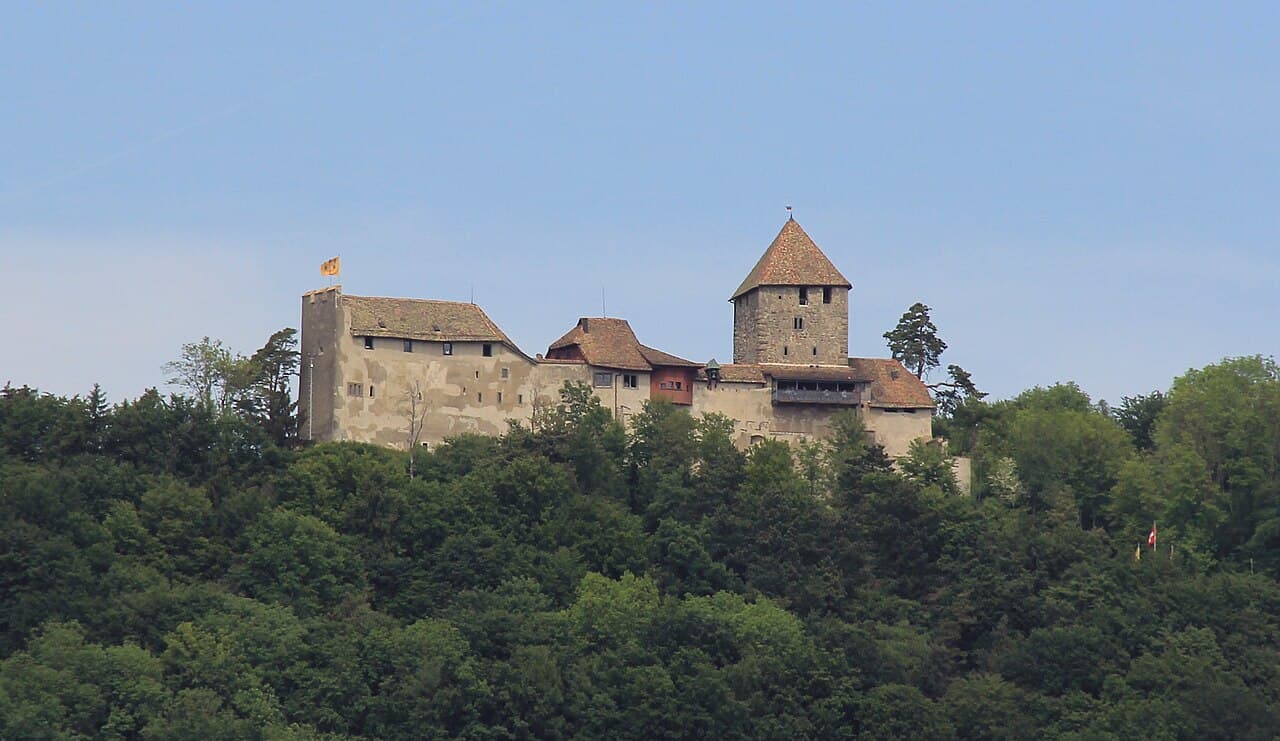
Hohenklingen Castle
Hohenklingen Castle stands prominently above the historic town of Stein am Rhein in the canton of Schaffhausen, Switzerland. Constructed around 1200, this hill castle was originally established as a fortified residence and toll castle controlling the vital trade route along the river Rhine. Its strategic location near the point where the High Rhine flows out of Lake Constance made it a crucial defensive and economic stronghold during the High Medieval period.
Early history and construction
The castle's foundation is attributed to Walter von Klingen, who erected the initial residential tower that forms the core of the present structure. The original design reflected typical High Medieval fortification techniques, including thick stone walls and a compact layout focused on defense and residence. Its position on a hill provided commanding views over the surrounding landscape, including the town and the river, enabling control over river traffic and trade.
Architectural developments and military significance
During the 15th century, particularly around 1460, the castle underwent significant upgrades to adapt to emerging military technology. Battlements designed to resist firearms were added, reflecting the transition from traditional medieval defenses to those capable of withstanding early gunpowder weapons. This modernization was crucial as the castle played a defensive role during the Swabian War of 1499 and later during the Thirty Years' War (1618–1648). In both conflicts, Hohenklingen was fortified and served as a military stronghold, guarding the region and the important Rhine crossing.
Role in regional conflicts
The castle's military importance is underscored by its involvement in these wars. Despite the turbulent times, Hohenklingen escaped significant damage, preserving much of its medieval character. Its fortifications and strategic position helped control movement along the Rhine and protect the nearby town of Stein am Rhein.
Preservation and restoration efforts
By the late 19th century, the castle had fallen into a state of disrepair. Between 1895 and 1897, the city of Stein am Rhein undertook a comprehensive renovation to restore the castle's structure and appearance. This restoration aimed to preserve the castle's historical integrity while stabilizing its condition for future generations.
Further restoration work was carried out from 2005 to 2007, focusing on maintaining the castle's structural soundness and enhancing its accessibility to visitors. These efforts have ensured that Hohenklingen remains one of the best-preserved medieval castles in Switzerland.
Architectural features and layout
Hohenklingen Castle retains much of its original medieval silhouette, including its stone walls, towers, and roofs that date back to the period between 1200 and 1422. The castle's design includes a prominent residential tower, defensive battlements, and a courtyard that would have supported both military and domestic functions.
The castle's position on a hill overlooking the Rhine provided natural defensive advantages, complemented by its robust stone construction. The addition of firearm-resistant battlements in the 15th century reflects the adaptation of the castle to evolving military needs.
Cultural significance and current status
Today, Hohenklingen Castle is recognized as a Swiss heritage site of national significance. It is notable for being the first toll castle on the Rhine, marking its historical role in controlling trade and movement along this major European waterway. Its proximity to the Rhine Falls, located about five miles downstream, adds to the castle's touristic appeal.
Stein am Rhein itself is a town rich in medieval architecture, and Hohenklingen Castle contributes significantly to the town's historic landscape. The castle is open to visitors, offering a glimpse into medieval life and fortification architecture.
In 2021, Hohenklingen was nominated for the Swiss Location Award, highlighting its importance as a cultural and historical landmark.
Geographical context
The castle's location near the border between Switzerland and Germany is geographically significant. Stein am Rhein is the last Swiss town before the German border along the Rhine, with the river serving as a natural boundary. Uniquely, both banks of the Rhine at Stein am Rhein belong to Switzerland, making it a distinctive border town. This positioning enhanced the castle's role in border defense and customs control.
Visitor information
Hohenklingen Castle is accessible to the public and serves as a cultural attraction. Visitors can explore the castle's historic rooms, battlements, and enjoy panoramic views of the Rhine and the surrounding region. The castle's well-preserved state allows for an authentic medieval experience.
Frequently asked questions (FAQ)
- How do I get to Hohenklingen Castle from Stein am Rhein town center?
- Hohenklingen Castle is located on a hill just above Stein am Rhein's town center. It is accessible by a short walk uphill, with clear signage guiding visitors from the main square. The walk takes about 10-15 minutes and offers scenic views of the town and river.
- What is the historical significance of Hohenklingen Castle?
- Hohenklingen Castle served as a toll castle controlling the Rhine trade route and played defensive roles during the Swabian War and the Thirty Years' War. Its well-preserved medieval architecture provides insight into High Medieval fortifications.
- Can I tour the interior of Hohenklingen Castle?
- Yes, the castle is open to visitors, and guided tours are available during the open season. The interior includes historic rooms, battlements, and exhibits about the castle's history and regional importance.
- Is Hohenklingen Castle suitable for families and children?
- The castle is family-friendly, with accessible paths and engaging historical displays. Children can enjoy exploring the castle grounds and learning about medieval life in an interactive setting.
- When is the best time to visit Hohenklingen Castle?
- The castle is open daily from April to October, with the best visiting conditions in late spring and early autumn when the weather is mild and the surrounding landscape is particularly scenic.
Photo gallery

Information
Opening hours
10:00-17:00, daily from April to October
Ticket prices
Varies seasonally, typically around CHF 8-12 for adults
Current owner
Municipality of Stein am Rhein
Website
Visit websiteSources & official resources
Verify the information above using these authoritative references.
Loading map...
Visitor reviews
No reviews yet. Been here? Write the first review and help other travelers!
Write the first reviewVisited this castle? Share your experience
Your review helps other travelers and adds first-hand knowledge to our encyclopedia.



