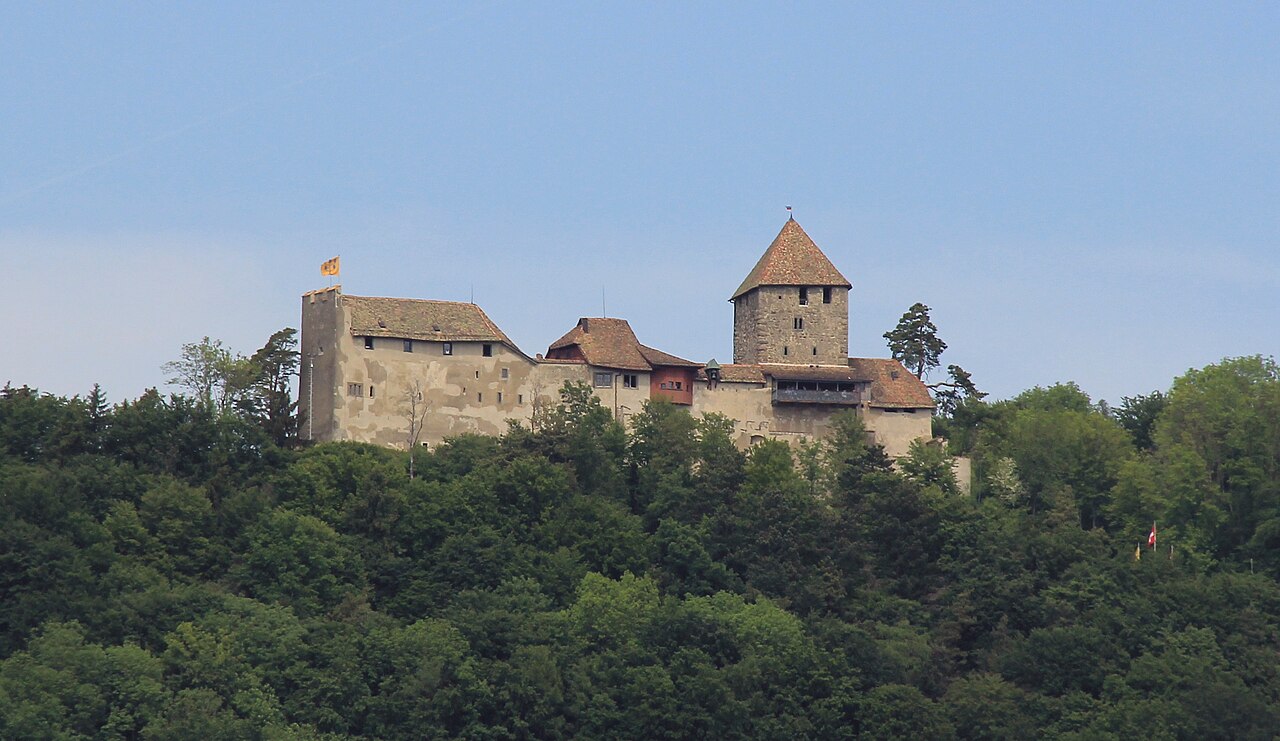
Freudenfels Castle
Freudenfels Castle stands as a remarkable example of a hill castle in Switzerland, located near the municipality of Eschenz. Constructed during the High Middle Ages, most likely in the 12th or 13th century, the castle was originally built by the Lords of Eschenz on a rocky promontory overlooking the southern shore of the Untersee, the lower part of Lake Constance. This strategic position allowed it to serve both defensive and residential purposes, guarding key trade routes in the region alongside nearby fortifications such as Hohenklingen Castle and Oberstaad Castle.
Medieval origins and strategic importance
The castle's initial construction centered around a fortified tower, which formed the stronghold controlling regional traffic routes. Its earliest mention in written records dates to 1359, during which ownership transitioned from the Lords of Hohenklingen to the Dukes of Austria. The medieval tower was a typical defensive structure of its period, built on a foundation of local stone and designed to oversee and protect the surrounding landscape.
Architectural evolution and baroque transformation
In 1617, Freudenfels Castle underwent a significant architectural transformation with the addition of a residential wing to the original medieval tower. This expansion marked a shift from a purely military fortress to a more comfortable noble residence, reflecting broader changes in castle use during the early modern period. The integration of residential quarters alongside defensive features illustrates the castle's dual function during this era.
Further renovations in the late 17th and mid-18th centuries introduced Baroque stylistic elements, notably under the direction of Caspar Moosbrugger, a lay brother renowned for his architectural expertise, and later by master builder Frank Singer in 1747. These modifications included redesigned façades and internal spaces aimed at enhancing comfort and aesthetic appeal while maintaining the castle's fortified character. The Baroque transformation gave the castle the elegant appearance it retains today, blending medieval robustness with refined architectural details.
Architectural features
- The original medieval tower remains the core of the complex, constructed with robust local stone foundations.
- The 1617 residential wing expanded living space and introduced more domestic architectural elements.
- Baroque renovations added decorative façades, refined interior layouts, and ancillary structures supporting administrative and residential functions.
- The castle's location on a rocky spur provides natural defensive advantages and commanding views of the surrounding area.
Ownership and historical role
Freudenfels Castle changed hands multiple times before being acquired in 1623 by Einsiedeln Abbey, a powerful Benedictine monastery. Under the leadership of Prince-Abbot Augustin Hofmann, the abbey sought to strengthen Catholic influence during the Counter-Reformation. The castle then served as the administrative center for the judicial lordship combining Freudenfels with the Einsiedeln district around Eschenz, overseeing estates in Kaltenbach, Wagenhausen, and Nussbaumen.
From 1623 until the late 20th century, the castle functioned as the residence of the bailiff, the local governing official appointed by Einsiedeln Abbey. Between 1730 and 1922, it also housed the Catholic parish priest of Eschenz, traditionally a monk from the abbey. The castle's role as an administrative and religious center highlights its importance in regional governance and ecclesiastical affairs over several centuries.
Political changes and modern adaptations
The upheavals of the late 18th century, particularly during the Helvetic Republic period (1798–1803), led to the dissolution of the judicial lordship's legal privileges. Despite this, Einsiedeln Abbey retained ownership, and the castle's administration focused on managing the estate and agricultural activities.
In the late 20th century, Freudenfels Castle transitioned to secular use. It was leased in 1988 to Marti Holding AG and converted between 1989 and 1992 into a center for education and professional training. Since 1996, the property has been owned by Schloss Freudenfels AG, linked to the Liechtenstein Academy Foundation and the Princely House of Liechtenstein. Today, the castle serves as a venue for various cultural and educational events, maintaining its historical significance while adapting to contemporary functions.
Surrounding historical context and site features
The castle's setting on a rocky spur overlooking the Untersee provides both natural defenses and scenic views. Nearby historical landmarks enrich its context, including the pilgrimage church of Klingenzell, located approximately 800 meters east. Dedicated in 1705 to the Sorrowful Mother Mary, this church underscores the religious connections of the castle's owners.
About one kilometer southeast lies a former watchtower linked to Hohenklingen Castle, which was replaced in the 1930s by the Swiss border fortification known as artillery observation bunker A 5600. These nearby structures highlight the region's longstanding military and religious significance.
Preservation and cultural heritage
Freudenfels Castle is recognized as a cultural heritage site of national importance in Switzerland. Its well-preserved complex showcases a layered history from medieval fortress to Baroque residence and modern cultural venue. Adaptations made in the late 20th century for educational use were carefully undertaken to preserve the castle's historic fabric, ensuring its architectural and historical integrity remains intact for future generations.
Today, visitors can appreciate the castle's blend of medieval defensive architecture and Baroque stylistic refinements, reflecting centuries of architectural evolution and the shifting roles of castles in Swiss history.
Frequently asked questions (FAQ)
- How do I get to Freudenfels Castle near Eschenz?
- Freudenfels Castle is located near the municipality of Eschenz in the Thurgau region of Switzerland. Visitors can reach the castle by car or local public transportation, with nearby parking available in Eschenz village.
- What is the historical significance of Freudenfels Castle?
- Freudenfels Castle played a key role in regional defense and administration from the High Middle Ages through the Baroque period. It was part of a network of fortifications protecting trade routes and later served as the administrative seat for Einsiedeln Abbey's judicial lordship.
- Can I visit the interior of Freudenfels Castle?
- As Freudenfels Castle is currently used as a venue for cultural and educational events, public access to the interior may be limited. Visitors should check ahead for guided tours or special events that allow interior visits.
- When was Freudenfels Castle built?
- The castle was constructed during the 12th or 13th century, placing it in the High Medieval period, originally as a fortified tower later expanded with residential wings.
- What architectural styles are represented at Freudenfels Castle?
- Freudenfels Castle features a combination of medieval defensive architecture and Baroque stylistic elements introduced during 17th and 18th-century renovations, blending fortress and noble residence characteristics.
Information
Current owner
Schloss Freudenfels AG / Princely House of Liechtenstein
Website
Visit websiteSources & official resources
Verify the information above using these authoritative references.
Loading map...
Visitor reviews
No reviews yet. Been here? Write the first review and help other travelers!
Write the first reviewVisited this castle? Share your experience
Your review helps other travelers and adds first-hand knowledge to our encyclopedia.