Leopoldov Fortress
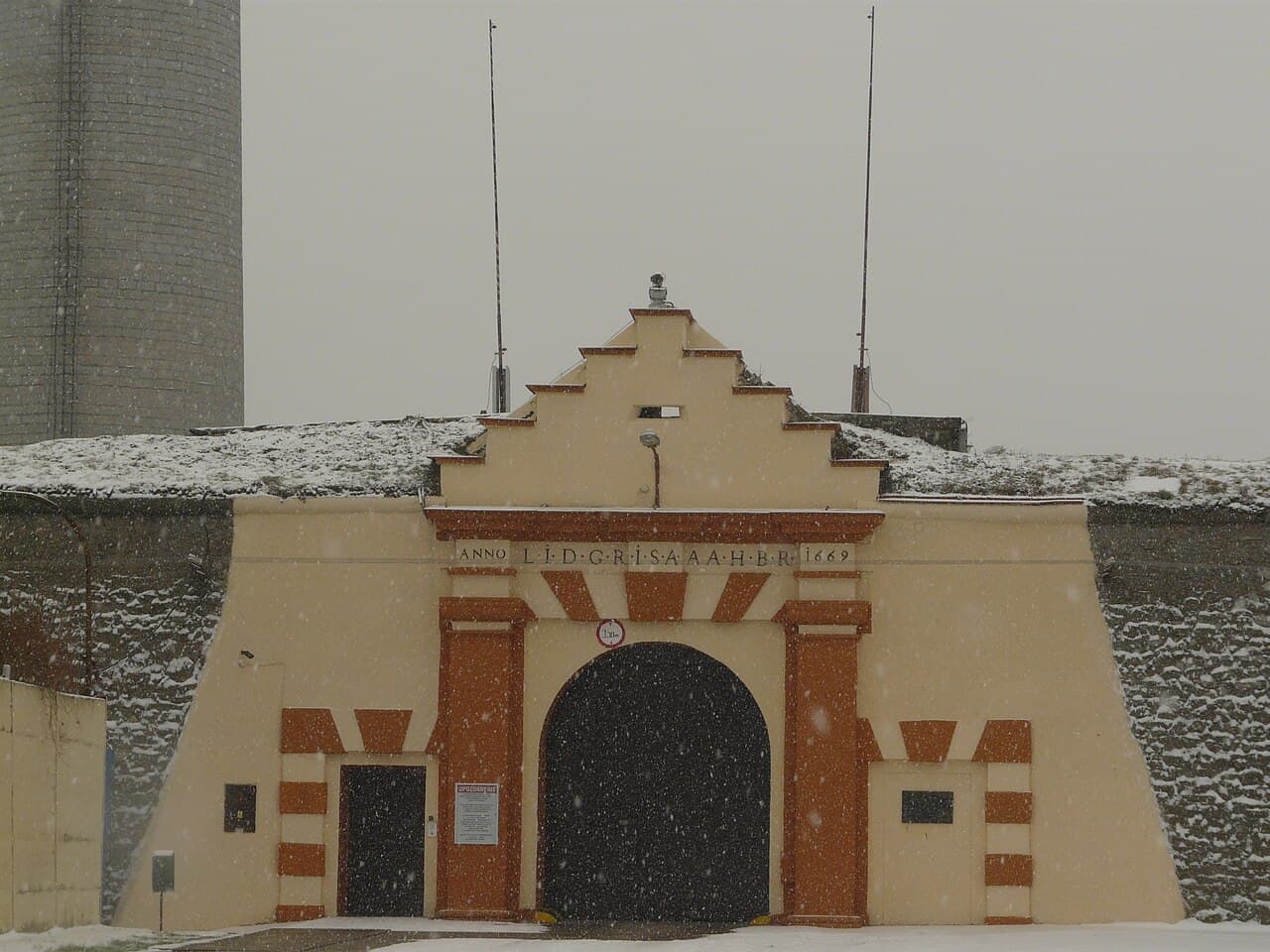
Leopoldov Fortress is a significant Renaissance bastioned fortress located in the town of Leopoldov, Slovakia. Constructed between 1664 and 1669 on the orders of Emperor Leopold I, the fortress was originally designed as a defensive stronghold against the advancing Ottoman Turks. Its strategic purpose was to protect the Habsburg monarchy's territories in the region during a period of intense military conflict in Central Europe. The fortress's name honors the emperor who commissioned its construction.
Architectural design and fortifications
The fortress exemplifies the bastioned fortress style, a hallmark of Renaissance military architecture that emerged in response to the development of powerful artillery. Its design incorporates angled bastions that allowed defenders to cover all approaches with overlapping fields of fire, minimizing blind spots. The fortress is surrounded by thick walls and deep moats, creating a formidable barrier against siege warfare. The layout is geometric and symmetrical, typical of the era's fortification principles, which emphasized both defense and order.
Structural features
The main defensive elements include several bastions positioned at the fortress's corners, curtain walls connecting these bastions, and a system of ravelins and outworks designed to delay attackers. The fortress also features a central courtyard and internal buildings that served various military and administrative functions. The robust stone construction and earthworks were designed to absorb and deflect cannon fire.
Historical role and evolution
Leopoldov Fortress was granted town status in 1669, shortly after its completion. Although its original purpose was military defense, the fortress's role evolved significantly over the centuries. From 1855 onward, the fortress was converted into a state prison, marking a new chapter in its history. This transformation utilized the fortress's secure and isolated design to detain prisoners under strict conditions.
Use as a state prison
The prison gained notoriety particularly during the Communist era in Czechoslovakia, when it was used to hold political prisoners and dissidents. The harsh conditions and strict regime made Leopoldov one of the most infamous prisons in the country. Among its inmates was Gustáv Husák, who was imprisoned from 1954 to 1960 before later becoming the Communist president of Czechoslovakia. The prison's reputation was marked by episodes of severe repression and human rights abuses.
Modern history and challenges
Following the Velvet Revolution of 1989, Leopoldov Prison experienced a series of violent riots, escapes, and disturbances. These events prompted direct intervention by high-ranking government officials, including the Prime Minister, who engaged in negotiations and reforms within the prison walls. The facility suffered significant damage during these upheavals.
Despite a 1990 vote by the Slovak National Council to close the prison, the decision was reversed in 1993. The prison underwent modernization and reconstruction to improve conditions and security. However, it remains a high-security penitentiary and one of the largest in Slovakia.
Notable incidents and legacy
One of the most dramatic episodes in the prison's history was the 1991 mass escape, when seven inmates violently broke out, killing five prison guards in the process. This event underscored the ongoing challenges of managing the facility and highlighted the tense atmosphere within its walls during the post-Communist transition.
Current status and cultural significance
Today, Leopoldov Fortress stands as both a historical monument and an active prison complex. Its architectural features reflect the military engineering of the Renaissance period, while its later adaptation as a prison tells a complex story of political repression and social change in Central Europe. The fortress is a tangible link to the region's turbulent history and remains a site of interest for those studying military architecture and 20th-century political history.
Frequently asked questions (FAQ)
- What is the historical significance of Leopoldov Fortress?
- Leopoldov Fortress was built in the 17th century as a bastioned fortress to defend against Ottoman invasions and later became a notorious state prison, especially during the Communist era.
- Can visitors tour Leopoldov Fortress?
- As an active high-security prison, Leopoldov Fortress is not open to the general public for tours, but its exterior and surrounding town can be viewed by visitors.
- When was Leopoldov Fortress constructed?
- Construction of Leopoldov Fortress took place between 1664 and 1669 under the direction of Emperor Leopold I.
- What architectural style characterizes Leopoldov Fortress?
- The fortress is a prime example of Renaissance military architecture featuring bastioned fortifications designed to withstand artillery attacks.
- What notable events occurred at Leopoldov Prison after 1989?
- After the Velvet Revolution, Leopoldov Prison experienced violent riots and a mass escape in 1991, leading to government interventions and subsequent modernization.
Photo gallery

Information
Current owner
State prison administration
Loading map...
Visitor reviews
No reviews yet. Been here? Write the first review and help other travelers!
Write the first reviewVisited this castle? Share your experience
Your review helps other travelers and adds first-hand knowledge to our encyclopedia.