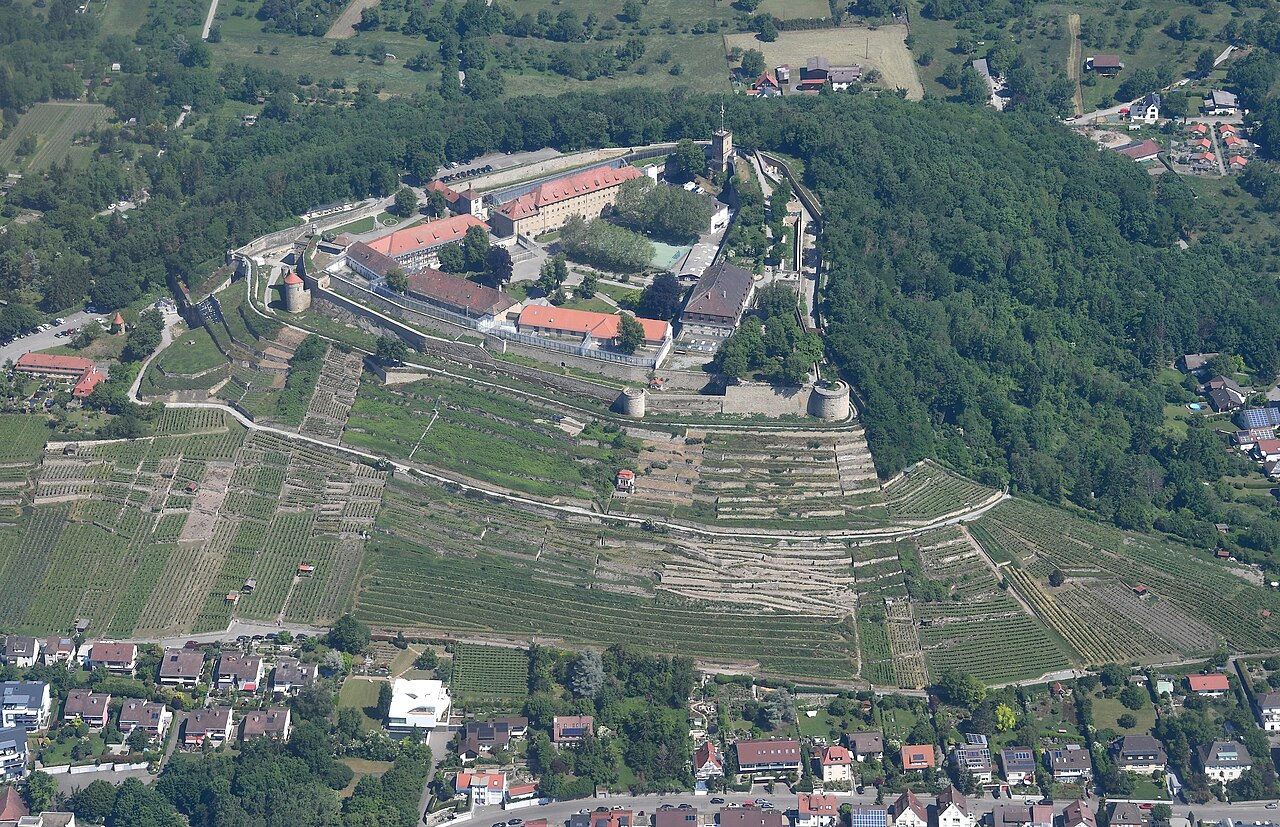
Leonberg Castle
Leonberg Castle, located in Leonberg, Germany, is a significant example of a medieval fortress that evolved into a Renaissance residence. Founded in 1248 by Count Ulrich I of Württemberg, the castle initially served as a strategic stronghold during the High Medieval period. Its location within the region of Württemberg was crucial for territorial control and defense.
Medieval origins and strategic importance
The original construction of Leonberg Castle reflected typical High Medieval defensive architecture, featuring robust walls and a fortified layout designed to withstand sieges and assert the power of the Württemberg counts. The castle's position in the town of Leonberg allowed it to oversee important trade routes and local territories, making it a focal point of regional authority.
Renaissance transformation under duke christoph
Between 1560 and 1565, the castle underwent significant modifications under the direction of master builder Aberlin Tretsch, commissioned by Duke Christoph of Württemberg. This period marked a transition from purely military functions to a more residential and representational role. The renovations introduced elements characteristic of Renaissance architecture, including more refined facades, larger windows, and enhanced living quarters that balanced defense with comfort and status.
Architectural features and layout changes
The modifications included the enlargement of the castle's residential wings and the addition of decorative elements that reflected contemporary tastes. While retaining its original defensive structures such as battlements and curtain walls, the castle incorporated Renaissance stylistic details that signaled the duke's prestige and the evolving nature of castle architecture in the 16th century.
Residence of duchess sibylla and later uses
From 1609, Duchess Sibylla of Württemberg (1564–1614), widow of Frederick I of Württemberg, used Leonberg Castle as her widow's residence. This period saw the castle functioning primarily as a noble residence rather than a military fortress. The castle's interiors were adapted to suit the needs of courtly life, with spaces dedicated to private living and official functions.
In the centuries following Duchess Sibylla's residence, the castle continued to be used intermittently as a noble residence. Its strategic and residential roles diminished over time, reflecting broader changes in the political and military landscape of the region.
Modern status and preservation
Today, Leonberg Castle serves a civic function as a tax office. Despite this modern adaptation, the castle's historical and architectural significance remains evident. The structure retains many of its Renaissance-era features, alongside remnants of its original medieval fortifications.
The castle is well preserved, allowing visitors and scholars to appreciate the layered history of Württemberg's noble residences and the architectural evolution from medieval fortress to Renaissance palace. Its continued use demonstrates the adaptability of historic castles within contemporary urban settings.
Architectural and cultural significance
Leonberg Castle stands as a testament to the region's history, illustrating the transition from medieval military architecture to Renaissance residential design. The involvement of notable figures such as Count Ulrich I, Duke Christoph, and Duchess Sibylla anchors the castle within the broader narrative of Württemberg's political and cultural development.
The castle's blend of defensive and residential features provides valuable insights into the changing functions of castles in the early modern period. Its preservation and adaptive reuse highlight the importance of maintaining historical structures within the fabric of modern communities.
Frequently asked questions (FAQ)
- How do I get to Leonberg Castle?
- Leonberg Castle is located in the town of Leonberg, Germany, and is easily accessible by public transportation. Visitors can take a train to Leonberg station and then enjoy a short walk to the castle, or drive and use the nearby parking facilities.
- What is the historical significance of Leonberg Castle?
- Leonberg Castle dates back to the 13th century and served as a residence for the Counts of Württemberg. Its historical significance lies in its well-preserved architecture and its role in the region's medieval history, making it a valuable site for understanding the local heritage.
- When was Leonberg Castle built?
- Leonberg Castle was established in the early 13th century, with its construction completed in 1240. Over the centuries, it has undergone various renovations, which have helped preserve its stunning medieval architecture.
- Can I take guided tours of the castle?
- Yes, guided tours of Leonberg Castle are available for visitors who want to learn more about its history and architecture. These tours are typically offered in multiple languages and provide an in-depth look at the castle's fascinating past.
- Why is Leonberg Castle a popular tourist destination?
- Leonberg Castle is popular due to its rich history, stunning architecture, and picturesque surroundings. Visitors enjoy exploring the castle grounds, taking in panoramic views of the town and the surrounding countryside, making it an ideal spot for both history enthusiasts and casual tourists.
- Is it possible to visit the castle year-round?
- Yes, Leonberg Castle is open to visitors year-round, though opening hours may vary by season. It’s advisable to check the official website for the most current information on visiting hours and any seasonal events.
- What are the ticket prices for visiting Leonberg Castle?
- Ticket prices for Leonberg Castle are generally affordable, with discounts available for students and seniors. Admission fees help maintain the castle and support its historical preservation efforts.
- What is the best time to visit Leonberg Castle?
- The best time to visit Leonberg Castle is during the spring and fall when the weather is mild and the surrounding gardens are in bloom. Summer can also be enjoyable, but it may be more crowded with tourists.
- Are there any nearby attractions to visit while at Leonberg Castle?
- Yes, nearby attractions include the charming old town of Leonberg, several local parks, and the stunning Schönbuchtal nature reserve. Visitors can easily explore these sites for a full day of sightseeing around the castle.
Information
Loading map...
Visitor reviews
No reviews yet. Been here? Write the first review and help other travelers!
Write the first reviewVisited this castle? Share your experience
Your review helps other travelers and adds first-hand knowledge to our encyclopedia.