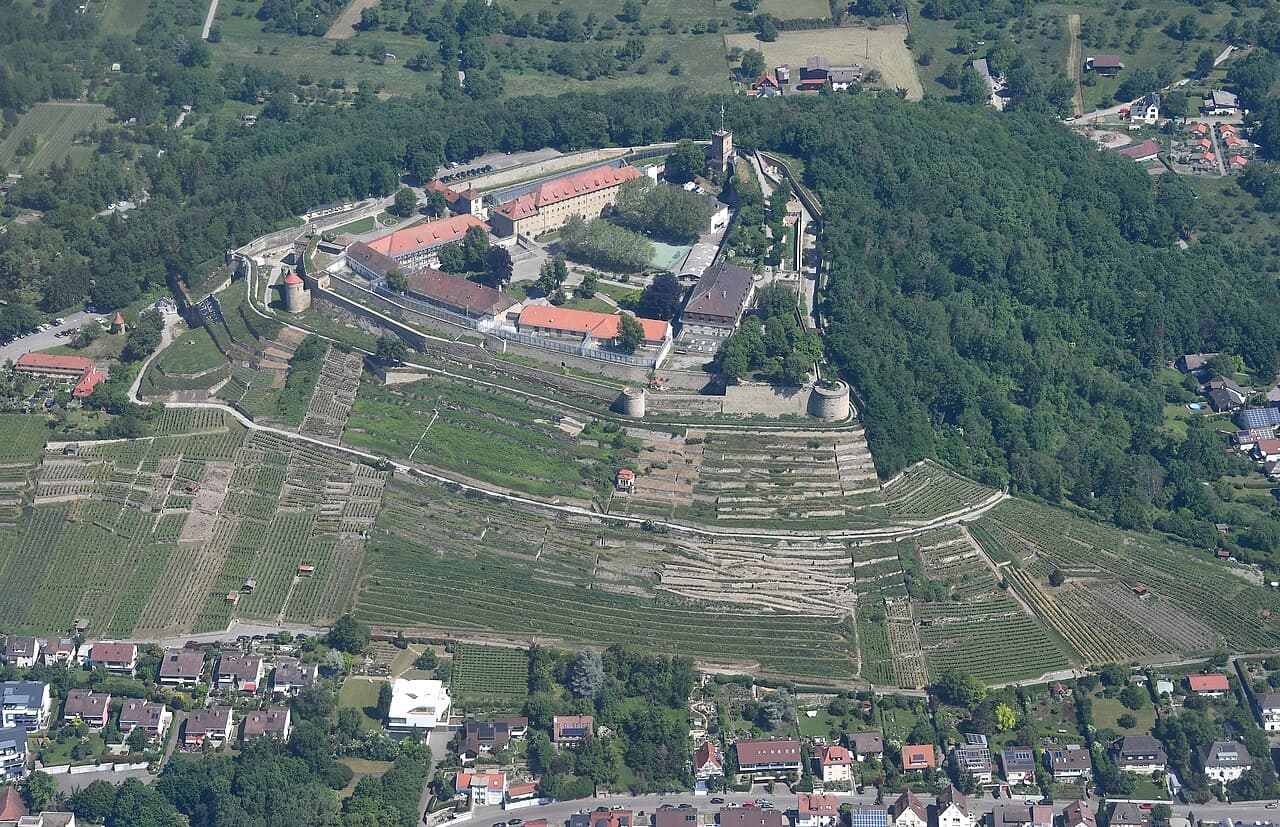
Hohenasperg
Hohenasperg is a prominent Renaissance bastioned fortress located in the federal state of Baden-Württemberg, near the city of Stuttgart, Germany. This imposing stronghold sits atop a hill overlooking the town of Asperg, serving historically as a strategic military site and later as a state prison. Its commanding position and extensive fortifications reflect its long-standing role in regional defense and governance.
Early history and celtic significance
The site of Hohenasperg has a history that predates its Renaissance fortifications, with origins tracing back to an important Celtic oppidum. This ancient fortified settlement was a center of power and trade during the late Iron Age. The surrounding area is notable for several princely burials, including the famous Hochdorf Chieftain's Grave, which is one of the most significant archaeological finds of the Celtic period in Europe. These graves indicate the high status and wealth of the Celtic elite who once inhabited the region.
Renaissance bastioned fortress architecture
The fortress as it stands today primarily dates from the 16th century, during the Renaissance period, when it was extensively rebuilt and modernized to incorporate bastioned fortifications. This style was developed in response to advancements in artillery and siege warfare, featuring angled bastions that allowed defenders to cover all approaches with overlapping fields of fire. The thick walls, moats, and defensive towers of Hohenasperg exemplify this military architectural evolution.
Fortification layout and features
The fortress complex includes multiple bastions arranged to maximize defensive capabilities. The design reflects the principles of the Italian school of fortification, which influenced many European fortresses during the Renaissance. The site also includes curtain walls, gatehouses, and a central keep that served as the last line of defense. These features combined to make Hohenasperg a formidable stronghold in its time.
Use as a prison and historical role
From the early modern period onward, Hohenasperg became known primarily as a state prison. Its isolated hilltop location and robust fortifications made it suitable for detaining political prisoners, military captives, and other high-profile detainees. The fortress prison played a significant role in various periods of German history, including the Napoleonic era and the 19th century.
Notable prisoners and events
Throughout its history as a prison, Hohenasperg held several notable figures, including political dissidents and revolutionaries. Its reputation as a secure detention facility was well established, and it remained in use for this purpose well into the 20th century. The prison's history reflects broader social and political changes in Germany over several centuries.
Cultural heritage and preservation
Today, Hohenasperg stands as a significant cultural and historical monument. Its well-preserved Renaissance bastioned fortifications offer valuable insights into military architecture and regional history. The site is accessible to visitors interested in exploring its extensive history, archaeological significance, and architectural features. Efforts to maintain and restore the fortress ensure that its legacy endures for future generations.
Archaeological importance
The proximity of Hohenasperg to notable Celtic burial sites, including the Hochdorf Chieftain's Grave, enhances its archaeological value. These discoveries have contributed significantly to understanding Celtic culture and social structures. The fortress and its surroundings form an important historical landscape that connects ancient and early modern European history.
Frequently asked questions (FAQ)
- What is the historical significance of Hohenasperg?
- Hohenasperg is a prominent hilltop castle that dates back to the 13th century and has played a crucial role in the history of the region. It served as a royal residence and a strategic military stronghold, witnessing numerous historical events, including its use as a prison for political figures.
- When was Hohenasperg built?
- Construction of Hohenasperg began in the early 1200s, with the castle being completed in the following centuries. Its architecture reflects various styles, showcasing the evolution of defensive structures throughout the medieval period.
- Can I visit Hohenasperg year-round?
- Yes, Hohenasperg is open to visitors throughout the year, but it's best to check specific opening hours depending on the season. Guided tours are available, providing insights into the castle's rich history and architectural features.
- What are the opening hours for Hohenasperg?
- Hohenasperg typically opens at 10 AM and closes at 6 PM during the peak season, while winter hours may vary. It is recommended to verify the current hours on the official website before planning your visit.
- Is Hohenasperg accessible for visitors with mobility challenges?
- While Hohenasperg offers breathtaking views and historical architecture, the castle's layout includes steep paths and stairs that may pose challenges for visitors with mobility issues. It's advisable to contact the site in advance to inquire about accessibility accommodations.
- What is the best time to visit Hohenasperg?
- The best time to visit Hohenasperg is during the spring and fall when the weather is pleasant and the surrounding landscape is particularly beautiful. Additionally, visiting during these seasons allows you to avoid large crowds often seen in the summer months.
- Can I purchase tickets in advance for Hohenasperg?
- Yes, tickets for Hohenasperg can usually be purchased in advance through the official website. This not only secures your entrance but also helps you avoid long lines at the ticket counter.
- What nearby attractions can I enjoy while visiting Hohenasperg?
- While visiting Hohenasperg, you can explore the charming town of Asperg, with its quaint shops and local restaurants. Additionally, nearby attractions include the historic city of Ludwigsburg and the beautiful gardens of the Ludwigsburg Palace.
Photo gallery

Information
Loading map...
Visitor reviews
No reviews yet. Been here? Write the first review and help other travelers!
Write the first reviewVisited this castle? Share your experience
Your review helps other travelers and adds first-hand knowledge to our encyclopedia.



