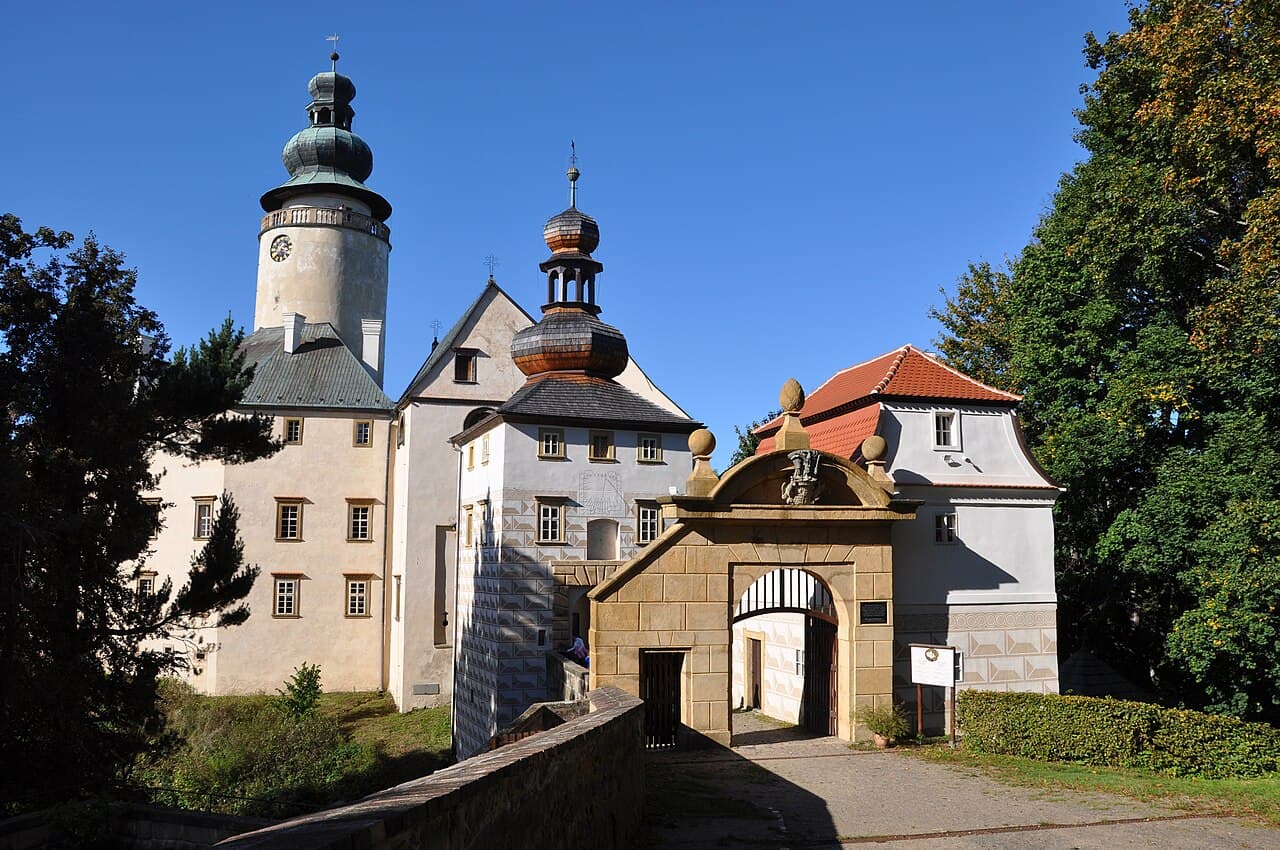
Lemberk Castle
Lemberk Castle stands as a remarkable testament to the architectural and historical evolution of noble residences in the Czech Republic. Situated near the village of Lvová, part of Jablonné v Podještědí, this hill castle was originally constructed in the 1240s by Havel of Markvartice, a prominent nobleman serving under the Bohemian kings. Its strategic location on a rocky outcrop overlooking the Panenský potok stream valley was chosen to guard a vital medieval trade route linking Bohemia to Žitava, underscoring its military and administrative significance in the high medieval period.
The castle's early history is closely intertwined with the Markvartic family and later the Lemberk noble lineage, with notable figures such as Saint Zdislava of Lemberk residing here in the 13th century. Zdislava's charitable works and spiritual legacy have left a lasting cultural imprint, adding a unique dimension to the castle's heritage. The first documentary mention of Lemberk dates to 1249, when Havel adopted the castle's name into his title, reflecting its importance as a seat of power.
Medieval origins and strategic importance
The original fortress was designed primarily for defense, featuring a cylindrical bergfried tower that remains the most intact medieval structure today. This tower, with an external diameter of approximately 8.5 meters and a distinctive polygonal base forming a diamond-shaped interior floor, exemplifies the military architecture of the 13th century. The tower's elevated entrance, accessible only by ladder, and its vaulted chambers illustrate typical defensive features of hill castles from this era.
Throughout the late medieval period, the castle changed hands among several noble families, including the Wartenbergs, Berkas of Dubá, Elsnic, and Donín families. These transitions reflected the shifting political landscape of Bohemia and the castle's continued role as a noble residence and stronghold.
Renaissance transformation and architectural evolution
In the mid-16th century, under the stewardship of Jindřich Berka of Dubá, Lemberk Castle underwent significant remodeling, transitioning from a purely defensive fortress to a Renaissance chateau. This transformation included the construction of a new wing shortly after 1550 and the addition of a second floor in the early 1600s by the Donín family. The Renaissance influence is evident in the castle's elegant rectangular palace layout, richly decorated interiors, and the introduction of ornamental features such as the Hall of Fables with its wooden coffered ceiling illustrating scenes from Aesop's fables.
The castle's entrance was enhanced with an early Baroque two-part gate and a Renaissance portal set into a tower crowned by a shingled onion dome. The use of sgraffito rustication on the tower's lower walls and half-timbered construction on the upper floor reflect the blend of Renaissance and Baroque architectural styles that characterize the castle's later phases.
Baroque enhancements and cultural significance
Following the Thirty Years' War, the castle's fortifications were reinforced with the addition of two bastions by the Breda family, who also introduced Baroque modifications including a chapel dedicated to the Holy Spirit and a knights' hall. The chapel features lavish early Baroque stuccoes with ornamental and figural designs, along with 19th-century ceiling paintings depicting the Ascension of Christ and the Assumption of Mary.
The castle's interiors boast exquisite stucco decorations, with the west wing containing rooms restored in the early 20th century by artist Jan Dukát. The north wing houses a barrel-vaulted hall adorned with stucco cartouches and ceiling paintings, as well as sixteen frescoes depicting scenes from the Thirty Years' War, which, despite some damage, remain a vivid historical narrative element.
Later ownership and preservation efforts
In 1726, ownership transferred to Count Filip Josef of Gallas, and subsequently to the Clam-Gallas family, who maintained possession until 1930. The Auersperg family held the castle until 1945, when it was confiscated by the Czechoslovak state under the Beneš decrees after World War II. Prior to the war, the castle remained inhabited and retained much of its historical character.
Post-war, Lemberk Castle served as a museum dedicated to rural culture starting in 1951. Although it fell into disrepair and closed in the mid-1970s, restoration efforts have revived interest in the site. Today, the castle is state-owned and open to the public through organized tours, highlighting its rich history and architectural layers.
Architectural features and grounds
The castle complex combines elements from its medieval fortress origins through Renaissance and Baroque periods. Besides the prominent bergfried tower, the grounds include remnants of the former farmyard, a Baroque well, and a surrounding park with two historic fountains from the 17th and 18th centuries. The nearby Bredovský letohrádek (Breda summerhouse) and a protected avenue of linden trees trace the historical routes connecting Lemberk to neighboring villages.
Beneath the castle lies a network of sandstone cellars and a 35-meter tunnel historically used for iron ore mining and later for wine storage and brewing equipment. The castle grounds also feature Baroque sculptures and mythological statues attributed to Matthias Bernard Braun, enhancing its cultural and artistic significance.
A notable local landmark is the pavilion built in 1862 over the historic Zdislava's spring, a water source associated with the castle's spiritual heritage. The site continues to host exhibitions of modern glass art, concerts, and theatrical performances, linking its medieval past with contemporary cultural life.
In summary, Lemberk Castle exemplifies the layered history of Bohemian noble residences, evolving from a high medieval hill castle to a Renaissance chateau enriched with Baroque grandeur. Its architectural features, historical associations, and cultural legacy make it a significant heritage site in Czechia, offering visitors a vivid journey through centuries of Central European history.
Frequently asked questions (FAQ)
- When was Lemberk Castle originally built and by whom?
- Lemberk Castle was originally built in the 1240s by Havel of Markvartice, a nobleman serving under the Bohemian kings Wenceslaus I and Přemysl Otakar II.
- What architectural styles are represented in Lemberk Castle?
- The castle features a blend of architectural styles including high medieval fortress elements, Renaissance remodeling, and Baroque enhancements reflecting its long history.
- Is Lemberk Castle open to the public for tours?
- Yes, Lemberk Castle is state owned and accessible to the public through organized tours that showcase its historical and architectural significance.
- What remains of the original medieval structure at Lemberk Castle?
- The most intact part of the original medieval castle is the cylindrical bergfried tower with a polygonal base, which served as a defensive stronghold.
- Who were some notable historical owners of Lemberk Castle?
- Notable owners include the Markvartic family, the Berkas of Dubá, the Breda family, and the Clam-Gallas family who owned it until 1945.
Photo gallery

Information
Sources & official resources
Verify the information above using these authoritative references.
Loading map...
Visitor reviews
No reviews yet. Been here? Write the first review and help other travelers!
Write the first reviewVisited this castle? Share your experience
Your review helps other travelers and adds first-hand knowledge to our encyclopedia.



