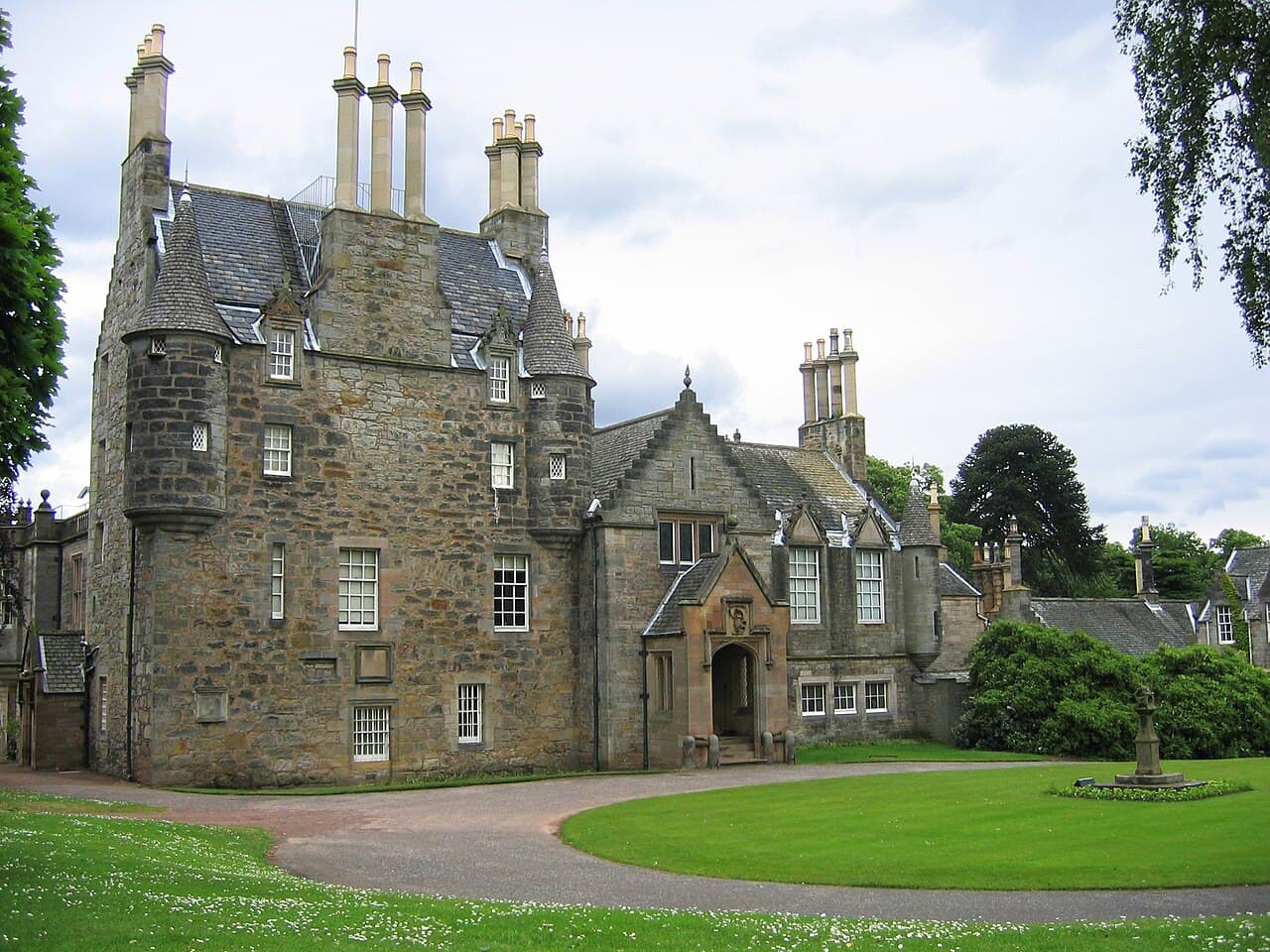
Lauriston Castle
Lauriston Castle stands as a remarkable testament to Scotland's layered history, embodying architectural evolution from a fortified medieval tower house to an elegant Edwardian manor set within expansive, picturesque grounds. Located in Edinburgh, Scotland, this hill castle traces its origins back to the 13th century, with significant rebuilding and enhancements spanning several centuries, reflecting changing tastes, ownership, and functions.
Originally established as a medieval fortress belonging to the Napier family, Lauriston Castle's early history is intertwined with notable figures such as John Napier, the inventor of logarithms. The castle’s strategic position overlooking the Firth of Forth made it a valuable defensive site, particularly during the Wars of Scottish Independence. It was part of a chain of fortifications strengthened by King Edward III in 1336 to counter potential invasions.
Medieval origins and strategic importance
The earliest known charter for Lauriston dates to 1243, marking its establishment as a classic courtyard castle. Tradition holds that the site was once the stronghold of Giric (Gregory the Great), one of the last Pictish kings, linking the location to Scotland’s ancient royal lineage. The castle’s medieval incarnation featured robust defensive elements including stone walls, corner towers, and a moat, typical of Scottish fortifications in the High Medieval period.
Lauriston suffered significant damage during the 1544 raids on Edinburgh led by the Earl of Hertford amid the conflict known as the Rough Wooing. The original fortress was almost completely destroyed, necessitating extensive rebuilding.
16th-century tower house reconstruction and the Napier family
Circa 1590, Sir Archibald Napier of Merchiston rebuilt Lauriston Castle as a substantial four-storey stone tower house in an L-plan layout, incorporating a circular stair tower and two-storey angle turrets equipped with gun loops for defense. This structure formed the core of the castle that survives today.
The Napier family, prominent in Scottish intellectual and scientific history, owned Lauriston for several generations. The castle is linked to John Napier, whose contributions to mathematics and astrology are commemorated by a unique carved stone astrological horoscope installed on the castle’s southwest exterior wall in 1905. This horoscope, reputedly created by John Napier for his brother, symbolizes the castle’s deep historical and scholarly connections.
Georgian and jacobean transformations
In the 18th century, Lauriston Castle passed through several families, including the Stratons, who held it for nearly 450 years. The estate was sold in 1695 to Sir James Falconer of Phesdo, under whose charter the estate became a burgh of barony with a freeport at Miltonhaven.
The most significant architectural transformation occurred in 1827 when Thomas Allan, a banker and mineralogist, commissioned the renowned architect William Burn to extend the tower house. Burn’s design introduced a Jacobean-style range that converted the medieval tower into a comfortable country manor house. This extension harmonized with the original stonework, blending defensive medieval features with the aesthetic preferences of the early 19th century.
20th-century modernization and the reid family legacy
In 1902, Lauriston Castle was acquired by William Robert Reid, proprietor of Morison & Co., an Edinburgh cabinetmaking firm. Reid and his wife, Margaret, undertook extensive modernization of the property, installing electric lighting, plumbing, central heating, and a telephone line, transforming the castle into a modern Edwardian residence.
The Reids enriched the interior with an impressive collection of British furniture, Chinese porcelain, Dutch ceramics, Blue John objects, and mezzotint engravings. Their eclectic taste reflected contemporary trends in collecting European furniture and oriental rugs, creating an interior that offers visitors a vivid glimpse into early 20th-century upper-class life.
Upon Margaret Reid's death in 1926, the castle was bequeathed to the Scottish state with the stipulation that the house and its contents be preserved unchanged. Since then, the City of Edinburgh Council has administered the property, maintaining its historical integrity and opening it to the public as a museum of Edwardian domestic life.
Architectural features and interior details
Lauriston Castle’s surviving medieval tower house is characterized by its L-plan design, four storeys, and defensive features such as gun loops and turrets. The castle’s main entrance, rebuilt in the mid-17th century by Robert Dalgleish, features an inscription expressing gratitude to God, contrasting with the nearby astrological horoscope.
The 19th-century Jacobean extension by William Burn added elegant living spaces, including reception rooms and bedrooms, reflecting the transition from fortress to country manor. The interior retains many original Edwardian fittings and furnishings, showcasing the Reids’ commitment to preserving the castle’s historic character while embracing modern comfort.
Gardens and landscape
The castle is set within approximately 12 hectares (30 acres) of grounds that exhibit a variety of landscaping styles. Notably, the Japanese garden, covering one hectare, was designed by Takashi Sawano and opened in 2002 to celebrate the Edinburgh-Kyoto friendship. This garden features traditional Japanese horticultural elements, providing a serene and culturally significant space within the estate.
The grounds also include mature Chilean monkey puzzle trees (Araucaria araucana), croquet lawns established in the mid-20th century, and woodland areas such as the "Hasenglöckchenwald," enhancing the estate’s biodiversity and recreational appeal.
Historical significance and preservation
Lauriston Castle is classified as a Category A listed building, recognizing its national importance as an architectural and historical monument. Its evolution from a High Medieval fortress to a Jacobean manor and finally an Edwardian country house encapsulates key phases of Scottish history and architectural development.
The castle’s preservation under the City of Edinburgh ensures that visitors can experience a rare continuity of Scottish heritage, from medieval defensive architecture to early 20th-century domestic life. Proposals to repurpose the castle as the official residence of Edinburgh’s Lord Provost were considered but ultimately abandoned due to financial constraints, underscoring the challenges of maintaining historic properties.
Today, Lauriston Castle offers a rich educational resource, combining its architectural features, historic collections, and gardens to provide an immersive experience of Scotland’s cultural legacy.
Frequently asked questions (FAQ)
- How do I get to Lauriston Castle in Edinburgh?
- Lauriston Castle is located in the northwest of Edinburgh and is accessible by car and public transport. Buses run regularly from the city center, and there is parking available nearby.
- What is the historical significance of Lauriston Castle?
- Lauriston Castle has origins dating back to the 13th century and was a medieval fortress linked to the Napier family. It features architecture from the High Medieval period through the 19th century and offers insights into Scottish history and Edwardian life.
- Can I visit the gardens at Lauriston Castle?
- Yes, the castle grounds include extensive gardens featuring a notable Japanese garden designed by Takashi Sawano. The gardens are open to the public and provide a peaceful environment for visitors.
- Is Lauriston Castle suitable for families and children?
- Lauriston Castle and its grounds are family-friendly, offering spacious outdoor areas for children to explore. The castle’s interior provides educational exhibits that can engage visitors of all ages.
- When is the best time to visit Lauriston Castle?
- The castle is open daily from 10:00 to 17:00. Spring and summer offer the best conditions for enjoying the gardens, while the interior exhibits can be visited year-round regardless of weather.
Photo gallery

Information
Opening hours
10:00-17:00, daily
Ticket prices
Free
Current owner
City of Edinburgh Council
Website
Visit websiteSources & official resources
Verify the information above using these authoritative references.
Loading map...
Visitor reviews
No reviews yet. Been here? Write the first review and help other travelers!
Write the first reviewVisited this castle? Share your experience
Your review helps other travelers and adds first-hand knowledge to our encyclopedia.



