Langenstein Castle
Langenstein Castle stands prominently in the municipality of Orsingen-Nenzingen, Germany, embodying a rich historical legacy that spans from the early Middle Ages to the modern era. This hill castle is strategically perched atop a striking Jurassic limestone formation in the Hegau region, offering commanding views and a natural defensive advantage. Its origins are closely tied to the influential Abbey of Reichenau, which initiated the castle's construction around the year 1100 by erecting the central bergfried, a towering stone keep that remains the oldest surviving element of the complex.
The castle's early function was primarily military and administrative, serving as the seat for a cadre of ministeriales—unfree knights who were vassals to the Abbey. These knights adopted the name "von Langenstein," directly derived from the castle itself, and governed the estate through the 12th and 13th centuries. The castle's ownership transitioned through several noble families after the original family line ended in the early 14th century, reflecting the shifting political landscape of medieval southern Germany.
Medieval origins and architectural features
The defining medieval feature of Langenstein Castle is its bergfried, constructed of robust stone on the limestone outcrop. This tower was built primarily for defense and as a symbol of feudal authority. The lower floor of the bergfried survives intact, providing valuable insight into early medieval military architecture. The castle's location between Singen and Stockach underscores its strategic importance in controlling regional routes and asserting the Abbey of Reichenau's territorial influence.
Ministeriales and feudal role
The ministeriales who held Langenstein Castle were part of a broader class of knights serving ecclesiastical lords, a common arrangement in the Holy Roman Empire. Their role combined military service with estate management, and their residence at Langenstein symbolized both their martial duties and their social status within the feudal hierarchy.
Renaissance transformation and expansions
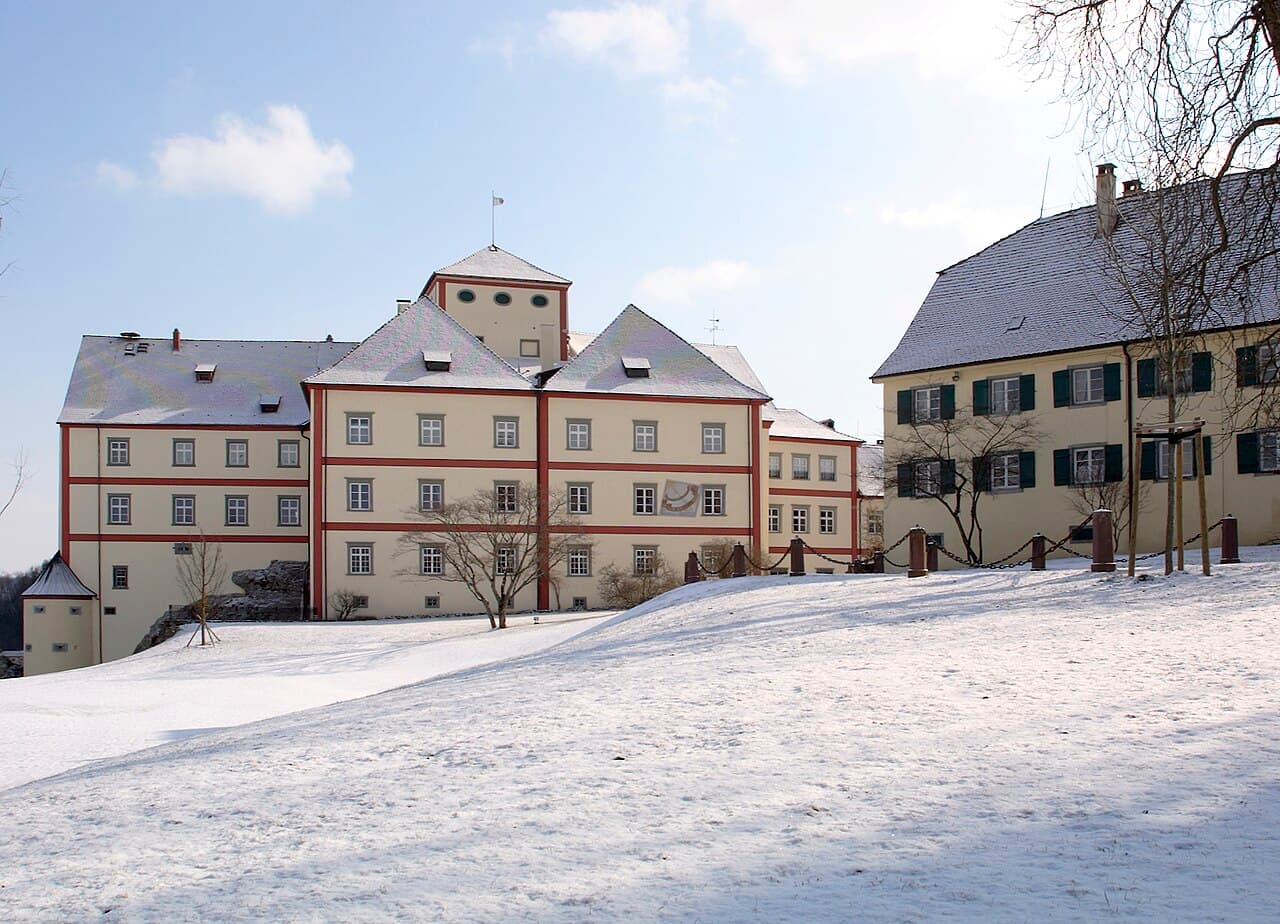
Between 1570 and 1605, Langenstein Castle underwent a significant transformation that reflected the changing nature of noble residences during the Renaissance. The castle was expanded around the original square tower, transitioning from a fortified stronghold into a more comfortable and representative noble home. This redevelopment introduced Renaissance architectural elements characterized by symmetry, proportion, and enhanced living quarters.
The new castle and connecting wing
A notable addition during this period was the construction of the so-called "New Castle", which was connected to the original residential building by an intermediate wing. This expansion increased the estate's residential capacity and modernized its facilities, aligning with contemporary tastes and the needs of noble families for more luxurious accommodations.
Ownership history and noble lineage
In 1826, the castle was acquired by Grand Duke Ludwig I of Baden, who incorporated it into the private estates of the Counts von Langenstein, a morganatic branch descended from his liaison with actress Katharina Werner. The death of Ludwig Wilhelm August von Langenstein in 1872 without heirs led to the transfer of ownership to his sister, Luise, who married Count Carl Douglas in 1848. Since then, the castle has remained under the stewardship of the Douglas family, who established it as their primary residence from 1906.
Following the political upheavals of the 1918 November Revolution and the abdication of Grand Duke Friedrich II of Baden, the former ruling family found refuge at Langenstein Castle until 1920, supported by their familial ties to the Douglas owners. This period highlights the castle's role as a sanctuary for displaced nobility during times of social change.
Cultural significance and modern adaptations
In the latter half of the 20th century, Langenstein Castle gained cultural prominence by hosting the Fasnacht Museum from 1969 to 2018. This museum housed an extensive collection of over 300 Swabian-Alemannic carnival masks and figures, showcasing the rich traditions of the regional Fasnacht festival. The museum's presence underscored the castle's role not only as a noble residence but also as a custodian of local heritage and folklore. Plans to relocate the museum to a new building near the castle by 2025 aim to continue this cultural mission.
The castle estate has also evolved to include recreational facilities such as a golf and country club, tennis courts, and equestrian amenities, which have been integrated into the surrounding landscape since the late 1980s. These modern adaptations respect the historical core of the castle while enhancing its function as a private residence and leisure estate.
Architectural elements and estate layout
The castle's architectural ensemble comprises several key components. The original bergfried remains a central defensive feature, while the Renaissance residential building retains its characteristic robust masonry and spatial layout. The "New Castle" wing provides expanded living quarters, connected by a transitional structure that unifies the complex.
Additional estate buildings include a chapel, which served religious functions for the castle's inhabitants, and auxiliary structures such as the Ludwigshof farm complex and the Reichenau tithe cellar, historically used for storing rents and offerings. These elements illustrate the castle's dual role as a noble residence and an administrative center for surrounding lands.
Overall, Langenstein Castle stands as a well-preserved historic estate that seamlessly blends its medieval defensive origins with Renaissance residential architecture and later expansions. Its continuous habitation and cultural significance contribute to its status as a landmark of regional heritage in southern Germany.
Frequently asked questions (FAQ)
- What is the historical significance of Langenstein Castle?
- Langenstein Castle dates back to the 13th century and is a prime example of medieval architecture in the region. It played a crucial role in the local defense strategies and has witnessed various historical events, making it an important landmark in Orsingen-Nenzingen.
- When was Langenstein Castle built?
- Langenstein Castle was constructed in the early 1200s, with its initial purpose being to serve as a fortress. Over the centuries, it has undergone several renovations, reflecting the architectural styles of different eras.
- What are the opening hours for Langenstein Castle?
- Langenstein Castle is open to visitors from April to October, typically from 10 AM to 6 PM. It is advisable to check the official website for any seasonal variations or special openings.
- Can I visit Langenstein Castle year-round?
- While the castle itself is primarily open from April to October, special arrangements may allow for visits outside these months. It’s best to contact the castle management in advance to inquire about winter tours or special events.
- Is Langenstein Castle accessible for visitors with disabilities?
- Langenstein Castle has made efforts to improve accessibility, but due to its historical nature, some areas may be challenging to navigate. It is recommended to contact the castle staff beforehand to learn about the specific accessibility options available.
- What are the ticket prices for visiting Langenstein Castle?
- Tickets for Langenstein Castle are reasonably priced, with discounts available for students and seniors. Children under a certain age may enter for free, so be sure to check the official site for the latest pricing details.
- When is the best time to visit Langenstein Castle?
- The best time to visit Langenstein Castle is during the spring and early autumn when the weather is pleasant, and the surrounding landscapes are particularly beautiful. Additionally, visiting during local festivals can provide a unique experience.
- Are there any nearby attractions to visit after Langenstein Castle?
- Yes, there are several nearby attractions, including picturesque hiking trails and the charming village of Orsingen-Nenzingen. Visitors can also explore local museums and parks that showcase the rich culture and history of the region.

Information
Website
Visit websiteSources & official resources
Verify the information above using these authoritative references.
Loading map...
Visitor reviews
No reviews yet. Been here? Write the first review and help other travelers!
Write the first reviewVisited this castle? Share your experience
Your review helps other travelers and adds first-hand knowledge to our encyclopedia.