Landsfort Herle
Landsfort Herle is a unique medieval fortification located in the centre of Heerlen, Netherlands, historically situated roughly where the current Pancratiusplein stands. This fortification is notable for being a rare example of a fortress church or Kirchenburg, a type of fortified church surrounded by a defensive curtain wall. Unlike more common fortified churches (Wehrkirchen) that lack such walls, Landsfort Herle represents the only known Kirchenburg in the Netherlands, making it an exceptional architectural and historical monument.
The original structure was probably constructed by the counts of Ahr-Hochstaden, also known as the Heren van Are, during the early High Medieval period. The name "Landsfort," meaning "fort of the land," was introduced in the 19th century, reflecting its status as a fortification under the responsibility of the land or regional authority. In the 13th century, specifically in 1244, the fortification came into the possession of the Dukes of Brabant, who undertook significant rebuilding efforts, reinforcing the walls and enhancing its defensive capabilities.
Architectural features and fortifications
The fortification was surrounded by a moat, which added an important layer of defense against invaders. The curtain wall of Landsfort Herle is considered one of the oldest still recognizable medieval walls in the Netherlands. Archaeological excavations have uncovered parts of this wall, providing valuable insight into medieval fortification techniques in the region.
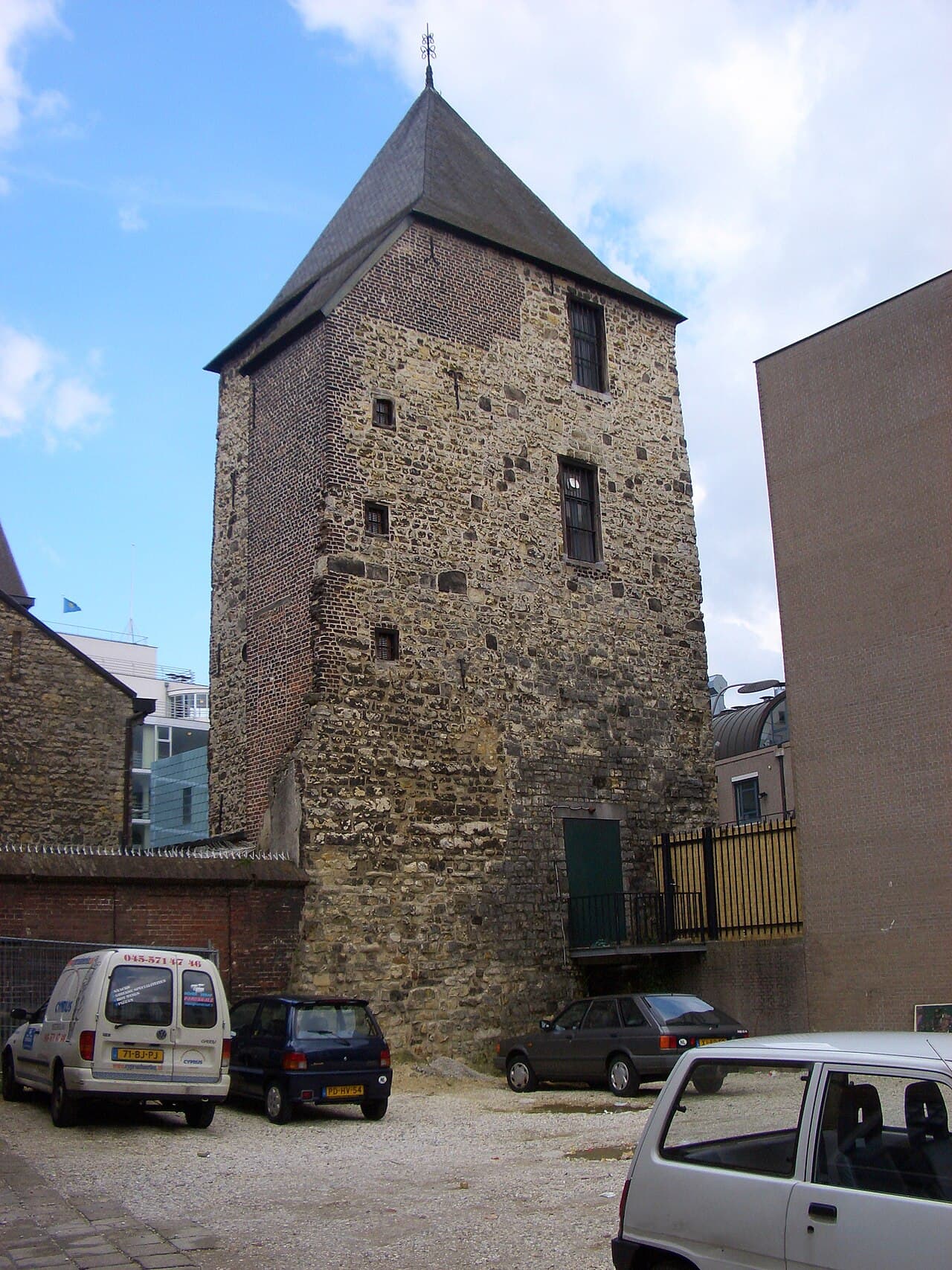
The fort had a total of three gates, controlling access to the interior, and two significant towers. One of these towers was the belfry of the Pancratiuskerk (St. Pancras Church), which also served a defensive function. The other tower was the Schelmentoren, a robust structure with walls approximately 2 meters thick. These towers were integral to the fort's defense, providing vantage points for surveillance and protection.
Fortress church design
The church itself was adapted for defense, with small rooms built into the rafters of its roof. These rooms served as shelters for the inhabitants of Heerlen during times of conflict or siege. Unfortunately, these protective spaces were destroyed during World War II when the church was hit by a bomb, reportedly German, on New Year's Eve of 1944/1945.
Historical context and ownership
Initially constructed by the counts of Ahr-Hochstaden, the fortification's strategic importance grew as Heerlen became part of the Duchy of Brabant. The Dukes of Brabant rebuilt and strengthened the fort in the mid-13th century, reflecting the region's shifting political and military landscape. The fort's name, Landsfort, emphasizes its role as a regional stronghold, overseen by the territorial rulers rather than a private lord.
Later developments and archaeological discoveries
In the 18th century, a detailed map of the fort from 1787 was discovered during extensive restorations of the Pancratiuskerk in the 1960s. This map allowed historians and archaeologists to reconstruct a model of the fort, shedding light on its layout and defensive structures. Excavations have since revealed parts of the curtain wall and other features, confirming the fort's significance as a medieval military and religious site.
Legacy and current status
Today, Landsfort Herle stands as a rare example of a medieval fortress church in the Netherlands. While much of the original structure has been lost or altered over the centuries, archaeological efforts continue to uncover and preserve its remains. The site offers valuable insights into medieval fortification architecture and the role of fortified churches in regional defense.
The Pancratiuskerk remains a central landmark in Heerlen, with its historic belfry once part of the fort's defensive system. Although the wartime bombing destroyed some of the protective features, the church and the excavated fortifications continue to attract interest from historians, architects, and visitors fascinated by medieval military architecture.
Frequently asked questions (FAQ)
- What is Landsfort Herle and why is it unique in the Netherlands?
- Landsfort Herle is a rare example of a fortress church (Kirchenburg) in the Netherlands, featuring a fortified church surrounded by a curtain wall, unlike more common fortified churches that lack such walls.
- When was Landsfort Herle built and by whom?
- The fortification was likely built by the counts of Ahr-Hochstaden and rebuilt in 1244 by the Dukes of Brabant during the High Medieval period.
- What remains of the fortification can be seen today?
- Parts of the original curtain wall have been excavated and are among the oldest recognizable medieval walls in the Netherlands, along with the church's belfry and the Schelmentoren tower.
- Can visitors see the model of Landsfort Herle?
- A model of the fort was constructed based on a 1787 map found during restorations in the 1960s, which helps illustrate the fort's layout and defensive features.
- What happened to the protective rooms in the church roof?
- The small rooms built into the church rafters for shelter were destroyed when the Pancratiuskerk was bombed on New Year's Eve 1944/1945 during World War II.
Photo gallery

Photo by Maarten van Wesel•Public domain
Information
Loading map...
Visitor reviews
No reviews yet. Been here? Write the first review and help other travelers!
Write the first reviewVisited this castle? Share your experience
Your review helps other travelers and adds first-hand knowledge to our encyclopedia.