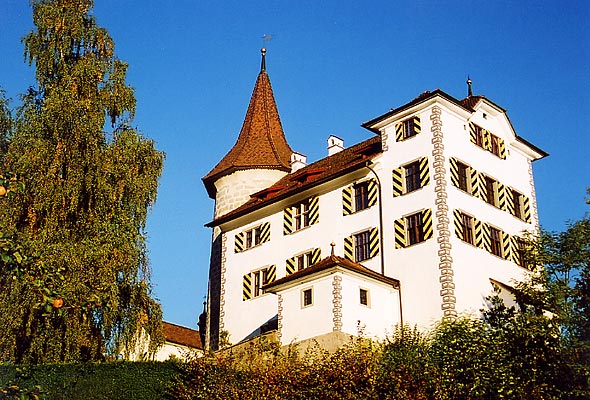
Landenberg Castle
Landenberg Castle stands as a significant historical and architectural landmark in Sarnen, Switzerland. Originally established in the early 11th century by the Counts of Lenzburg, this castle began as a wooden fortification atop Landenberg hill. Over the centuries, it evolved through various phases of construction, abandonment, and reinvention, reflecting the complex history of central Switzerland and its shifting political landscape.
The earliest fortifications at Landenberg were wooden structures, typical of early medieval defensive architecture. Following the extinction of the Lenzburg line in 1173, the estate passed to the powerful Habsburg family. They undertook significant enhancements, notably constructing a robust stone ring wall that enclosed much of the hill's summit. This transformation marked Landenberg as one of the largest and most formidable hill castles in the region during the High Medieval period.
Medieval origins and strategic importance
The castle's strategic location atop Landenberg hill provided commanding views over the surrounding landscape, crucial for defense and regional control. The stone walls built by the Habsburgs were up to 1.36 meters thick, indicating the importance of the site as a military stronghold. The castle's enclosure spanned approximately 40 by 90 meters, making it one of the largest medieval fortifications in central Switzerland.
Within the castle grounds, a gatehouse once controlled access from the western side, although it has since been completely demolished, leaving no visible remains. The western corner of the hill, the highest point, was fortified with a substantial square tower measuring about 10.5 meters on each side. This tower likely served as a key defensive bastion and lookout point.
Decline and abandonment in the 13th century
Despite its formidable construction, Landenberg Castle was abandoned in the early 13th century for reasons that remain uncertain. The Hexenturm, a tower built in the late 13th century nearby, has been subject to debate regarding its relationship to Landenberg. While traditionally thought to be part of the Landenberg complex or its replacement, recent research suggests it may have been a separate structure altogether.
The White Book of Sarnen, compiled in the 15th century, recounts a local legend of Swiss patriots storming and burning a castle on Christmas Eve in the early 14th century. This event was long attributed to Landenberg Castle, but modern scholarship leans towards the Hexenturm as the likely target of this historic attack.
Post-medieval transformation and civic use
Following its abandonment, the castle fell into ruin. Its walls were gradually dismantled and repurposed as building materials for the growing town of Sarnen. The site was also used agriculturally, with animals penned within the remaining enclosures. By the early 17th century, the ruins were still prominent and owned by Hauptmann Marquard Seiler. After his death, the property was sold to the Canton of Obwalden, ushering in a new phase of use.
Around 1620, the canton constructed the first armory on the site, utilizing the remains of a medieval tower. This armory served to store artillery and weapons, marking the site's transition from a feudal fortress to a military facility. In 1646, the Landsgemeinde, the annual assembly of all voters in the canton, began meeting at Landenberg. To accommodate these gatherings, the grounds were cleared, and parts of the medieval walls were repaired. The Landsgemeinde convened here until its dissolution in 1998, making Landenberg a center of regional governance for over three centuries.
Baroque architectural additions
In 1711, the medieval tower on the southwest corner was demolished to make way for a new Baroque armory building, designed and constructed by Hans Josef von Flüe. This building exemplifies Baroque military architecture with its functional design and decorative touches. The armory's ground floor was an open space for storing cannons, while the upper floors housed smaller arms and armor. Remarkably, this armory remains largely intact and is considered one of the few preserved examples of its kind in central Switzerland.
A shooting range was also established on the hill in the early 18th century but was destroyed by fire in 1747. It was rebuilt in 1752 by Johann Anton Singer, featuring a distinctive three-story central building flanked by symmetrical single-story wings, each topped with onion dome-capped towers. The upper story of the central block contains a richly decorated ballroom or assembly hall, reflecting the site's social and political functions alongside its military role.
Archaeological remains and preservation
Today, visitors to Landenberg can observe long stretches of low stone walls that outline the original castle's footprint. These walls, remnants of the medieval fortifications, provide insight into the castle's scale and defensive capabilities. The absence of the gatehouse and the demolition of some walls during armory and shooting range construction reflect the site's layered history of adaptation and reuse.
Excavations and restorations conducted in 1895 uncovered and preserved sections of the old walls, allowing for a better understanding of the castle's original layout. The combination of medieval ruins with Baroque military buildings creates a unique architectural ensemble that illustrates the evolution of defensive and civic architecture in central Switzerland.
Landenberg Castle is not only a testament to medieval military engineering but also a symbol of the region's political and social development. Its transformation from a feudal stronghold to a military armory and civic meeting place encapsulates centuries of Swiss history, making it a site of national cultural significance.
Frequently asked questions (FAQ)
- How do I get to Landenberg Castle in Sarnen?
- Landenberg Castle is located on Landenberg hill in Sarnen, Switzerland. It is accessible by foot from the town center, with well-marked paths leading up to the castle ruins and armory buildings.
- What is the historical significance of Landenberg Castle?
- Landenberg Castle played a crucial role in central Switzerland's medieval defense and later served as a military armory and the site for the Landsgemeinde assemblies, reflecting its importance in regional governance.
- Can I visit the Baroque armory and shooting range at Landenberg?
- Yes, the Baroque armory built in 1711 and the shooting range rebuilt in 1752 are preserved and can be viewed by visitors, showcasing unique examples of military architecture from the 17th and 18th centuries.
- When was Landenberg Castle abandoned and why?
- Landenberg Castle was abandoned in the early 13th century for reasons that remain unclear, possibly due to shifting political or military circumstances in the region.
- Is there evidence of the castle's original medieval structures?
- Yes, long stretches of low stone walls and the foundation of a square tower remain visible, outlining the castle's original layout and defensive features.
Information
Sources & official resources
Verify the information above using these authoritative references.
Loading map...
Visitor reviews
No reviews yet. Been here? Write the first review and help other travelers!
Write the first reviewVisited this castle? Share your experience
Your review helps other travelers and adds first-hand knowledge to our encyclopedia.