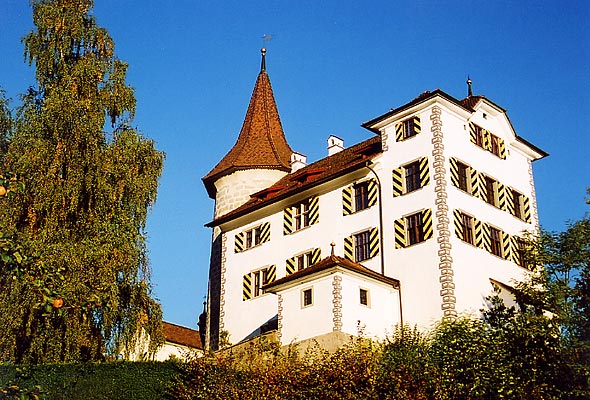
Schnitzturm
The Schnitzturm is a remarkable example of medieval military architecture located in the municipality of Stansstad, in the canton of Nidwalden, Switzerland. Constructed in the early 14th century, between 1310 and 1315, this stone tower played a crucial role in the defensive system protecting the lakeshore of Lake Lucerne. It was part of a larger fortification network known as the Teller / Palisaden medieval fortifications, which are recognized today as a Swiss heritage site of national significance.
The tower's strategic location on an artificial spit extending into Lake Lucerne allowed it to serve as a key point in guarding against attacks from rival forces, particularly from the nearby city of Lucerne. The Schnitzturm was designed with a square footprint measuring 8.8 meters on each side and rising to a height of 16 meters. Its walls, constructed from robust stone, are 1.4 meters thick at the base, providing formidable protection against siege weaponry and assault.
Historical significance and military role
The Schnitzturm was built during the late medieval period as part of the regional efforts to defend the lakeshore and surrounding territories from external threats. Notably, the tower was active during the Battle of Morgarten in 1315, a pivotal conflict between the Swiss Confederates and the Habsburg forces. According to a 1428 chronicle, defenders stationed in the tower used a mill stone to destroy an enemy ship approaching from Lucerne, demonstrating the tower's defensive capabilities in naval engagements.
Despite the defenders' efforts, the attackers eventually breached the fortifications and plundered the town of Stansstad. This event led to the strengthening of the fortifications with additional earthen and stone walls. However, the Schnitzturm's military importance declined after Lucerne joined the Old Swiss Confederacy in 1332, reducing the likelihood of attacks from that direction.
Division of ownership and decline
Following the division of the region of Unterwalden into Obwalden and Nidwalden in the mid-14th century, responsibility for the tower and its defenses was shared. This joint ownership led to neglect and lack of coordinated maintenance. By 1587, the Schnitzturm had fallen into significant disrepair.
Renovations and changes in function
The local assembly, known as the Landsgemeinde, ordered renovations to preserve the tower. These included the addition of round arch windows, relocating the entrance from the second floor to ground level on the south side, and constructing a flat hipped roof. These modifications reflected a transition from purely military use to more practical and residential functions.
In 1634, the tower suffered damage from a lightning strike that partially destroyed the roof. Repairs were incomplete, leading to interior decay. The tower was subsequently repurposed for drying fishing nets, marking a clear shift away from its original defensive role.
Role during the 1798 french invasion
During the French invasion of 1798, the Schnitzturm was again manned for military defense. The wooden palisade surrounding the tower was temporarily replaced with floating fir trunks to resist the French fleet advancing on Lake Lucerne. The defenders managed to hold out for several days, but ultimately the town of Stansstad and the tower were captured and burned on April 9, 1798.
19th-century restoration and modern status
In 1880, the cantonal authorities undertook a significant restoration of the Schnitzturm. This restoration reinstated the tower's medieval character by adding a staircase, an observation platform, and restoring the crenelations that had been removed during the 1635 roof construction. These efforts preserved the tower as an important historical monument.
Historically, ownership of the tower was divided, with Obwalden holding two-thirds and Nidwalden one-third. In 1997, Obwalden transferred its share to the municipality of Stansstad, consolidating ownership and facilitating preservation efforts.
Today, the Schnitzturm stands as a well-preserved medieval stone tower and is a prominent feature of the municipal coat of arms. The grounds around the tower are open to the public year-round, allowing visitors to appreciate its historical and architectural significance firsthand.
Architectural features and fortifications
Construction and materials
The Schnitzturm is constructed from durable stone, with walls measuring 1.4 meters thick at the base to withstand attacks. The square plan of the tower, measuring 8.8 meters per side, supports its height of 16 meters, creating a formidable defensive structure.
Integration with surrounding defenses
The tower was part of a larger defensive complex that included a wooden blockhouse known as the Teller and a palisade formed by approximately 8,000 wooden pillars driven into the lakebed about two meters deep. This palisade created a defensive barrier in the water, complemented by a channel called the Grendel, which allowed controlled boat access to the harbor.
Modifications and adaptations
Renovations in the late 16th century altered the tower's appearance and function. The addition of round arch windows and the relocation of the entrance to ground level improved accessibility and usability. The original second-floor entrance was closed, and a flat hipped roof replaced the earlier crenelated battlements.
Following the lightning damage in 1634, the roof was only partially repaired, accelerating the tower's interior deterioration. The 1880 restoration reversed many of these changes, reinstating the crenelations and adding an observation platform and staircase to facilitate visitor access.
Frequently asked questions (FAQ)
- What is the historical significance of Schnitzturm?
- Schnitzturm, located in Stansstad, Switzerland, is a medieval tower that dates back to the 15th century. It served as a defensive structure and played a crucial role in the region's history, particularly during conflicts in the area. The tower is now a symbol of local heritage and is recognized for its architectural and historical value.
- When was Schnitzturm built?
- The construction of Schnitzturm began in the late 1400s, making it a significant structure from the late medieval period. Its construction reflects the architectural styles and defensive needs of that time, providing insight into the historical context of the region. Over the centuries, it has been preserved as a historic monument.
- Can I visit Schnitzturm?
- Yes, Schnitzturm is open to visitors and offers a unique glimpse into the region's history. Guests can explore the tower and enjoy guided tours that highlight its historical and architectural features. It is advisable to check the opening hours before your visit, as they may vary seasonally.
- What are the opening hours for Schnitzturm?
- Schnitzturm typically opens its doors to visitors from 10 AM to 5 PM, but these hours can change depending on the season. It is recommended to verify the current hours on the official website before planning your visit. Special events or tours may also affect the schedule.
- Is it possible to access Schnitzturm with mobility aids?
- Schnitzturm is a historic structure, and while efforts have been made to accommodate visitors, accessibility may be limited due to stairs and uneven surfaces. It is best to contact the site directly for detailed information regarding accessibility options. Staff members are generally helpful and can provide assistance where needed.
- What is the best time to visit Schnitzturm?
- The best time to visit Schnitzturm is during the spring and early autumn when the weather is pleasant, and the surrounding landscape is particularly beautiful. Summer can also be a great time, but it may attract larger crowds. Visiting during weekdays may provide a quieter experience.
- Are there any nearby attractions to visit?
- Yes, the area around Schnitzturm offers several attractions, including Lake Lucerne and the nearby historic town of Stans. Visitors can enjoy various outdoor activities, such as hiking and boating, making it an excellent destination for a full day of exploration. Don't forget to check out local restaurants and shops for a taste of Swiss culture!
- What are the ticket prices for visiting Schnitzturm?
- Ticket prices for Schnitzturm are generally quite affordable, with discounts available for children and seniors. Admission fees contribute to the maintenance and preservation of this historic site. Check the official website for the most current pricing information and any special offers.
Information
Website
Visit websiteSources & official resources
Verify the information above using these authoritative references.
Loading map...
Visitor reviews
No reviews yet. Been here? Write the first review and help other travelers!
Write the first reviewVisited this castle? Share your experience
Your review helps other travelers and adds first-hand knowledge to our encyclopedia.