Lancaster Castle
Lancaster Castle stands as a monumental example of medieval military architecture and judicial history in England. Founded in the 11th century on the site of a Roman fort overlooking the River Lune, it occupies a commanding position on Castle Hill in the city of Lancaster. This hill castle has evolved over nearly a millennium from a strategic defensive stronghold to a prominent center of law and governance, reflecting the complex history of the region and the nation.
The castle’s origins trace back to the Roman era, with the site originally fortified by substantial earthworks and stone walls known as the Wery Wall. These remnants underscore the long-standing military significance of the location. The medieval castle was established in the aftermath of the Norman Conquest, with the earliest surviving structure being the imposing Norman keep, built around the 12th century. This keep rises approximately 20 metres high, featuring thick walls up to three metres reinforced by buttresses, and was designed for both defense and residence.
Early medieval foundations and high medieval expansion
The castle’s early history is intertwined with the turbulent politics of medieval England. In the 12th century, Lancaster Castle became part of the Honour of Lancaster, which came under royal control in 1164. It was a site of military importance during the civil war known as the Anarchy (1139–1153), during which it was occupied by Scottish forces under David I. Subsequent monarchs such as Henry II, Richard the Lionheart, and King John further fortified the castle, adding defensive walls and towers to strengthen its position.
One notable structure from this period is Adrian’s Tower, a cylindrical tower dating to the early 13th century, likely constructed during King John’s reign. The castle’s curtain walls were reinforced with stone and a defensive ditch was dug under King John’s orders, enhancing its defensive capabilities.
The castle as a seat of justice and prison
By the late 12th century, the castle’s role as a prison was established, with the first recorded use in 1196. Over the centuries, this function grew in importance, especially after the English Civil War (1642–1651), when the castle was slighted to reduce its military value but retained its judicial role. The castle became a central hub for legal proceedings in Lancashire and the Duchy of Lancaster, hosting courts and a county jail.
The Shire Hall and Crown Court buildings were constructed in the late 18th and early 19th centuries, replacing the medieval hall that was demolished in 1796. These Georgian structures provided modern facilities for legal administration and reflected the castle’s evolving civic function.
Notable trials and executions
Lancaster Castle is famously associated with the Pendle witches trial of 1612, one of England’s most notorious witch trials. Ten people from the Pendle area were tried and convicted of witchcraft here, with executions carried out on the nearby moor. The castle also witnessed numerous other trials, including those of political prisoners and religious dissenters.
Until 1868, public executions were held at the castle, making Lancaster known as "the hanging city" due to the high number of death sentences passed there. The castle’s prison held thousands of inmates over the centuries, ranging from common criminals to notable figures.
Architectural features and preservation
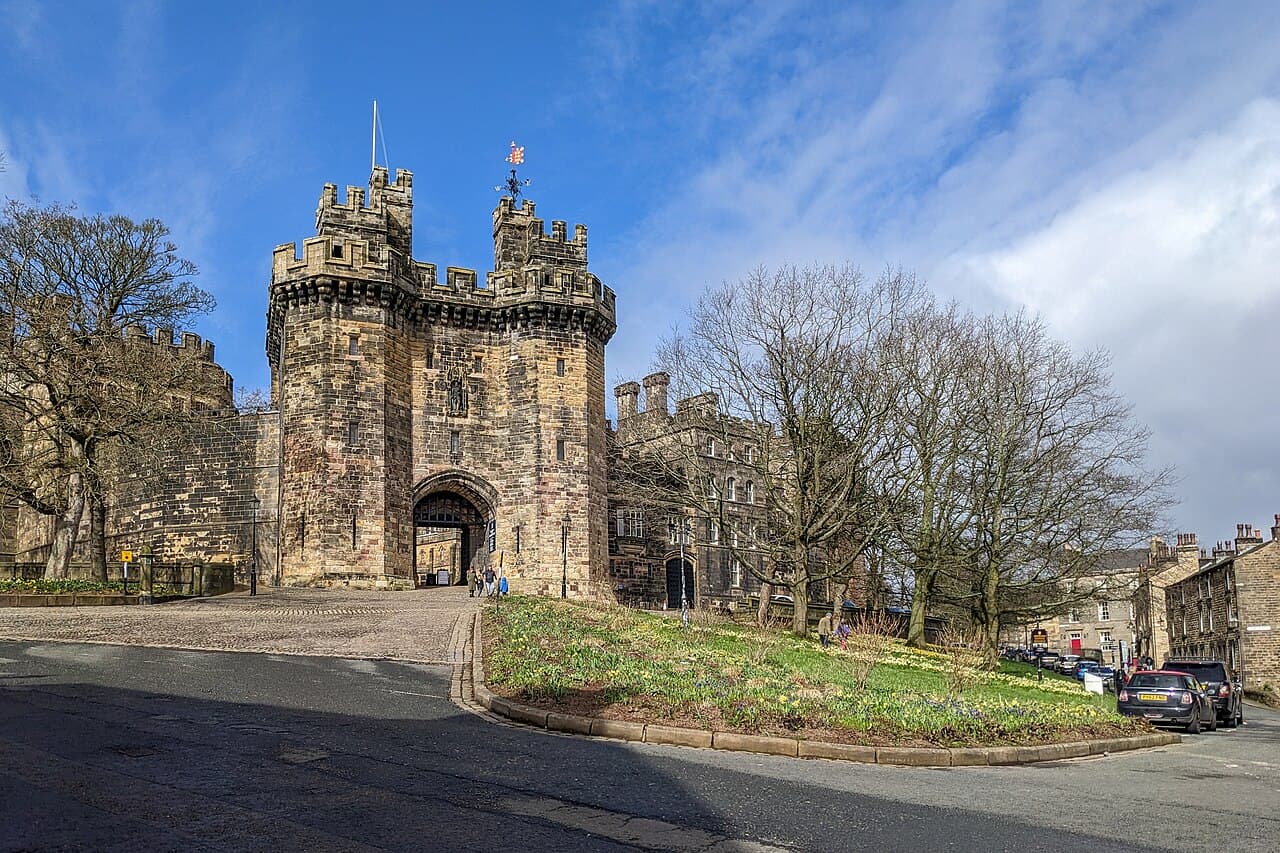
The castle’s gatehouse, built in the early 15th century during the reign of King Henry IV, remains one of its most impressive features. This tall structure features two semi-octagonal towers flanking the entrance passage, battlements, a portcullis, and the statue of John of Gaunt in a niche above the gate. The gatehouse contains multiple rooms, including the constable’s apartment.
Despite some demolition of walls and towers ordered after the Civil War, key structures such as the keep and gatehouse have survived intact. Archaeological investigations and tree-ring dating have confirmed phases of construction and renovation from the late 14th to early 15th centuries, providing valuable insights into the castle’s development.
The castle complex includes a courtyard open to visitors since 2013, with modern amenities such as a café integrated sensitively against the old curtain wall. Refurbishment projects between 2017 and 2019 transformed former prison spaces into educational and commercial areas, supporting the castle’s role as a public heritage site.
Historical significance and modern use
Lancaster Castle has played a vital role in the history of the Duchy of Lancaster, the county of Lancashire, and England as a whole. It was granted to Edmund, 1st Earl of Lancaster, by King Henry III in 1267, cementing its status as a seat of power and administration.
The castle remained a functioning prison until its closure in 2011. Since then, it has been managed by the Duchy of Lancaster and opened to the public as a tourist attraction. The castle’s connection to the monarchy was celebrated in 1999 and again in 2012 when Queen Elizabeth II visited to mark significant anniversaries of the Duchy.
Today, Lancaster Castle stands as a well-preserved example of high medieval military and civic architecture. Its layers of history, from Roman fortifications to Georgian courtrooms, offer visitors a comprehensive view of England’s evolving legal, military, and social landscape.
Frequently asked questions (FAQ)
- How do I get to Lancaster Castle?
- Lancaster Castle is conveniently located in the city of Lancaster, accessible by car, train, and bus. If you're coming by train, the castle is just a short walk from the Lancaster railway station. For those driving, there are nearby parking facilities available.
- What is the historical significance of Lancaster Castle?
- Lancaster Castle has a rich history dating back to the 11th century and has served various roles, including a royal fortress, a prison, and a court. It played a pivotal role in the English legal system and was the site of many significant trials, including those during the Pendle witch trials. Today, it stands as a symbol of Lancaster's heritage and a testament to its medieval past.
- When was Lancaster Castle built?
- Lancaster Castle was established in the 11th century, with its earliest structures likely constructed around 1093. Over the centuries, it has undergone numerous renovations and expansions, reflecting various architectural styles and historical periods. The castle's enduring presence makes it a fascinating subject of study for those interested in history and architecture.
- Can I take a guided tour of Lancaster Castle?
- Yes, guided tours of Lancaster Castle are available and provide an in-depth experience of its history and architecture. These tours are led by knowledgeable guides who share captivating stories and insights about the castle's past. It's advisable to book in advance, especially during peak tourist seasons.
- Why is Lancaster Castle considered an architectural gem?
- Lancaster Castle is renowned for its impressive blend of medieval and Victorian architecture, showcasing features such as the iconic gatehouse, the impressive Great Hall, and the well-preserved prison buildings. The castle's strategic location on a hill provides stunning views of the surrounding area, adding to its architectural charm. Its design reflects the importance of the castle throughout various historical periods.
- Is it possible to visit Lancaster Castle with limited mobility?
- Yes, Lancaster Castle is committed to accessibility and offers facilities for visitors with limited mobility. While some areas may have historical constraints, there are accessible routes available, and staff are on hand to assist as needed. It is recommended to check in advance for any specific accessibility inquiries.
- What are the opening hours of Lancaster Castle?
- Lancaster Castle typically opens to visitors from 10 AM to 5 PM, with extended hours during the summer months. However, hours may vary on public holidays or for special events, so it's best to check the official website for the most current information before your visit. Planning ahead ensures you make the most of your time at the castle.
- What are the ticket prices for Lancaster Castle?
- Ticket prices for Lancaster Castle vary depending on age and whether you choose a guided tour. As of now, standard adult tickets are priced around £10, with discounts available for children, seniors, and families. Tickets can be purchased on-site or through the official website, where you may find special offers or promotions.
- When is the best time to visit Lancaster Castle?
- The best time to visit Lancaster Castle is during the spring and early autumn months when the weather is generally mild and pleasant. These seasons also see fewer tourists compared to the summer, allowing for a more relaxed experience. Additionally, special events often take place during these times, enhancing your visit.
- Are there any nearby attractions to explore after visiting Lancaster Castle?
- Yes, Lancaster Castle is surrounded by several attractions worth exploring, including the beautiful Williamson Park and the impressive Ashton Memorial. The city of Lancaster itself offers a variety of shops, restaurants, and cultural sites, such as the Lancaster Maritime Museum and the Judges' Lodgings. A visit to these nearby sites can enrich your overall experience in the area.
Photo gallery

Information
Website
Visit websiteSources & official resources
Verify the information above using these authoritative references.
Loading map...
Visitor reviews
No reviews yet. Been here? Write the first review and help other travelers!
Write the first reviewVisited this castle? Share your experience
Your review helps other travelers and adds first-hand knowledge to our encyclopedia.