Lamego Castle
Lamego Castle, locally known as Castelo de Lamego, is a commanding medieval fortress perched on a rocky spur between the Leomil and Meadas mountains in the Douro region of Portugal. Its strategic location overlooking the surrounding hills and vineyards has made it a vital stronghold throughout centuries of Iberian history. The castle's origins trace back to a fortified settlement during the Roman and Visigothic periods, with archaeological evidence indicating local coin minting under King Sisebut in the early 7th century. This early medieval site underscores Lamego's longstanding importance as a military and administrative center.
During the 8th century, the Moors reinforced the castle's defenses and established it as a regional administrative hub. In 1057 or 1058, King Ferdinand I of León besieged and captured the fortress, reportedly requiring siege towers to overcome its formidable walls. Following this conquest, the Muslim governor was permitted to retain control under allegiance to León. However, during the Christian reconquest of Portugal, the Muslim governor Echa Martim rebelled, prompting Count Henry of Burgundy to capture Lamego and restore Christian rule.
Early origins and roman influence
The site of Lamego Castle was originally a prehistoric hillfort, likely inhabited by the Lacão people around the 5th century B.C., highlighting its early strategic significance. Under Roman rule, the settlement known as Lameca was rebuilt by order of Emperor Trajan in the 2nd century A.D. By the 4th century, Lameca had gained the status of a civitas, reflecting its administrative importance. The early presence of Christianity is evidenced by the construction of religious buildings such as the Basilica of São Pedro de Balsemão during the 6th and 7th centuries, coinciding with the Visigothic period when Lamego served as a bishopric seat.
Medieval fortifications and political history
The castle's main keep and upper enclosure were likely rebuilt under King Sancho I (1185–1211), who granted Lamego its first charter, marking a significant phase in its medieval development. The outer walls enclosing the lower town were added later under King Afonso III, incorporating key gates such as the Sun Gate (Porta do Sol) and Fig Gate (Porta dos Figos). These fortifications were part of a defensive network alongside castles like Numão, Penedono, Trancoso, and Marialva, securing the upper Douro valley and controlling vital routes to the Beira frontier and the Spanish Meseta.
Throughout the medieval period, the castle was governed by notable figures including the alcalde Abril Peres de Lumiares and the influential Coutinho family, who contributed to its architectural evolution. The 15th century saw modifications such as the addition of a window to the keep tower by Francisco Coutinho, 4th Count of Marialva, reflecting changing residential and defensive needs.
Sieges and reconquest
Lamego Castle witnessed several key military events during the Christian reconquest. The first Christian capture occurred in 910 by Ordoño II of Galicia, but the fortress was retaken by Muslim forces under Almanzor in 997. The decisive siege by Ferdinand I of León in 1057 culminated in Christian control, after which the castle became part of the dowry of Teresa of León upon marrying Henry of Burgundy, integrating it into the County of Portugal's holdings.
Architectural features and layout
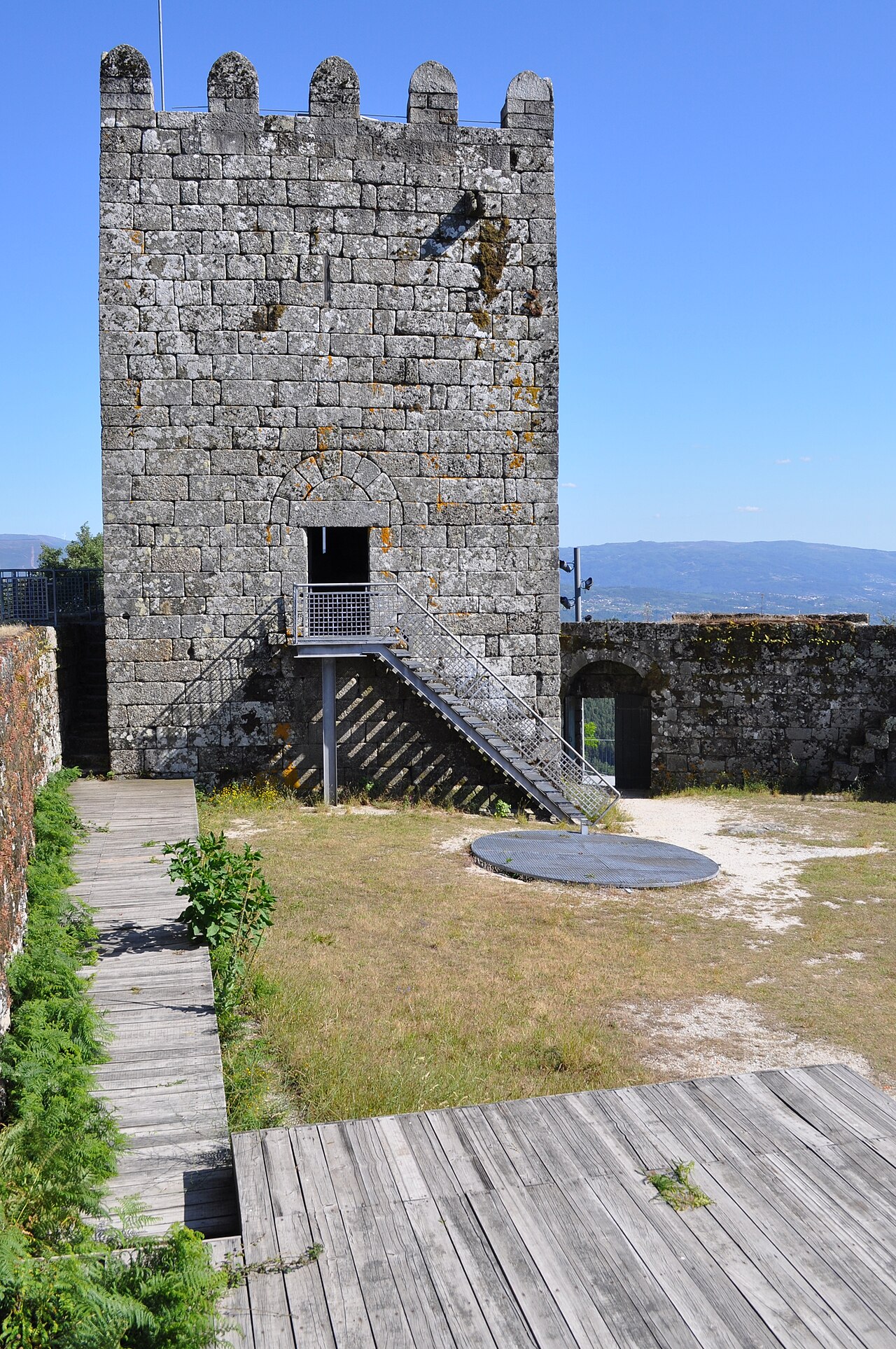
The castle occupies an irregular polygonal plan adapted to the natural granite and schist rock formations atop a hill approximately 543 meters above sea level. Its defensive perimeter consists of two lines of walls. The inner wall encloses the main fighting area or citadel, featuring battlements and a prominent east-facing gateway with a broken arch. The outer wall extends at a lower elevation, curving southward to protect additional space around the town.
A dominant architectural feature is the rectangular keep tower, rising three stories with thick masonry walls and crenellated battlements. Originally accessed via a door elevated two to three meters above ground for defensive purposes, the tower now has ground-level entry. Narrow arrow slits and several windows, some dating from late 16th-century renovations, punctuate the tower. The mid-level window added in the late 15th century illustrates evolving architectural styles and functional adaptations.
Gates and defensive structures
The outer wall includes significant gates such as the Porta da Vila (also known as Porta dos Figos, Porta do Norte, and Porta dos Fogos), flanked by a square and a circular tower, providing layered defense. Adjacent to this gate is a recessed arched doorway topped by a small wooden oratory with a staircase leading to a balcony that once housed a bell, linked to the tower of the old municipal hall. The southern Porta do Sol features a broken arch entrance with an epigraphic niche, likely for inscriptions or religious symbols.
The cistern and water management
One of the castle's most remarkable features is a large vaulted cistern located below the walls along Rua da Cisterna. Measuring about 20 by 10 meters, it showcases a ribbed ogival ceiling supported by four stone arches resting on pillars. This cistern includes a small light opening and an internal staircase, exemplifying medieval ingenuity in ensuring a reliable water supply during sieges. It is among the best-preserved medieval cisterns in Portugal.
Later history and conservation
In the 17th century, the castle saw additions such as a window above the Sun Gate dated 1642 and a niche dedicated to Nossa Senhora da Graça commissioned by António de Castro. The castle hosted the Cortes convened by King Pedro II in 1679, one of the last royal assemblies held in a medieval fortress. Over subsequent centuries, various maintenance projects included the installation of prison grates, bells, and plastering works.
By the 19th century, parts of the fortifications were repurposed for residential use, and one tower was dismantled. In the 20th century, public conservation efforts by Portugal's Directorate-General for National Buildings and Monuments (DGEMN) focused on clearing annexed structures, strengthening walls, and restoring sections of the castle from 1940 through 1991. Since 1976, the site has been maintained by the Portuguese Scouts Group No. 49, who also guard the castle.
Recognized for its historical and architectural significance, Lamego Castle was classified as a National Monument on June 23, 1910. Today, visitors can explore its walls, gates, keep, and the impressive cistern. A small exhibition inside the keep provides insights into the castle's rich history, although access to the keep's roof is restricted. The castle remains a vivid testament to Portugal's medieval heritage and its complex history of conquest, defense, and governance.
Frequently asked questions (FAQ)
- How do I get to Lamego Castle?
- Lamego Castle is located in the heart of Lamego, Portugal, and can be easily reached by car or public transport. If you're coming from the nearby city of Peso da Régua, consider taking a bus that connects these two locations. There are also several parking options available near the castle for those driving.
- What is the historical significance of Lamego Castle?
- Lamego Castle dates back to the 12th century and played a crucial role in the Reconquista, serving as a stronghold for Christian forces against the Moors. The castle is a symbol of the city's medieval heritage and has witnessed significant historical events throughout the centuries. Today, it stands as a testament to Portugal's rich history and architectural evolution.
- When was Lamego Castle built?
- Lamego Castle was constructed in the 12th century, with its origins linked to the early Christian reconquest of the Iberian Peninsula. The castle underwent various renovations and expansions over the centuries, reflecting the architectural styles of different periods. Its well-preserved structure allows visitors to appreciate its historical significance.
- Can I enter Lamego Castle?
- Yes, visitors can enter Lamego Castle to explore its impressive walls and enjoy panoramic views of the surrounding area. The castle grounds are open to the public, allowing you to walk along its battlements and soak in the historical atmosphere. However, some areas may be restricted for preservation purposes.
- Why is Lamego Castle a popular tourist attraction?
- Lamego Castle is popular among tourists due to its stunning architecture and breathtaking views of the Douro Valley. The castle's rich history and strategic location make it a fascinating destination for history buffs and casual visitors alike. Additionally, its proximity to other attractions in Lamego, such as the Sanctuary of Nossa Senhora dos Remédios, enhances its appeal.
- Is it possible to visit Lamego Castle year-round?
- Yes, Lamego Castle is open to visitors year-round, although specific opening hours may vary by season. It is advisable to check the local tourism website for the most current information regarding visiting hours. Visiting during spring and fall can provide a more pleasant experience, as the weather is typically mild.
- What are the ticket prices for visiting Lamego Castle?
- Entry to Lamego Castle is often free, making it an accessible attraction for all visitors. However, some guided tours or events may have a fee, so it's best to check in advance for any special activities. This makes it a great option for budget-conscious travelers looking to explore Portugal's history.
- What is the best time to visit Lamego Castle?
- The best time to visit Lamego Castle is during the spring and fall months when the weather is milder and the tourist crowds are smaller. This allows for a more enjoyable experience as you explore the castle's grounds and take in the views. Additionally, the surrounding landscape is particularly beautiful during these seasons.
- Are there any nearby attractions to Lamego Castle?
- Yes, Lamego Castle is close to several other attractions, including the Sanctuary of Nossa Senhora dos Remédios, which features stunning baroque architecture. The city is also known for its wine production, and nearby vineyards offer tastings and tours. Exploring the charming streets of Lamego can also reveal local shops and restaurants that enhance your visit.
Information
Address
R. do Castelo, Lamego, Portugal
Loading map...
Visitor reviews
No reviews yet. Been here? Write the first review and help other travelers!
Write the first reviewVisited this castle? Share your experience
Your review helps other travelers and adds first-hand knowledge to our encyclopedia.