Laiuse Castle Ruins
Laiuse Castle stands as a significant example of a late-medieval hill castle in Estonia, renowned for its early adaptation to firearms warfare. Located in Laiusevälja within the Jõgeva municipality, this fortress was originally constructed by the Livonian Order around the end of the 14th century, with its first documented mention dating to 1406. The castle's strategic position atop a hill allowed it to serve as a formidable defensive stronghold in the turbulent Baltic region throughout the Middle Ages and into the early modern period.
Early construction and architectural evolution
The initial structure of Laiuse Castle likely began as a manor house or an expanded tower measuring approximately 21 by 12 meters, situated on the western corner of the hilltop. Over time, the castle expanded into a large courtyard fortress with a roughly trapezoidal layout, conforming to the natural contours of the hill. The irregular sides of the enclosure range between 60 and 85 meters in length, enclosing the summit area effectively.
One of the castle's most distinctive architectural features is its wall construction method, which employs timber posts connected by supporting arches known as Schwibbogen. This unusual technique in castle building may have been a resource-saving measure or a response to urgent defensive needs. The walls were repeatedly reinforced throughout the Middle Ages, eventually reaching heights of around 15 meters, making them a formidable barrier against attackers.
Artillery fortifications and towers
In response to the evolving nature of warfare, especially the introduction of gunpowder and cannons, Laiuse Castle underwent significant modernization in the late 15th or early 16th century. Three major round towers were added to enhance its artillery defenses. Two large cannon towers, approximately 14 meters in diameter with walls up to 4 meters thick and standing roughly 25 meters tall, were constructed at the northwest and southeast corners. These towers were specifically designed to accommodate heavy artillery and withstand bombardment.
A smaller hook gun tower was built at the northeast corner, measuring about 12 meters wide with walls around 1.5 meters thick and rising over 15 meters high. This tower was intended for smaller firearms, providing a versatile defensive position. Additionally, a small octagonal tower projects outward from the western corner of the castle, a cantilevered structure stylistically similar to towers found in other medieval Estonian castles such as Narva and Paide, built in the early 1400s.
Historical significance and military role
Laiuse Castle played a pivotal role in the regional conflicts of the Baltic area, particularly during the Livonian War (1558–1583). The fortress endured multiple sieges and was captured by Russian forces in 1558 after a determined assault. Despite significant damage, the castle remained in use under various rulers, including the Polish-Lithuanian Commonwealth and later the Swedish Empire.
Following the Peace of Jam Zapolski in 1582, Laiuse became the administrative center of the Laiuse starostwo under Polish-Lithuanian rule. In the early 17th century, it was a contested site during the wars between Sweden and the Polish-Lithuanian Commonwealth. The castle was captured by Swedish troops in 1600 and again in 1622, suffering damage including the probable demolition of parts of the northeastern and southeastern sections and the southern artillery tower.
During the Great Northern War (1700–1721), Laiuse Castle gained further prominence when King Charles XII of Sweden established his winter quarters there from 1700 to 1701, following the Battle of Narva. For five months, the castle served as the administrative center of the Swedish Empire. However, subsequent fighting between 1702 and 1704 inflicted further destruction, leading to the castle's abandonment.
Layout and structural features
The castle's buildings were primarily arranged along the inside of the western and southern walls. The western wing extended along the entire wall, while the southern wing's constructions covered only the southeastern side. Access to the fortress was through two gates: the main gate, located in the middle of the northwest wall, remains preserved today; a secondary gate at the southern end of the southwest wall was later sealed.
The fortress was surrounded by a water-filled moat supplied by the nearby Laiuse stream. A dam and watermill were situated to the northeast, and between the castle and the mill lay an outer bailey—a fortified courtyard enclosed by wooden palisades and crossed by drawbridges over the moat. A medieval road likely passed near the northern cannon tower, providing access close to the outer bailey.
The walls are constructed mainly of fieldstones and limestone, with brick used notably in the vaults and the external façades of the northwest cannon tower. This combination of materials contributed to the castle's robustness and aesthetic.
Current condition and preservation
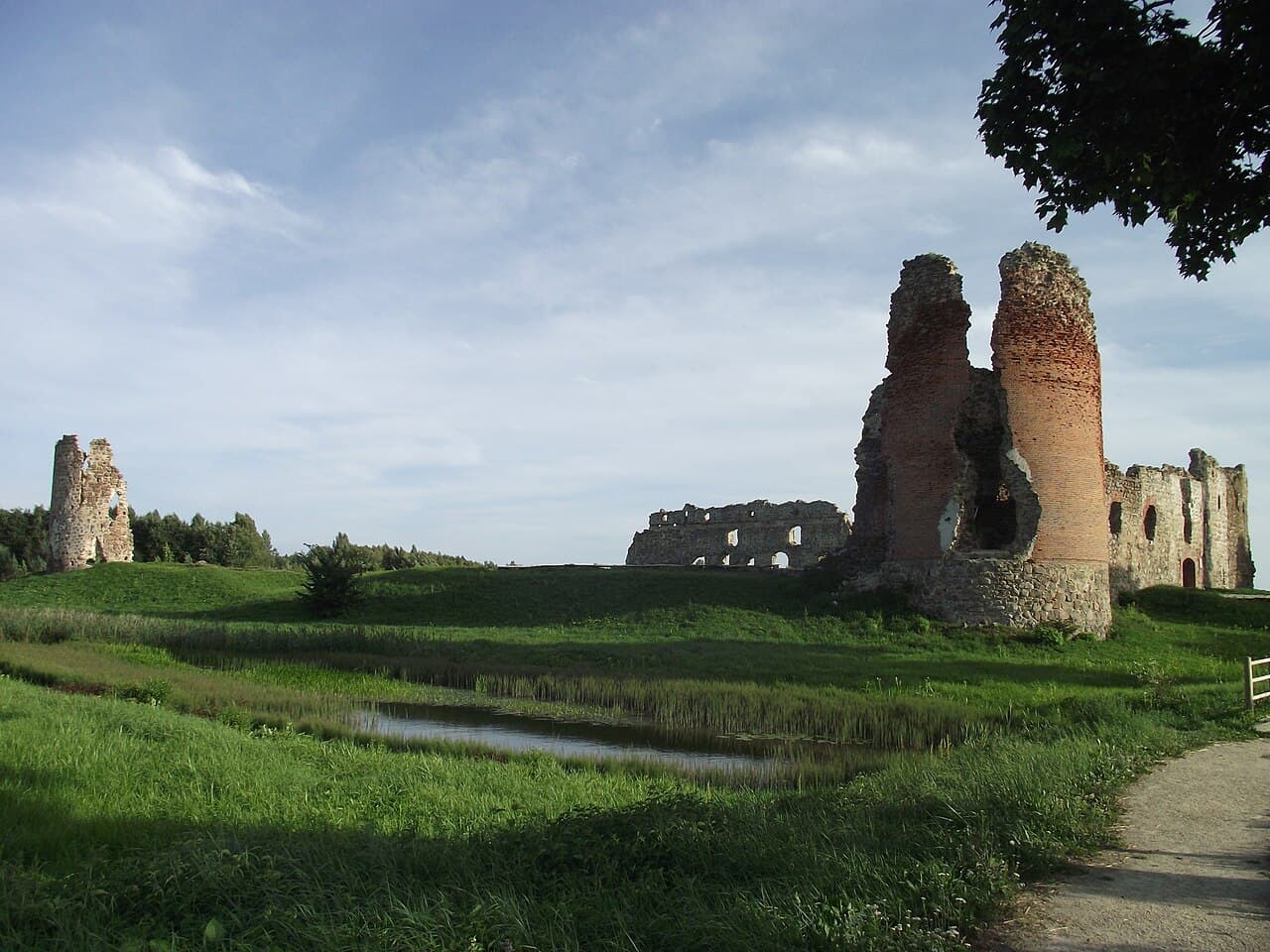
Today, Laiuse Castle exists as partially preserved ruins that have been stabilized for conservation and public education. The most intact sections include the fully preserved outer wall of the northwest wing, featuring window and gate openings; much of the northern cannon tower; portions of the hook gun tower at the northeast corner; and fragments of the southwestern wall. Informational signage and protective measures help visitors appreciate the castle's historical and architectural significance.
The ruins serve as a cultural heritage monument in Estonia, attracting historians, archaeologists, and tourists interested in medieval military architecture and Baltic history.
Cultural and historical legacy
Laiuse Castle is a testament to the dynamic history of the Baltic region, reflecting the military innovations and political shifts from the late medieval period through the early modern era. Its adaptation for firearms marks it as a pioneering fortress in Estonia. The castle's role as a military stronghold, administrative center, and royal winter quarters underscores its multifaceted importance.
Today, Laiuse Castle ruins provide valuable insights into medieval fortification techniques, Livonian Order architecture, and the complex history of warfare and governance in Estonia. The site remains a symbol of resilience and historical continuity in the region.
Frequently asked questions (FAQ)
- How do I get to Laiuse Castle ruins?
- Laiuse Castle ruins are located in Laiusevälja, near the town of Jõgeva in Jõgeva County, Estonia. Visitors can reach the site by car or local transport, with signage directing to the ruins from the main roads.
- What is the historical significance of Laiuse Castle?
- Laiuse Castle was the first castle in Estonia designed to withstand firearms and played a key role during the Livonian War and the Great Northern War. It also served as King Charles XII's winter quarters, marking its importance in regional history.
- Is Laiuse Castle accessible to visitors year-round?
- The ruins of Laiuse Castle are open to visitors year-round, though accessibility may vary in winter due to weather conditions. There are informational signs and maintained paths to help visitors explore the site safely.
- Can I explore the entire castle grounds?
- While much of Laiuse Castle is in ruins, the main outer walls, towers, and gate remain accessible. Some areas may be restricted for safety reasons, but visitors can explore the majority of the preserved structures and learn about the castle's history on site.
- Are there guided tours available at Laiuse Castle?
- Guided tours are occasionally offered by local heritage organizations and during special events. Visitors are advised to check with the Jõgeva municipality or local tourist information centers for current tour availability.
Photo gallery

Information
Current owner
State heritage authorities
Loading map...
Visitor reviews
No reviews yet. Been here? Write the first review and help other travelers!
Write the first reviewVisited this castle? Share your experience
Your review helps other travelers and adds first-hand knowledge to our encyclopedia.