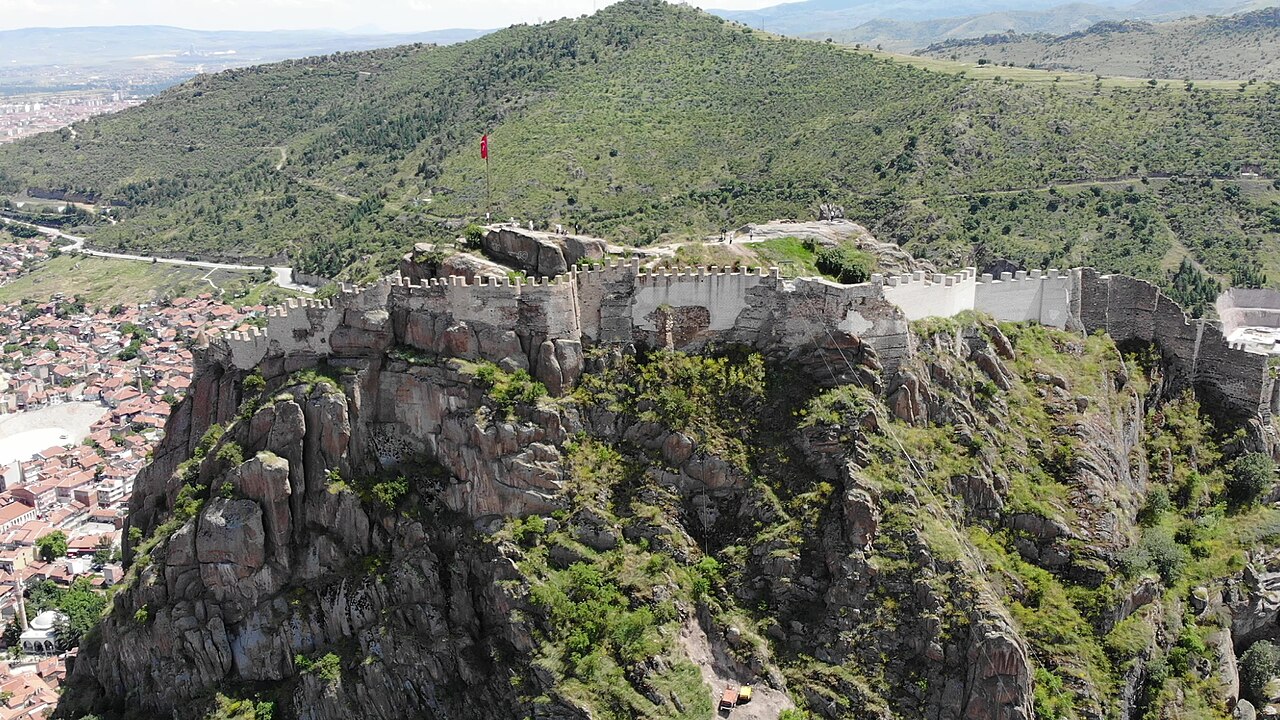
Kutahya Castle
Kutahya Castle stands prominently in the municipality of Maruf, Kütahya, Turkey, as a testament to centuries of strategic military architecture and regional governance. Originally constructed by the Byzantine Empire, this hill castle occupies a commanding position atop a steep rocky hill, overseeing the city below and controlling vital routes through the region. Its enduring presence reflects the layered history of Anatolia, where Byzantine and Ottoman influences meld in a complex fortress complex.
The castle's strategic location on a rocky hill composed of striking blue and reddish stone provides natural defenses, with sheer cliffs on four sides and walls rising directly from these precipitous drops. This natural fortification negated the need for a moat around the main fortress, enhancing its defensive capabilities. The fortress takes a roughly pentagonal shape, with its walls extending about three thousand meters and punctuated by closely spaced towers. The towers are spaced at intervals approximately equal to two arm lengths, creating a continuous and formidable ring of fortifications encircling the hilltop.
Byzantine origins and early history
The initial construction of Kutahya Castle dates back to the Byzantine period, when it was established as a military stronghold to secure the region and control the city beneath. Its elevated position was ideal for surveillance and defense against invading forces. The castle's robust walls and natural topography made it a key defensive site in the Byzantine military network across Anatolia.
Ottoman period: military and administrative significance
Following the decline of Byzantine control, Kutahya Castle came under Ottoman rule, where it retained its military importance. The fortress was managed by a dizdar, a fortress commander appointed by imperial decree who held a hereditary land grant known as ocaklık. The dizdar received income from local taxes and commanded a garrison of 119 tımarlı müstahfiz soldiers. These soldiers were responsible for the castle's defense and also participated in military campaigns beyond the fortress.
The castle's staff included several key officials essential for its operation: a steward (kethüda), artillery chief, armorer chief, jailer, and gatekeeper. This administrative structure ensured the fortress functioned not only as a military bastion but also as a center of local governance and justice.
Military reforms and garrison life
During the late 17th to early 19th centuries, the Ottoman military underwent significant reforms, including the establishment of the Nizam-ı Cedid, a modernized army unit based in Üsküdar, Istanbul. Some soldiers from Kutahya Castle were linked to this new military organization, reflecting the castle's ongoing strategic relevance.
The fortress also served a judicial role, functioning as a prison for local offenders and external criminals. Notably, the sons of Gediz Voyvoda Nasuhzâde Nasuh were imprisoned here under the guard of fifty soldiers, illustrating the castle's role in regional law enforcement and security.
Inspection and administration
The castle was subject to regular inspections by the Anatolian governor, at least annually. These inspections evaluated the condition of the garrison, the state of prisoners, the artillery, and munitions. Officials who failed to maintain standards were held accountable, underscoring the fortress's importance in Ottoman regional administration.
Architectural features and expansions
A significant architectural addition during the reign of Sultan Mehmed II was the construction of the Aşağı Kale or Lower Castle. This lower enclosure was built to protect the Ilıpınar spring within the castle complex, ensuring a reliable water supply during sieges. The Lower Castle includes about twenty houses and a small mosque, indicating a settled community living within the fortress walls.
Main fortress and inner castle
The inner castle, or quadrangular citadel, housed the residences of the dizdar and other key officials, a mosque, granaries, and living quarters. This inner section supported a population that occasionally experienced social tensions with the lower city residents, as evidenced by disputes over resources such as butchers' liver supplies. These conflicts were resolved through imperial edicts, reflecting the castle's active and complex community life.
The main entrance to the fortress faces east and is notable for its three-story iron door, flanked by ornate white marble lion statues. These lions serve both symbolic and defensive functions, overlooking the city below. Nearby, a guardhouse provides commanding views for monitoring the surrounding area.
In contrast, the gate to the inner castle is wooden and reinforced with buffalo hide rather than iron, highlighting different construction techniques within the fortress. Beyond this gate lies a courtyard containing two water cisterns, essential for storing water during sieges and daily use. Surrounding the courtyard are important structures including a mosque, residences for the fortress commander (dizdar), imam, muezzin, steward, two wheat granaries, and eight houses, forming a compact but functional community.
Defensive installations
The castle's defenses included two armories and two artillery emplacements. Historical records from 1817 list seventeen cannons, including howitzers and mortars. Two cannons positioned on the southeast and northeast sides of the fortress were traditionally fired during Ramadan, reflecting Ottoman military customs linked to religious observances.
Architectural heritage from the Germiyan period
On the northeast side of the castle stands the Kale-i Bâlâ Mosque and a fountain, both attributed to the Germiyan period. These structures add layers of cultural and architectural significance, illustrating the castle's evolution through different ruling eras and its role as a religious and community center.
Current remains and archaeological significance
Today, Kutahya Castle remains a striking example of layered Anatolian fortification architecture. Its walls and towers, built of distinctive blue and reddish stone, continue to dominate the skyline. The castle's roughly pentagonal shape, natural cliff defenses, and integrated community spaces offer valuable insights into medieval and early modern military and social organization.
The Lower Castle's moat and settlement remnants, along with the main fortress's robust defenses and administrative buildings, highlight the castle as a multifunctional complex. This site not only served military purposes but also housed a community engaged in governance, religion, and daily life under the watchful eye of Ottoman authorities.
As a cultural heritage site, Kutahya Castle offers historians, archaeologists, and visitors a tangible connection to the Byzantine and Ottoman eras in Turkey. Its preserved structures and archaeological remains continue to inform studies of fortification design, military history, and regional administration in Anatolia.
Frequently asked questions (FAQ)
- How do I get to Kutahya Castle?
- Kutahya Castle is located in the city of Kütahya in Kütahya Province, Turkey. It is accessible by local transport or car, with clear signage leading to the hilltop fortress.
- What are the opening hours for visiting Kutahya Castle?
- The castle is open to visitors daily from 09:00 to 17:00, allowing ample time to explore the extensive grounds and architectural features.
- Is there an entrance fee to Kutahya Castle?
- Entrance to Kutahya Castle is free, making it an accessible historical site for all visitors interested in Byzantine and Ottoman heritage.
- What architectural styles are visible at Kutahya Castle?
- Kutahya Castle showcases a mix of architectural styles, including Byzantine military construction and Ottoman-era expansions, with elements from the Germiyan period as well.
- Can I explore the Lower Castle area of Kutahya Castle?
- Yes, visitors can explore the Lower Castle (Aşağı Kale) area, which includes the Ilıpınar spring, historic houses, and a small mosque, connected to the upper fortress by pathways.
- Why was the Lower Castle added to Kutahya Castle?
- The Lower Castle was built during Sultan Mehmed II's reign to protect the Ilıpınar spring, ensuring a secure water supply during sieges, a critical feature for fortress sustainability.
Information
Opening hours
09:00-17:00, daily
Ticket prices
Free
Current owner
Municipality
Loading map...
Visitor reviews
No reviews yet. Been here? Write the first review and help other travelers!
Write the first reviewVisited this castle? Share your experience
Your review helps other travelers and adds first-hand knowledge to our encyclopedia.