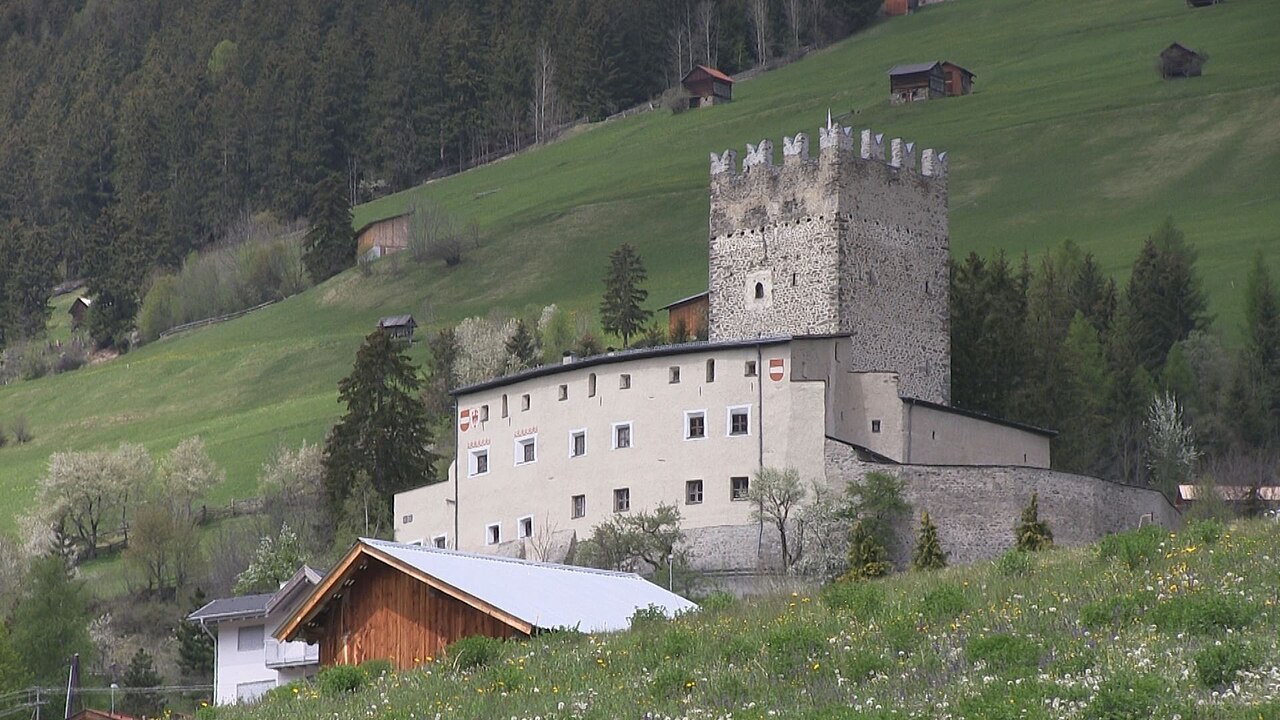
Kronburg Castle stands as a significant medieval fortress located near the municipality of Zams in the Austrian state of Tyrol. Constructed in the late 14th century, this hill castle occupies a commanding rocky outcrop approximately 350 meters above the Inn Valley, at an elevation of 1,066 meters. Its strategic position provided extensive views over the surrounding landscape, making it a vital stronghold in the region during the Middle Ages.
The origins of Kronburg Castle date back to around 1380, when Hans von Starkenberg, a member of the Austrian nobility, obtained approval from Duke Leopold III to establish the fortress. The castle was built on a steep rocky promontory east of Zams, designed primarily for defensive purposes and to assert noble control over the Tyrolean territory. The initial owners, the Starkenberg family, played a prominent role in the castle's early history, although their fortunes changed following political upheavals.
Historical context and ownership transitions
In 1423, after the Starkenberg family's unsuccessful uprising against Duke Friedrich IV, the castle was seized by ducal forces. This event marked a significant shift in control, as the castle then served as an administrative center under appointed ducal officials. Records from 1434 mention Vrban Sigwein as one such official, highlighting the castle's role in regional governance.
Throughout the 15th century, ownership of Kronburg Castle changed hands multiple times, often through financial arrangements. In 1485, Archduke Sigismund pawned the castle to Ruprecht von Rindsmaul, a canon at Salzburg Cathedral. Subsequently, in 1502, the castle was redeemed by Emperor Maximilian I, who granted it as a fiefdom to Hans Fieger the Middle, a member of his council. Under the Fieger family, the estate saw notable religious developments, including the construction of a chapel below the castle in 1673, which was later expanded into a pilgrimage church by 1715.
Following the extinction of the Fieger lineage in 1802, Kronburg Castle reverted to state ownership. The castle's history during the Napoleonic era was marked by brief Bavarian control before it was sold to a local farmer, Sebastian Stocker. Later, in 1845, a chaplain named Krismer acquired much of the estate and established a monastery adjacent to the church. An attempt to found a school for religious brothers in 1858 was short-lived, closing after just one year.
In 1860, the Poor School Sisters of Munich purchased the castle and its grounds, only to sell it seven years later to the Third Order Sisters. Declining membership led to the merger of this congregation with the Hallein School Sisters in 1952. More recently, in 2004, the castle was offered for sale again, but local authorities rejected proposals for private division and sale. Since December 2005, the Sisters of Mercy of Zams have assumed stewardship of the property, preserving its historic legacy.
Architectural features and castle layout
Kronburg Castle is characterized by its division into two main sections: the outer bailey (Vorburg) and the principal castle (Kernburg). The castle's position on a steep rocky outcrop provided natural defensive advantages, enhanced by its robust stone construction and strategic design.
Outer bailey
The outer bailey is enclosed on three sides by crenellated stone walls, accessed via a narrow path originating near a local guesthouse. These walls, constructed with carefully layered masonry, include a gateway leading into the courtyard. Along the southern section, double rows of post holes and traces of plaster indicate the former presence of a building, likely serving functional or residential purposes. The walls supported a battlement walkway, allowing defenders to patrol and surveil the surroundings effectively.
Principal castle complex
About 400 meters beyond the outer bailey lies the main castle complex, featuring a gatehouse with a gabled roof and a rounded arch portal marking the entrance. A semicircular shell tower projects from the southern wall, a curved fortification element designed to provide wider defensive angles against attackers. A protective wall runs along the southern approach to the palas, the main residential building of the castle.
On the northern slope overlooking the Inn Valley stands a partially preserved tower with battlements and narrow arrow slits. Its three masonry sides remain intact, exemplifying medieval defensive architecture. The palas itself rises five stories high, tapering as it ascends, constructed with finely hewn corner stones and stone window frames. The west side features two elongated arrow slits used by defenders to repel assaults.
A Romanesque-style portal on the left side of the palas leads into an inner courtyard, where vaulted ceilings remain visible on both the ground level and the first floor, showcasing impressive medieval stonework. Another rounded arch gate opens from the exterior into the courtyard, which contains four rows of post holes along the south side of the palas wall. These holes mark the former presence of battlements on the castle's second and third floors.
Within the courtyard, a door provides access into the palas. To the east, a dividing wall separates the courtyard and hints at two attached three-story residential buildings. This wall contains two gates: a smaller round-arched gate to the north and a larger Gothic-style gate in the southern section. Vaulted structures once stood within the courtyard but have since collapsed, and the full layout of the southern area remains uncertain due to an oriel window projecting from the northern building into the courtyard, suggesting extensions beyond the main walls.
Defensive and religious significance
Kronburg Castle's design reflects a blend of residential, defensive, and religious functions. Its strategic location and robust fortifications underscore its military importance during the late medieval period. The presence of a chapel and later pilgrimage church below the castle highlights the site's religious significance, serving both the castle's inhabitants and the local community.
The castle's battlements, towers, and arrow slits exemplify the defensive architecture typical of 14th and 15th-century hill castles in the Tyrol region. The semicircular shell tower and the palas' multiple floors with arrow slits allowed defenders to cover a wide range of approaches. The vaulted ceilings and stone portals within the castle demonstrate the craftsmanship and architectural sophistication of the period.
Preservation and current status
Today, Kronburg Castle remains a well-preserved ruin and a protected historic monument. Its walls, towers, and courtyards offer valuable insights into medieval castle construction and life in the Tyrol region. The castle is accessible to visitors who can explore its outer bailey and main complex, appreciating its architectural features and panoramic views over the Inn Valley.
The stewardship by the Sisters of Mercy of Zams ensures ongoing preservation efforts, maintaining the castle as a cultural heritage site. Visitors interested in medieval history, architecture, and the Tyrolean landscape find Kronburg Castle a compelling destination that combines natural beauty with rich historical significance.
Frequently asked questions (FAQ)
- How do I get to Kronburg Castle from Zams?
- Kronburg Castle is located a few kilometers east of Zams. Visitors can reach the castle by car or on foot via marked hiking trails that lead to the steep rocky outcrop where the ruins stand.
- What is the historical significance of Kronburg Castle?
- Kronburg Castle was a strategic stronghold in the Tyrol region during the late medieval period, serving military, administrative, and religious functions. Its history reflects important regional power struggles and noble ownership changes.
- Can I explore the ruins of Kronburg Castle?
- Yes, the castle ruins are accessible to visitors. You can explore the outer bailey, main castle complex, and enjoy panoramic views of the Inn Valley. However, some areas may be restricted due to preservation efforts.
- When is the best time to visit Kronburg Castle?
- The best time to visit Kronburg Castle is during the warmer months from late spring to early autumn when hiking trails are accessible and the weather is favorable for outdoor exploration.
- Is there an entry fee to visit Kronburg Castle?
- Currently, there is no information about an entry fee for visiting Kronburg Castle. It is advisable to check locally for any updates on ticketing or guided tours before planning your visit.
Information
Current owner
Sisters of Mercy of Zams
Loading map...
Visitor reviews
No reviews yet. Been here? Write the first review and help other travelers!
Write the first reviewVisited this castle? Share your experience
Your review helps other travelers and adds first-hand knowledge to our encyclopedia.