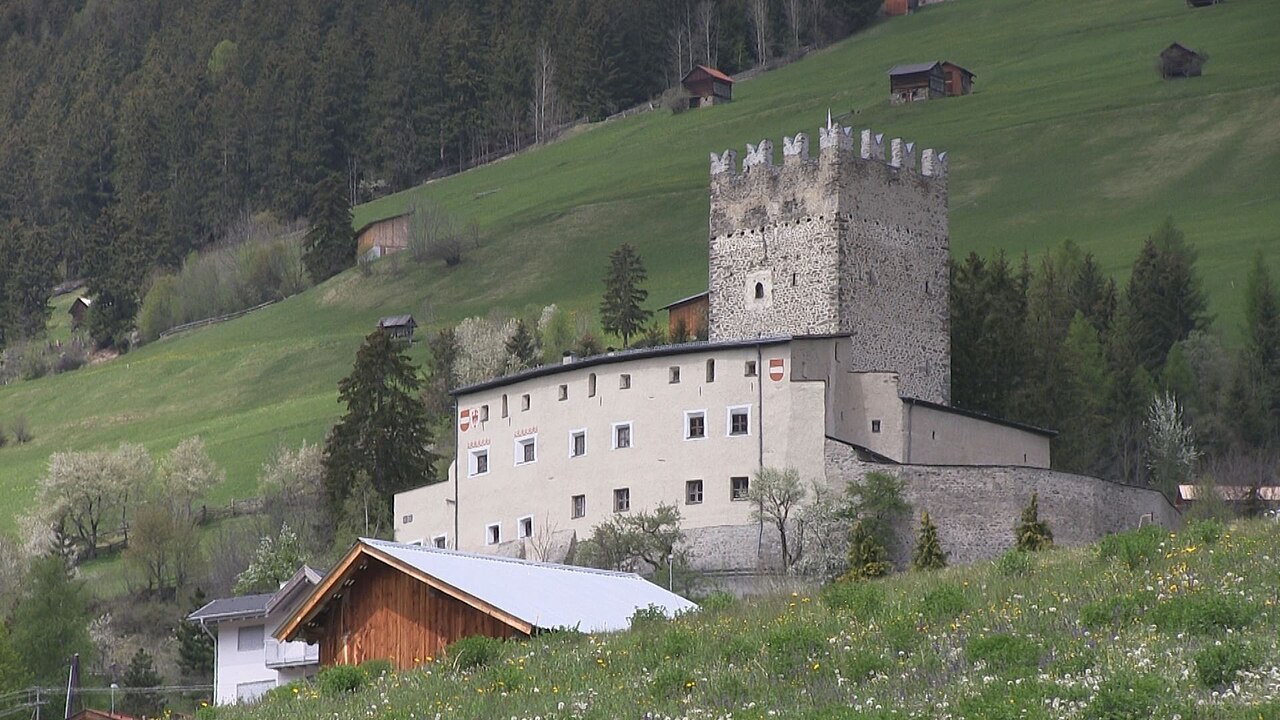
Burg Schrofenstein
Burg Schrofenstein is a remarkable medieval hill castle located near the community of Stanz bei Landeck in Tyrol, Austria. Perched at an elevation of approximately 1122 meters above sea level, it occupies a commanding position on a rocky outcrop, providing strategic oversight of the Perjen district and key mountain pass routes. This elevated placement was crucial for controlling the vital connections between the Vinschgau valley and the Arlberg and Fernpass areas, which were significant for trade and military movements during the medieval period.
Historical background and significance
Constructed in the medieval period by a Germanic civilization, Burg Schrofenstein was initially established to secure and monitor these important mountain passes. Early in its history, the castle was occupied by ministeriales, a class of unfree knights who served ecclesiastical or noble lords. These ministeriales originated from the region near Chur, reflecting the castle's integration into broader regional power networks. The castle also played an administrative role, functioning temporarily as a local court seat, which highlights its importance beyond purely military functions.
From the 13th century onward, Burg Schrofenstein became the hereditary seat of the von Schrofenstein family, a noble lineage established in Tyrol. This family maintained control over the fortress until their line ended in 1546. After the extinction of the Schrofenstein family, ownership passed to the counts and princes of Trautson, signaling a shift in territorial possession and reflecting the changing political landscape of the region.
Over subsequent centuries, the castle gradually fell out of active use, mirroring broader transformations in military technology and regional governance. By the 19th century, Burg Schrofenstein entered a phase of decline and partial ruin. Nevertheless, its most prominent surviving structure, the bergfried or main keep, has been subject to restoration efforts by a private owner, preserving a vital link to the castle's medieval past.
Architectural features and layout
Burg Schrofenstein is classified as a rock castle (Felsenburg), uniquely integrated into the natural rocky terrain of the mountainside. This type of construction maximizes natural defensive advantages by building directly onto a rocky outcrop. The castle's layout extends from the elevated bergfried down the slope to various service areas, illustrating a typical mountain stronghold adapted to challenging topography.
The bergfried
The bergfried is the castle's central fortified tower and was originally designed as a refuge during sieges. Standing about 12 meters high, this tower dominates the ruins and has been carefully restored to preserve its essential form. The bergfried's robust construction and elevated position provided both defense and a vantage point for surveillance over the surrounding landscape.
Service and economic areas
Approximately 50 meters downhill from the main castle ruins lie the remains of the stables, which were essential for housing horses and supporting the logistical needs of the fortress. Further down the slope toward Stanz is the area that once served as the economic courtyard (Wirtschaftshof). This space was used for daily operational activities such as storage, crafts, and possibly agricultural processing, reflecting the multifunctional nature of the castle complex.
Strategic importance and regional role
The castle's location near key mountain passes made it a critical point of control in Tyrol. Its oversight of the routes connecting the Vinschgau valley with the Arlberg and Fernpass ensured that Burg Schrofenstein played a significant role in regional defense and trade regulation. Control of these passes was vital for the movement of armies, merchants, and travelers, making the castle a linchpin in the area's medieval power dynamics.
Preservation and modern status
Today, Burg Schrofenstein stands as a partially preserved ruin, with the bergfried being the most prominent and well-maintained feature. The castle's difficult-to-reach location has helped protect it from extensive modern development, while restoration efforts by private owners have ensured that key architectural elements remain visible and accessible to visitors interested in medieval history and architecture.
The castle ruins offer valuable insights into the construction techniques and defensive strategies employed in alpine mountain castles. Visitors can explore the remnants of the fortified tower, stables, and economic courtyard, gaining an understanding of the castle's multifaceted role as a military, administrative, and residential center during the medieval period.
Architectural style and construction period
Burg Schrofenstein was built during the high to late medieval period, reflecting typical medieval hill castle architecture adapted to alpine terrain. Its classification as a rock castle emphasizes the integration of natural rock formations into its defensive design, a common feature in mountainous regions where terrain was used to enhance fortifications. The architectural style is primarily functional, focused on defense, with the bergfried serving as the key stronghold within the complex.
Frequently asked questions (FAQ)
- How do I reach Burg Schrofenstein?
- Burg Schrofenstein is located near Stanz bei Landeck in Tyrol, Austria. The castle ruins are situated on a rocky outcrop at high elevation and are difficult to access, so visitors should be prepared for a challenging hike and wear appropriate footwear.
- What is the historical significance of Burg Schrofenstein?
- Burg Schrofenstein was built in the medieval period to control important mountain passes connecting the Vinschgau valley with the Arlberg and Fernpass areas. It served as a military fortress, local court seat, and the hereditary seat of the von Schrofenstein family until 1546.
- Can I visit the bergfried at Burg Schrofenstein?
- The bergfried, or main keep, is the primary surviving structure of Burg Schrofenstein and has been restored by a private owner. Visitors can view the tower from outside, but access inside may be restricted for safety reasons.
- When was Burg Schrofenstein built?
- Burg Schrofenstein was constructed during the high medieval period, with origins likely in the 12th or 13th century, reflecting typical medieval hill castle architecture.
- Is Burg Schrofenstein accessible year-round?
- Due to its mountainous location and challenging terrain, accessibility to Burg Schrofenstein may be limited during winter months. The best time to visit is late spring through early autumn when hiking conditions are safer.
- Are there any nearby attractions to visit along with Burg Schrofenstein?
- Visitors to Burg Schrofenstein can also explore the nearby town of Stanz bei Landeck and the scenic mountain landscapes of Tyrol, which offer opportunities for hiking, skiing, and cultural experiences.
Information
Loading map...
Visitor reviews
No reviews yet. Been here? Write the first review and help other travelers!
Write the first reviewVisited this castle? Share your experience
Your review helps other travelers and adds first-hand knowledge to our encyclopedia.