Kożuchów
Kożuchów Castle stands as a significant example of late medieval hill castle architecture in Poland, embodying centuries of military, political, and religious history. Situated on a raised site surrounded by marshy meadows, the castle's origins trace back to the early 13th century when a wooden and earth fortification served as the seat of the local castellany. This early stronghold catalyzed the development of the adjacent settlement, which was granted town rights before 1273.
During the early 14th century, under the initiative of the Dukes of Głogów, the wooden fort was transformed into a stone fortress, marking the beginning of the castle's evolution into a formidable defensive structure. The construction of the castle coincided with the building of the town's fortifications, reflecting the strategic importance of Kożuchów in the region.
Architectural design and defensive features
The castle was originally designed on a nearly square plan measuring approximately 39 by 41 meters. It was enclosed by robust stone walls about 2.7 meters thick and 10 meters high, providing substantial defense against attackers. Along the walls ran a covered defensive gallery for guards, equipped with a parapet featuring arrow slits for archers. The main residential building was located in the northeast section of the castle, rectangular in shape (12 by 26.5 meters) and built with two stories, serving as the primary living quarters.
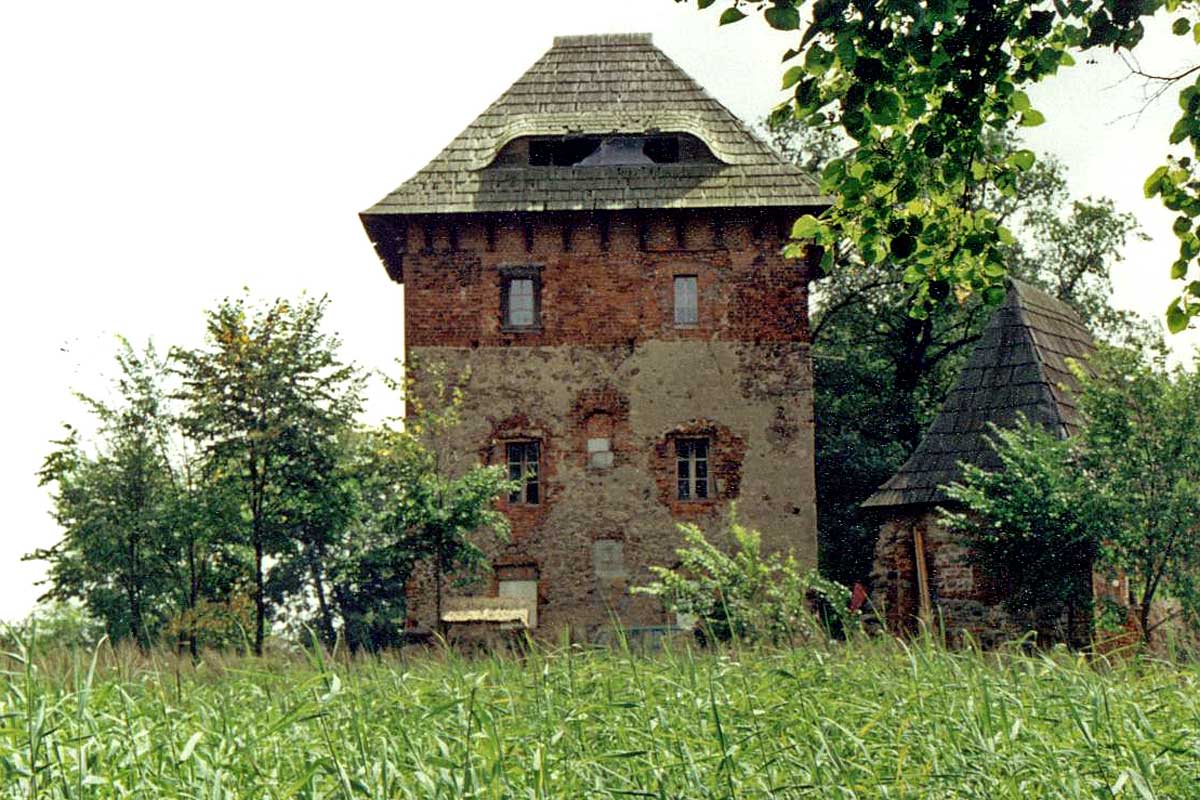
A smaller building occupied the northwest corner, while the southwest part of the courtyard housed a freestanding brick tower, which functioned as the castle’s last defensive bastion. This tower had a square base of 10 meters per side, transitioning to a cylindrical shape about 8 meters above ground level. The entrance to the tower was elevated, accessed from the upper floors. It likely had four stories, with walls 2.6 meters thick. The lowest level contained the notorious "hunger dungeon," accessible only through a ceiling opening, used for imprisoning captives under harsh conditions. The upper floors served as platforms for combat, equipped with arrow slits and topped with a crenellated parapet.
The castle’s southern entrance was defended by a wooden bridge spanning a 20-meter-wide moat, which was fed by water and separated the castle from the town, enhancing its defensive capabilities.
Historical developments and modifications
Following the occupation of Głogów by the Czech king in 1331, the Dukes of Głogów relocated their capital to Żagań and focused on strengthening their remaining castles, including Kożuchów. After the death of Duke Henryk V, Kożuchów became the seat of his son Henryk XVIII, nicknamed "the Sparrow." His presence led to significant modernization efforts, including the construction of a new western residential wing and a chapel. The eastern residential building and the tower were rebuilt, and the castle’s entrance was reinforced with a gatehouse measuring 13 by 8 meters, built on the inner side of the walls.
In the mid-15th century, possibly under Duke Henryk IX’s initiative, the castle was surrounded by a second ring of defensive walls approximately 8 to 10 meters from the original fortifications. The space between the walls was raised with earth to strengthen the defenses. The new walls featured semicircular two-story bastions at the corners, constructed of brick and stone. The upper levels were designed to accommodate artillery, while the lower floors had arrow slits for soldiers armed with handheld firearms, reflecting the evolving military technology of the period.
The castle witnessed significant military action during the succession wars following Duke Henryk XI’s death. In December 1476, the town was captured by Duke Jan II of Żagań, but the castle, defended by Brandenburg troops, withstood a siege until October the following year. Later conflicts involved King Matthias Corvinus of Hungary, whose forces seized Kożuchów after a brief siege in December 1488. The garrison resisted until spring of the next year before surrendering.
Transition under Jagiellonian and Habsburg rule
Between 1492 and 1505, the Duchy of Głogów came under the rule of the Jagiellonian dynasty, first under King John I Albert and later under Sigismund I the Old. After the transition to Habsburg control, Hans von Rechenberg became the castle’s owner and starost. Following his death in 1537, the castle was administered by various officials, including Hieronim Biberstein and Frederick II of Legnica.
During the Thirty Years' War (1618–1648), Kożuchów Castle changed hands multiple times, suffering considerable damage. After the war, the castle remained in ruins for nearly fifty years until it was entrusted to the Carmelite order in 1685 for conversion into a monastery.
Monastic transformation and later use
The Carmelites significantly altered the castle’s structure, partially demolishing the defensive walls and constructing new eastern and western wings. The western wing incorporated the lowered freestanding tower, while the southern wing included the gatehouse building. The entrance was relocated, and the wooden bridge was replaced by an earthen embankment. Between 1701 and 1706, the construction of a church led to the demolition of the southwest bastion and parts of the town walls. These renovations effectively erased the castle’s medieval defensive character, transforming it into a baroque monastic complex.
After the dissolution of the Carmelite order in 1810, the castle was taken over by the Prussian army and used as an armory until the late 19th century. During this time, the moat was drained and filled, and the bastion was demolished. From 1897 to 1945, the castle was used by the local Evangelical community. A renovation completed in 1984 adapted the castle for cultural purposes.
Current state and architectural significance
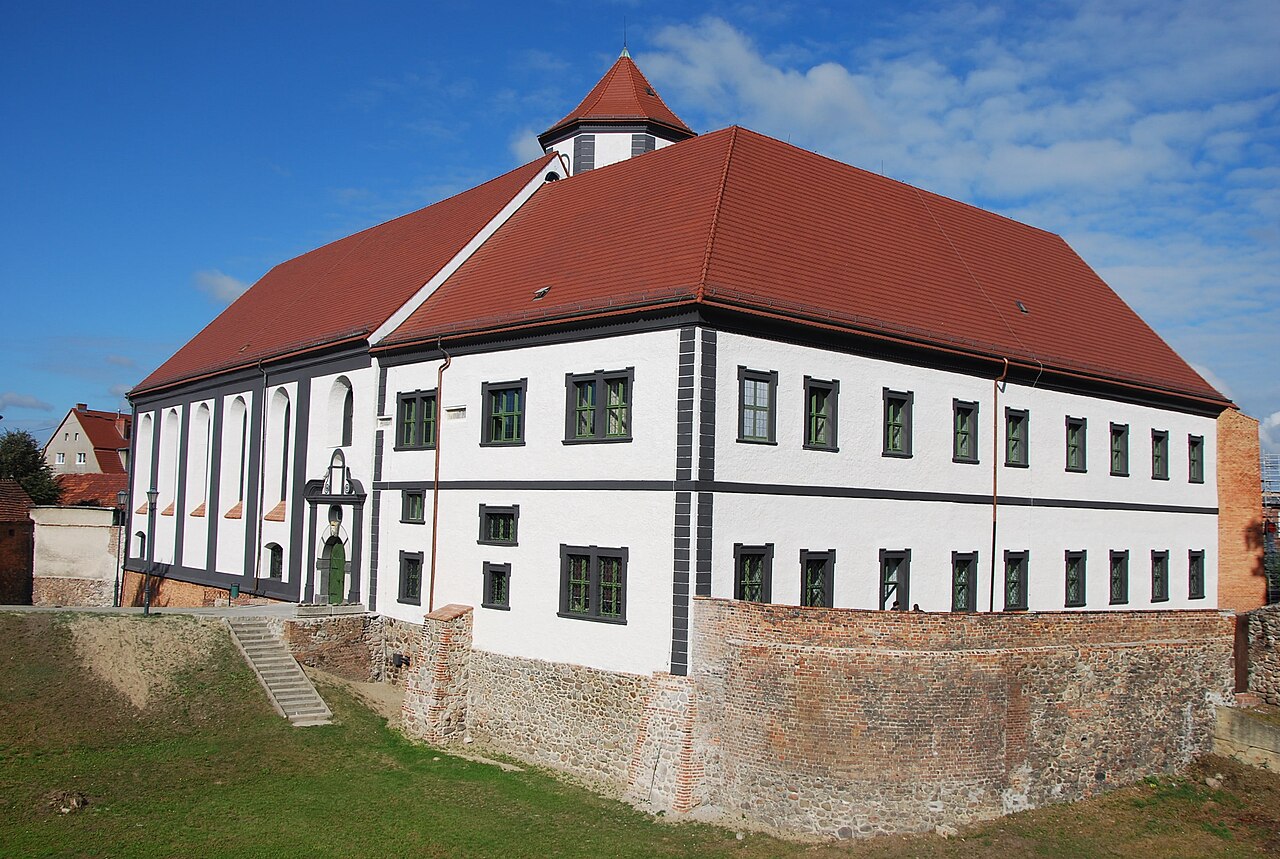
Today, Kożuchów Castle presents a four-winged complex with two stories and steep tile roofs. Its Gothic origins are still visible in the partially preserved tower and the castle’s cellar walls. The former chapel building on the southwest side now serves as a performance hall. Access to the courtyard is through an ornate Baroque portal. Remnants of the castle’s military past remain in the form of a wide, dry moat and the southeast bastion with adjoining wall fragments.
The castle’s layered history—from a medieval fortress to a monastic residence and later military and community use—offers valuable insights into the architectural evolution and regional history of southwestern Poland. Its surviving structures and ruins are important for understanding the defensive strategies and residential arrangements of late medieval hill castles in the region.
Architectural features summary
- Original stone walls: 2.7 m thick, 10 m high
- Main residential building: rectangular, two stories
- Freestanding brick tower: square base transitioning to cylindrical, four stories, with a hunger dungeon
- Defensive moat: originally water-filled, now dry
- Second ring of walls with artillery bastions from the 15th century
- Baroque modifications by Carmelites, including new wings and church
- Current use: cultural center with performance spaces
Historical significance
Kożuchów Castle played a key role in the defensive network of the Duchy of Głogów, witnessing sieges and political transitions from the 13th century through the early modern period. Its transformation from a military fortress to a religious and later military facility reflects broader historical shifts in the region.
Frequently asked questions (FAQ)
- How do I get to Kożuchów Castle?
- Kożuchów Castle is located in the town of Kożuchów, Poland, easily accessible by car or public transportation. If you are traveling by train, the nearest station is in the nearby town of Nowa Sól, from which you can take a local bus or taxi to reach the castle.
- What is the historical significance of Kożuchów Castle?
- Kożuchów Castle dates back to the 13th century and served as a prominent defensive structure during various conflicts in the region. It has witnessed significant historical events and changes in ownership, reflecting the rich history of Silesia and the surrounding areas.
- When was Kożuchów Castle built?
- The initial construction of Kożuchów Castle began in the 13th century, with various modifications and expansions occurring over the centuries. The castle features elements from different architectural styles due to its long and varied history.
- Can I visit Kożuchów Castle year-round?
- Yes, Kożuchów Castle is open for visitors throughout the year, although specific opening hours may vary by season. It is advisable to check the official website or contact the local tourist information for the most current visiting times.
- Why is the architecture of Kożuchów Castle significant?
- The architecture of Kożuchów Castle is significant due to its blend of Gothic and Renaissance styles, showcasing the evolution of defensive structures in the region. The castle's design includes impressive towers and fortifications, making it a fascinating subject for architecture enthusiasts.
- Is it possible to take guided tours of Kożuchów Castle?
- Yes, guided tours of Kożuchów Castle are available, providing visitors with in-depth knowledge about its history and architecture. These tours are typically conducted in Polish, but English-speaking guides can be arranged upon request.
- What are the ticket prices for visiting Kożuchów Castle?
- Ticket prices for Kożuchów Castle are generally affordable, with discounts available for students and seniors. It is recommended to check the official website for the most up-to-date pricing and special offers before your visit.
- What is the best time to visit Kożuchów Castle?
- The best time to visit Kożuchów Castle is during the spring and summer months when the weather is pleasant for exploring the grounds. Additionally, various cultural events and festivals often take place during these seasons, enhancing the visitor experience.
- Are there any nearby attractions to visit along with Kożuchów Castle?
- Yes, there are several nearby attractions worth visiting, including the picturesque town of Kożuchów itself, which offers charming streets and local eateries. Additionally, the surrounding region is rich in natural beauty, with parks and walking trails ideal for outdoor enthusiasts.
Information
Loading map...
Visitor reviews
No reviews yet. Been here? Write the first review and help other travelers!
Write the first reviewVisited this castle? Share your experience
Your review helps other travelers and adds first-hand knowledge to our encyclopedia.