Kowno
Kaunas Castle, located in Kaunas, Lithuania, is a prominent example of a late-medieval hill castle with a rich history spanning several centuries. Positioned strategically near the confluence of the Neris and Nemunas rivers, the castle served as a vital defensive stronghold guarding important trade routes and territorial borders, particularly between the Lithuanian state and the Teutonic Order.
The origins of Kaunas Castle trace back to the late 13th century, with archaeological evidence suggesting the initial fortifications were constructed in the mid-14th century. The earliest written records date from 1361, when the Grand Master of the Teutonic Knights, Winrich von Kniprode, ordered reconnaissance of the castle's defenses in preparation for an assault. The castle was besieged in 1362 during a protracted three-week siege involving siege towers, battering rams, and possibly early gunpowder weapons, leading to its capture by the Teutonic Knights. Despite this, the castle was repeatedly rebuilt and remained a contested site for decades.
Architectural evolution and defensive features
Kaunas Castle was originally constructed as an irregular quadrilateral enclosure with thick stone walls but without towers. The initial defensive walls were made of field stones with brick used for corners and finishing, measuring up to 2.5 meters thick and rising between 9 and 12 meters high. The castle was surrounded by wide, water-filled moats connected to the Neris River, enhancing its defensive capabilities. Initial fortifications lacked towers, but later reconstructions introduced corner towers alternating between circular and square plans, with the main entrance located in one of the square towers.
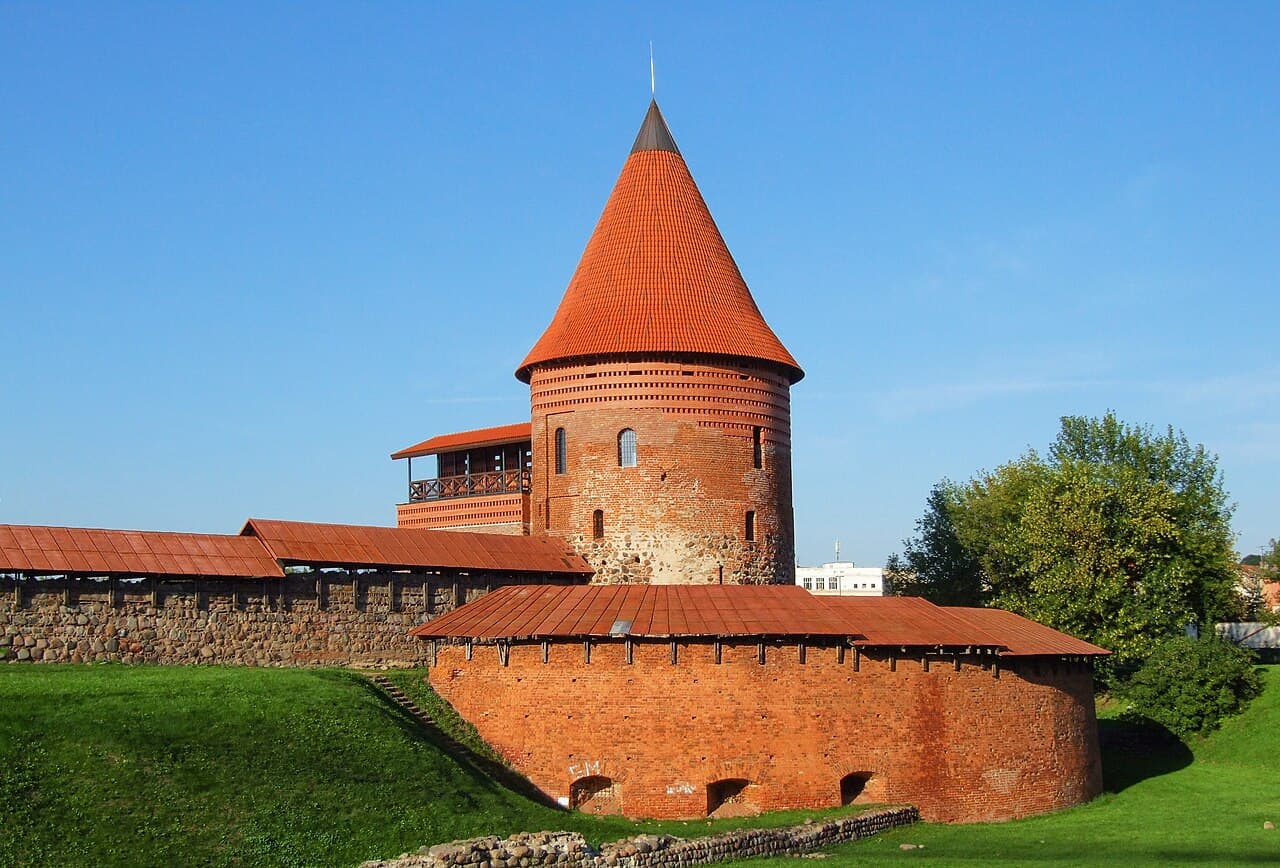
In the late 14th and early 15th centuries, the castle underwent significant rebuilding. The Teutonic Knights renamed it Marienwerder during their occupation and reinforced its defenses with thicker walls (3 to 3.5 meters) and four corner towers. The southeastern tower, notable for its round shape and four-story height, became a key defensive and residential structure. Wooden galleries were added inside the walls to accommodate defenders wielding firearms, reflecting the evolution of military technology.
Artillery bastion and adaptation to gunpowder warfare
In the mid-16th century, the castle was modernized to accommodate artillery. A large semicircular bastion approximately 40 meters in diameter and 12 meters high was constructed near the southeastern tower. This bastion featured firing niches for cannons and a subterranean gallery connecting to the tower's basement, allowing defenders to operate artillery while remaining protected. The walls were adapted with new gunports, demonstrating the castle's transition from medieval fortification to early modern military architecture.
Historical significance and military conflicts
Kaunas Castle played a pivotal role in the Lithuanian-Teutonic conflicts during the late medieval period. It was first captured by the Teutonic Knights in 1317 and again in 1362 after a notable siege. The castle was destroyed and rebuilt multiple times due to its strategic importance on the Lithuanian border. In 1383, the Teutonic Knights under Grand Master Konrad Zöllner von Rotenstein seized the castle and attempted to permanently annex the territory, renaming it Marienwerder.
The Lithuanians successfully recaptured the castle in 1384 after a siege involving cannons and trebuchets, marking a turning point in the region's power dynamics. After the decisive Battle of Grunwald in 1410, the castle's military significance diminished, transitioning to an administrative and residential role. It served as the seat of the local governor and housed courts and archives by the early 17th century.
Later conflicts and decline
During the mid-17th century, the castle was occupied by Swedish forces and severely damaged by fire in 1655. Flooding from the Neris River in the early 17th century caused structural damage, including the collapse of one tower. Over the following centuries, the castle fell into ruin, with parts dismantled for building materials. By the 19th century, only fragments of walls and towers remained, and residential buildings were constructed within the former castle grounds.
Archaeological research and preservation efforts
Archaeological excavations beginning in the 1920s and intensifying after World War II uncovered foundations of the original 14th-century fortress, the artillery bastion, and other architectural elements. Conservation work has focused on preserving the southeastern tower and bastion, which were partially restored and fitted with protective roofing in the late 20th century. Extensive restoration between 2009 and 2011 added floors and a tiled roof to the southeastern tower, along with a new wooden bridge spanning the defensive moat.
Today, Kaunas Castle stands as a significant cultural and historic monument, with its remaining structures integrated into a museum complex. The castle hosts cultural events and festivals, attracting visitors interested in Lithuania's medieval heritage and architectural history.
Cultural impact and legacy
Kaunas Castle is embedded in Lithuanian cultural memory and folklore. It has been referenced in literary works such as Adam Mickiewicz's 19th-century poem "Konrad Wallenrod" and is associated with local legends involving historical figures like Queen Bona Sforza. The castle's enduring presence highlights the region's turbulent history and the evolution of military architecture from medieval fortifications to early modern bastioned defenses.
Frequently asked questions (FAQ)
- When was Kaunas Castle originally built?
- Kaunas Castle was originally constructed in the mid-14th century, with the first recorded mention in 1361. Archaeological evidence suggests earlier fortifications from the late 13th century.
- What architectural styles are evident in Kaunas Castle?
- Kaunas Castle features late-medieval defensive architecture with later adaptations for artillery, including thick stone walls, corner towers, and a semicircular artillery bastion.
- Can visitors explore Kaunas Castle today?
- Yes, Kaunas Castle is open to visitors as a museum complex with preserved ruins, including the southeastern tower and artillery bastion, hosting cultural events and exhibitions.
- What historical events is Kaunas Castle known for?
- The castle is known for its role in Lithuanian-Teutonic conflicts, including sieges in 1362 and 1384, its capture by the Teutonic Knights, and its decline after the Battle of Grunwald in 1410.
- How has Kaunas Castle been preserved?
- Archaeological excavations and restoration efforts since the 20th century have preserved key structures such as the southeastern tower and artillery bastion, with ongoing conservation to maintain the site.
Photo gallery

Information
Sources & official resources
Verify the information above using these authoritative references.
Loading map...
Visitor reviews
No reviews yet. Been here? Write the first review and help other travelers!
Write the first reviewVisited this castle? Share your experience
Your review helps other travelers and adds first-hand knowledge to our encyclopedia.