Korzkiew
Korzkiew Castle stands as a significant example of a late medieval hill castle in Poland, nestled in the village of Korzkiew. Established in the mid-14th century, this fortress was strategically constructed on a defensible promontory encircled by the Korzkiewka stream, which provided natural protection on three sides, making it a formidable stronghold for its time. The castle's origins date back to 1352 when Jan z Syrokomli, a Kraków judge and voivode of Sandomierz, acquired the hill and initiated the construction of a stone tower that served both residential and defensive purposes.
Early construction and defensive features
The initial structure of Korzkiew Castle was a free-standing stone tower, known as a "kamieniec," measuring approximately 9.5 by 12 meters with walls up to 2.5 meters thick. This rectangular tower was partially vaulted and featured a basement, designed to withstand attacks and provide secure living quarters. Narrow arrow slits on the southern and western walls attest to its defensive role. To enhance its protection, the hill was surrounded by a dry moat, and an irregularly shaped defensive wall was constructed, conforming to the terrain's topography. The main gate was located on the southern side, providing controlled access to the courtyard.
Ownership changes and expansions in the 15th and 16th centuries
Ownership of Korzkiew Castle changed hands multiple times during the 15th and 16th centuries, reflecting the turbulent political and social landscape of Poland. In 1486, Barbara, daughter of Stanisław z Korzkwi, sold the estate to Stefan Świętopełk z Irząd, who shortly thereafter sold it to Kraków merchant Piotr Krupka. Krupka expanded the castle by adding a staircase tower and service annex on the northeast side, and adapted the fortress for the use of firearms by creating firing positions at the basement level. Two rectangular bastions were added to the southern wall, reinforcing the castle's defenses.
Renaissance remodeling
During the tenure of Szymon Ługowski and his nephew Stanisław in the late 16th century, Korzkiew Castle underwent a significant transformation from a purely defensive fortress to a more comfortable noble residence. The northern and western walls were partially demolished and rebuilt to create a two-winged structure with a slightly obtuse angle. The number of residential rooms increased, and new vaulted ceilings and larger windows were installed to improve light and comfort. A four-flight staircase was added, and a two-story loggia adorned the entrance, featuring ornate portals. The buildings were crowned with a Renaissance attic and covered by a hipped roof, reflecting contemporary architectural trends. Behind the wings, economic buildings supported the castle's household, and a prominent gatehouse was constructed at the entrance.
Later history and decline
In 1651, following the death of Aleksander Ługowski, the castle passed to the Jordan family. Although it is uncertain whether Korzkiew Castle suffered damage during the Swedish Deluge, a major conflict in the mid-17th century, the Jordans undertook a substantial renovation around 1720. This renovation included removing the original hipped roof and Renaissance attic crenellations, lowering the attic, and adding a multi-faceted wooden shingle roof. The loggia was enclosed with glass to create a veranda, and the walls were plastered and decorated with sgraffito, a popular ornamental technique.
By the mid-18th century, Korzkiew Castle changed ownership several times, eventually ceasing to be a noble residence. It fell into disrepair and was repurposed as a granary in the 19th century, with descriptions from this period noting bricked-up windows and a ruined gate tower.
20th-century conservation and modern restoration
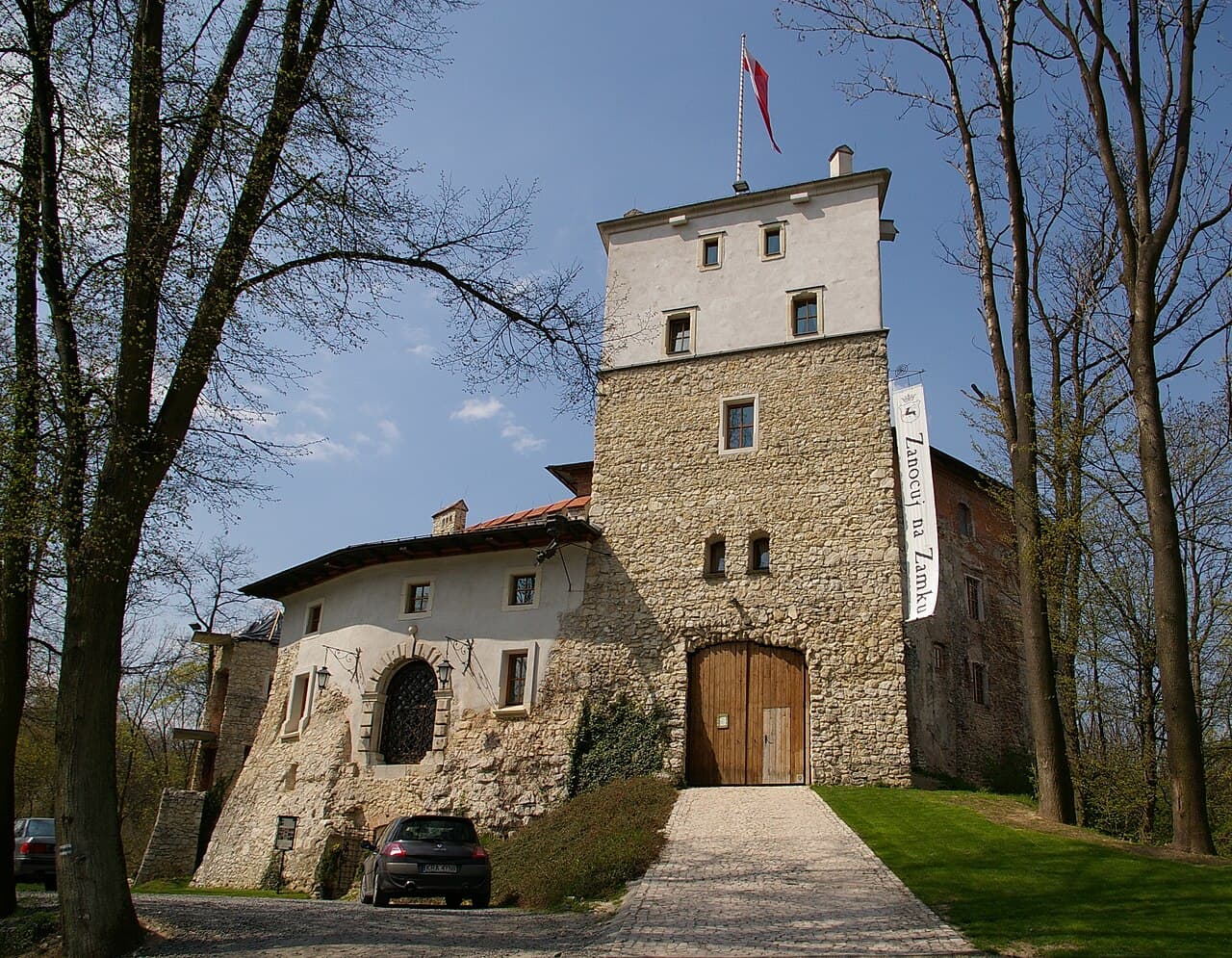
Initial conservation efforts in the 1960s stabilized the ruins and cleared debris from the courtyard. In 1997, architect Jerzy Donimirski acquired the castle and began extensive restoration and reconstruction projects. These efforts included rebuilding a gate tower atop one of the quadrangular bastions and restoring the castle's medieval character. Today, Korzkiew Castle functions as a boutique hotel and conference center, blending its rich historical legacy with modern hospitality. Plans also include revitalizing the surrounding manor houses, ponds, and establishing cultural museums, enhancing its role as a cultural and heritage site.
Architectural significance and features
The castle exemplifies the evolution of Polish medieval fortifications, transitioning from a solitary defensive tower to a complex fortified residence. Its stone tower remains the oldest and most prominent feature, showcasing medieval defensive architecture with its thick walls and arrow slits. The addition of bastions and curtain walls reflects adaptations to emerging military technologies, including firearms. The Renaissance remodeling introduced residential comfort and stylistic elements, such as vaulted ceilings, loggias, and decorative attics, marking a shift in castle architecture from purely military to noble habitation.
The castle's location on a hill surrounded by steep slopes and a stream highlights strategic site selection typical of hill castles, maximizing natural defenses. The dry moat and irregular defensive walls further augmented its protection. The surviving ruins, including the residential house, agricultural outbuildings, and park, contribute to understanding the castle's historical function and layout.
Historical context and cultural importance
Korzkiew Castle was part of the "Trail of the Eagles' Nests," a chain of fortifications built during the reign of King Casimir III the Great to protect the northwestern border of the Kraków region. This network played a crucial role in defending the Kingdom of Poland from external threats, particularly the Teutonic Order. The castle's owners, including the Syrokomla family and later prominent noble families such as the Jordans and Wodzickis, were influential in regional politics and military affairs.
Notably, Zaklik Korzkiewski, a member of the founding family, is recorded as commanding a military banner at the Battle of Grunwald in 1410, one of the most significant battles in Polish and Lithuanian history. The castle's long history of ownership changes and architectural adaptations reflects the broader socio-political transformations in Poland from the medieval period through the Renaissance and into the modern era.
Visiting korzkiew castle today
Today, visitors to Korzkiew Castle can experience a blend of historical ambiance and modern amenities. The restored castle operates as a boutique hotel and event venue, offering guests a unique opportunity to stay within a medieval fortress. The surrounding landscape, including the park and remnants of the manor complex, provides a picturesque setting for exploration and cultural events.
Efforts to preserve and promote Korzkiew Castle contribute to the appreciation of Poland's medieval heritage and architectural evolution. The castle's story, from its 14th-century origins to its current restoration, embodies the resilience and cultural richness of the region.
Frequently asked questions (FAQ)
- How do I get to Korzkiew Castle?
- Korzkiew Castle is located in the village of Korzkiew, Poland, approximately 15 kilometers from Kraków. You can reach it by car or public transportation, with buses frequently running from Kraków to nearby towns. Once in the area, local signage will guide you to the castle.
- What is the historical significance of Korzkiew Castle?
- Korzkiew Castle dates back to the 14th century and is one of the oldest castles in Poland. It played a significant role in the defense of the region and has been a focal point of local history. Today, it stands as a testament to medieval architecture and the heritage of Polish nobility.
- When was Korzkiew Castle built?
- Korzkiew Castle was constructed in the late 14th century, specifically around 1350. It was originally built as a defensive fortress and has undergone various renovations over the centuries, reflecting the architectural styles of different periods. The castle's historical layers make it an interesting site for visitors.
- Can I visit Korzkiew Castle year-round?
- Yes, Korzkiew Castle is open to visitors year-round, although hours may vary by season. It's recommended to check their official website or contact the castle management to confirm current visiting hours. The castle offers guided tours that provide insight into its rich history.
- Why is Korzkiew Castle popular among tourists?
- Korzkiew Castle is popular for its stunning architecture, beautiful surroundings, and rich history. Visitors appreciate the blend of medieval charm and natural beauty in the area. Additionally, its proximity to Kraków makes it an easy and attractive day trip for those exploring the region.
- Is it possible to hold events at Korzkiew Castle?
- Yes, Korzkiew Castle is available for private events, including weddings and corporate gatherings. The castle offers a unique backdrop and can accommodate various functions, making it a memorable venue. It's best to contact the castle administration in advance to discuss options and availability.
- What are the ticket prices for visiting Korzkiew Castle?
- Ticket prices for Korzkiew Castle vary depending on the type of tour and age group. Generally, adults can expect to pay a modest fee, while discounts are often available for children and seniors. It's advisable to check the official website for the most up-to-date ticket information and any special offers.
- What are the opening hours for Korzkiew Castle?
- Korzkiew Castle typically opens to visitors from 10 AM to 6 PM, with extended hours during peak tourist season. However, hours can vary, especially on holidays or for special events. Always confirm the current opening times before planning your visit to ensure you don’t miss out.
- Are there any nearby attractions to visit alongside Korzkiew Castle?
- Yes, there are several attractions near Korzkiew Castle, including the picturesque village of Ojców and Ojców National Park, known for its stunning landscapes and hiking trails. Additionally, the historic city of Kraków is just a short drive away, offering a wealth of cultural experiences and sightseeing opportunities. These nearby sites make for a great day trip combination.
Photo gallery

Information
Website
Visit websiteSources & official resources
Verify the information above using these authoritative references.
Loading map...
Visitor reviews
No reviews yet. Been here? Write the first review and help other travelers!
Write the first reviewVisited this castle? Share your experience
Your review helps other travelers and adds first-hand knowledge to our encyclopedia.