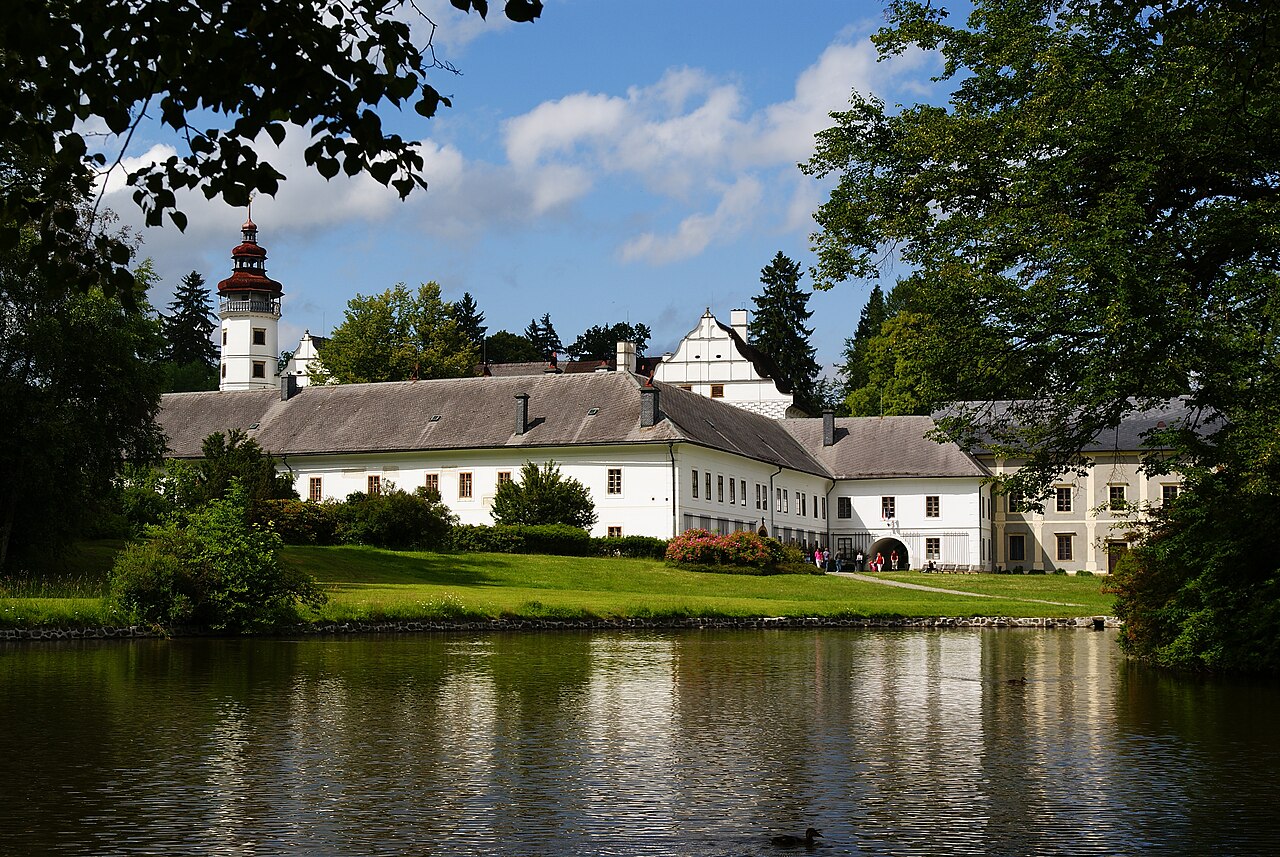
Kolstejn Castle
Kolstejn Castle, also known as Branná Castle, is a significant historical fortress ruin located in the village of Branná in the Šumperk District of Czechia. It stands prominently on a rocky cliff at approximately 630 meters above the Branná River, commanding strategic views of the surrounding landscape. The site has been protected as a cultural monument since 1964, reflecting its importance in the region's medieval and early modern history.
The castle's origins date back to the late medieval period, with construction believed to have occurred between 1306 and 1310. It was initially built as a defensive stronghold to control the vital trade routes and local territory. The first recorded owner was Jan of Wüstehube, mentioned in 1313. Soon after, the castle came under the ownership of King John of Luxembourg, who granted it to the Lords of Lipá, a powerful noble family confirmed by Margrave Charles in 1340.
Historical significance and ownership
Early ownership and medieval conflicts
During the turbulent Hussite Wars in the early 15th century, Hynek of Valdštejn controlled Kolstejn Castle. He was known for shifting allegiances amid the religious and political upheavals until his death in 1427 during a raid on Prague. The castle then passed to Markvart of Zvole and subsequently to his son Hynek of Zvole, marking a period of relative stability.
Renaissance transformation and later history
In the late 16th century, the castle underwent significant changes when Hynek Bruntálský of Vrbno acquired it in 1582. His son, Jan Bruntálský, transformed the outer bailey into a Renaissance-style chateau, blending defensive medieval architecture with more comfortable residential features. The western part of this chateau was later completed under the ownership of the Liechtenstein family, who came into possession of the estate following confiscations in 1622.
During the Thirty Years' War, Kolstejn Castle served as a garrison for imperial troops, emphasizing its continued military importance. After the war, its role shifted primarily to administrative functions. The castle's decline accelerated following two destructive fires in 1770 and 1926, which damaged much of the Renaissance additions and original medieval structures.
Architectural features and layout
Medieval core and fortifications
The castle's core is defined by a massive curtain wall running along the edge of the cliff, with a thickness of approximately 3.3 meters on the side facing the outer bailey. Behind this defensive wall stood a prominent cylindrical tower with a diameter of 8.8 meters, which was later converted into a lookout tower in the 19th century. This tower remains one of the most visible features of the ruins today.
Remnants of the original palace building likely stood along the southwestern wall, evidenced by blocked window openings and a barrel-vaulted cellar that survive to this day. A fragment of the lower part of a portal is also preserved between the tower ruins and the eastern wall, hinting at the castle's former grandeur.
Renaissance and baroque modifications
During the Renaissance and early Baroque periods, the castle's core was extensively built over to accommodate more comfortable living quarters and administrative spaces. However, these additions were largely destroyed in the fire of 1770, leaving only fragments visible today. The transformation from a purely defensive fortress to a combined castle and chateau reflects broader architectural trends in Central Europe during this era.
Current condition and cultural importance
Today, Kolstejn Castle exists as a partially preserved ruin with significant historical and architectural value. Its location on a rocky cliff provides dramatic views and insight into medieval defensive strategies. The site attracts visitors interested in medieval history, architecture, and the cultural heritage of Czechia.
Efforts to preserve the ruins focus on maintaining the remaining structures, particularly the curtain wall and tower, while interpreting the site's layered history from the late medieval fortress through its Renaissance transformation and later decline. The castle's story is a vivid example of the changing nature of fortifications and noble residences in Central Europe over several centuries.
Information
Loading map...
Visitor reviews
No reviews yet. Been here? Write the first review and help other travelers!
Write the first reviewVisited this castle? Share your experience
Your review helps other travelers and adds first-hand knowledge to our encyclopedia.