Kokorin Castle
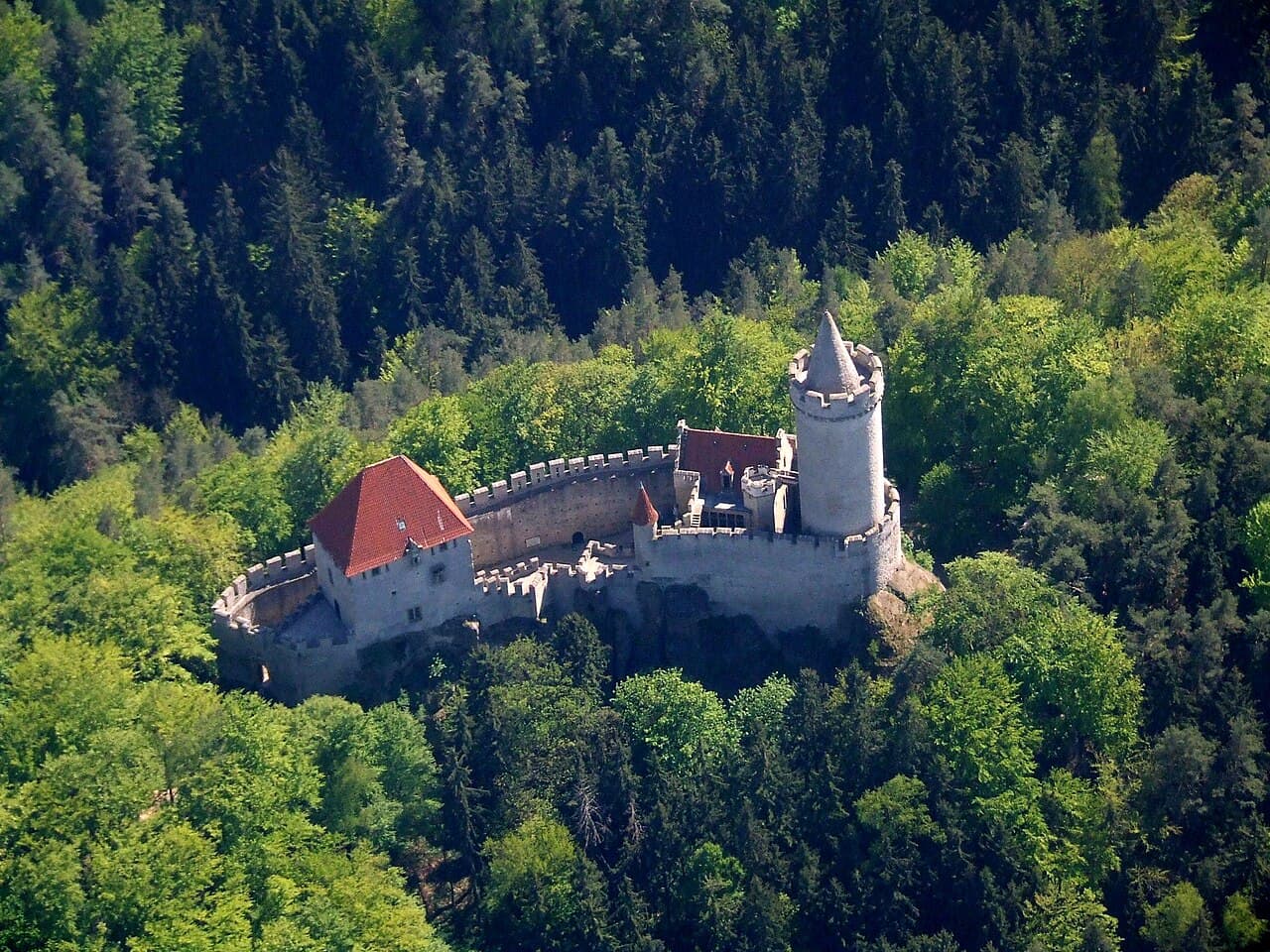
Kokořín Castle stands majestically atop a steep sandstone outcrop in the heart of the Kokořínsko Protected Landscape Area in the Czech Republic. Built around 1320 by Hynek Berka of Dubá, a prominent Bohemian noble and burgrave of Prague, this late medieval hill castle was strategically positioned to oversee the surrounding valley and mining region. Its unique crescent-shaped layout, carved directly into the sandstone rock, reflects an ingenious adaptation of medieval military architecture to the natural terrain.
The castle's early history is closely intertwined with the turbulent events of the 14th and 15th centuries. First documented in 1320, it was initially constructed as a fortified noble residence. During the Hussite Wars in the early 15th century, Kokořín Castle suffered heavy damage when Hussite forces captured and partially destroyed it in 1426. This event marked a significant turning point, leading to extensive rebuilding efforts in the late Gothic style under the ownership of the Lords of Klinštejn.
Historical significance and ownership
Over the centuries, Kokořín Castle passed through the hands of many noble families, including the Berks of Dubá, Jan Řitka of Bezdědice, the Lords of Klinštejn, the Beřkovští of Šebířov, and the Kaplíř family of Sulevice. Each contributed to its evolving architecture and status. Following the Battle of White Mountain in 1620, the castle was acquired by the influential military leader Albrecht von Wallenstein, who incorporated it into his northern Bohemian estates. After Wallenstein's assassination in 1634, the castle was confiscated and transferred to General Jan Böck.
By the early 16th century, the castle began to lose its strategic importance and was gradually abandoned, with records by 1544 describing it as deserted. The decline accelerated when Emperor Ferdinand II declared it a "cursed castle," forbidding any repairs to prevent its use against royal authority. This decree hastened its decay, and by the mid-17th century, it was largely tenantless and in ruins.
Romantic revival and restoration
Despite its dilapidated state, Kokořín Castle captured the imagination of 19th-century Romantic artists and poets such as Karel Hynek Mácha, Josef Navrátil, and Antonín Mánes. Their works highlighted the castle's picturesque ruins, inspiring a cultural appreciation that led to its preservation.
In 1894, the castle ruins were purchased by Václav Špaček of Starburk, who initiated efforts to restore the site. His son, Jan Špaček, oversaw a comprehensive Neo-Gothic restoration between 1911 and 1918, led by architect Eduard Sochor. This restoration is notable as one of the last Romantic-era reconstructions of a medieval castle in the Czech Republic, emphasizing cultural patriotism and historic preservation.
Following nationalization under the communist regime in 1951, the castle was returned to the Špaček family heirs in 2006. Today, it remains a popular tourist destination and a protected cultural monument, showcasing a remarkable blend of medieval architecture and early 20th-century restoration ideals.
Architectural features and layout
Site and fortifications
Kokořín Castle is uniquely integrated into the natural sandstone rock formation, which dictates its crescent-shaped core. The castle is surrounded by a high stone curtain wall crowned with battlements and several defensive towers, creating a formidable barrier against invaders. The main entrance is located on the eastern side, featuring a pointed arch gate accessed via a rock-carved moat and a bridge, emphasizing its defensive design. A smaller secondary gate on the southern wall provided alternative access.
Principal buildings
The castle complex includes three main structures: the Old Palace, the New Palace, and a towering cylindrical watchtower. The Old Palace, situated near the entrance, is a three-story rectangular building with a hipped tile roof. It houses a chapel partly carved into the rock, notable for its barrel vault ceiling and the tombs of the Špaček family. The first floor contains the historic Knights’ Hall, an important ceremonial chamber, while the upper floors include private chambers and a large wood-paneled hall.
The New Palace lies southwest of the Old Palace and features a rectangular main block with a side wing. Its double-sloped roof and exposed stone walls maintain the castle’s medieval character. A portico with arched columns opens to the courtyard, and beneath it lie two Gothic vaulted cellars, likely used for storage.
The watchtower and defensive elements
The cylindrical watchtower is the oldest part of the castle, rising approximately 32 to 38 meters with walls about three meters thick. Its elevated entrance, 11 meters above the courtyard, was accessible only by a drawbridge or ladder, enhancing its defensive capabilities. A pulley system above the doorway remains visible, once used to raise the drawbridge. Inside, a stone chamber encases a wooden spiral staircase leading to the top.
Additional defensive features include a stair tower, a terrace with a rock hall, outer walls, a well outside the main enclosure, stables, and a courtyard. Artistic elements such as the sculpture of Jarmila Špačková by Josef Kalvoda and interior paintings by Julius Fischer enrich the castle’s cultural heritage.
Cultural significance and visitor experience
Kokořín Castle is not only a monument of medieval military architecture but also a symbol of Czech cultural identity and Romantic nationalism. Its restoration in the early 20th century represents a pioneering effort in historic preservation within the country.
Visitors today can explore the well-preserved courtyards, halls, and towers, gaining insight into medieval life and architecture. The castle’s location within a protected natural reserve offers scenic hiking opportunities and a chance to experience the harmonious blend of history and nature.
The castle is managed by the Špaček family heirs and remains open to the public, featuring guided tours and cultural events that celebrate its rich history and architectural splendor.
Frequently asked questions (FAQ)
- How do I get to Kokorin Castle?
- Kokorin Castle is located in the Czech Republic, about 50 kilometers north of Prague. You can reach it by car or take public transport to the nearby village of Kokorin and then enjoy a scenic walk to the castle.
- What is the historical significance of Kokorin Castle?
- Kokorin Castle was built in the 14th century and is an important example of medieval architecture in the Czech Republic. It served as a fortress and residence, and it has a rich history connected to the region's nobility.
- When was Kokorin Castle built?
- The construction of Kokorin Castle began in 1320 and was commissioned by the nobleman Havel of Markvartice. Over the centuries, it has undergone various renovations and restorations, preserving its historical charm.
- Can I visit Kokorin Castle year-round?
- Yes, Kokorin Castle is open to visitors throughout the year, although opening hours may vary by season. It is advisable to check the castle's official website for the most up-to-date information on visiting times.
- Why is Kokorin Castle a popular tourist destination?
- Kokorin Castle is renowned for its stunning architecture and picturesque setting amidst the Bohemian countryside. Visitors are drawn to its historical significance and the breathtaking views it offers from its towers.
- Is it possible to take guided tours at Kokorin Castle?
- Yes, guided tours are available at Kokorin Castle, providing in-depth information about its history, architecture, and legends. These tours are a great way to enhance your visit and gain a deeper understanding of the castle.
- What are the ticket prices for visiting Kokorin Castle?
- Admission prices for Kokorin Castle are generally affordable, with discounts available for children and students. It is recommended to check the official website for the latest pricing information before your visit.
- What is the best time to visit Kokorin Castle?
- The best time to visit Kokorin Castle is during the spring and early autumn months when the weather is mild and the surrounding nature is in full bloom. Summer can also be a great time, but it may be more crowded with tourists.
- Are there any nearby attractions to visit while at Kokorin Castle?
- Yes, the area surrounding Kokorin Castle is rich in natural beauty and historical sites. Visitors can explore the picturesque Kokorin Valley, hike in the nearby forests, or visit other nearby castles such as Houska Castle.
Photo gallery

Information
Website
Visit websiteSources & official resources
Verify the information above using these authoritative references.
Loading map...
Visitor reviews
No reviews yet. Been here? Write the first review and help other travelers!
Write the first reviewVisited this castle? Share your experience
Your review helps other travelers and adds first-hand knowledge to our encyclopedia.