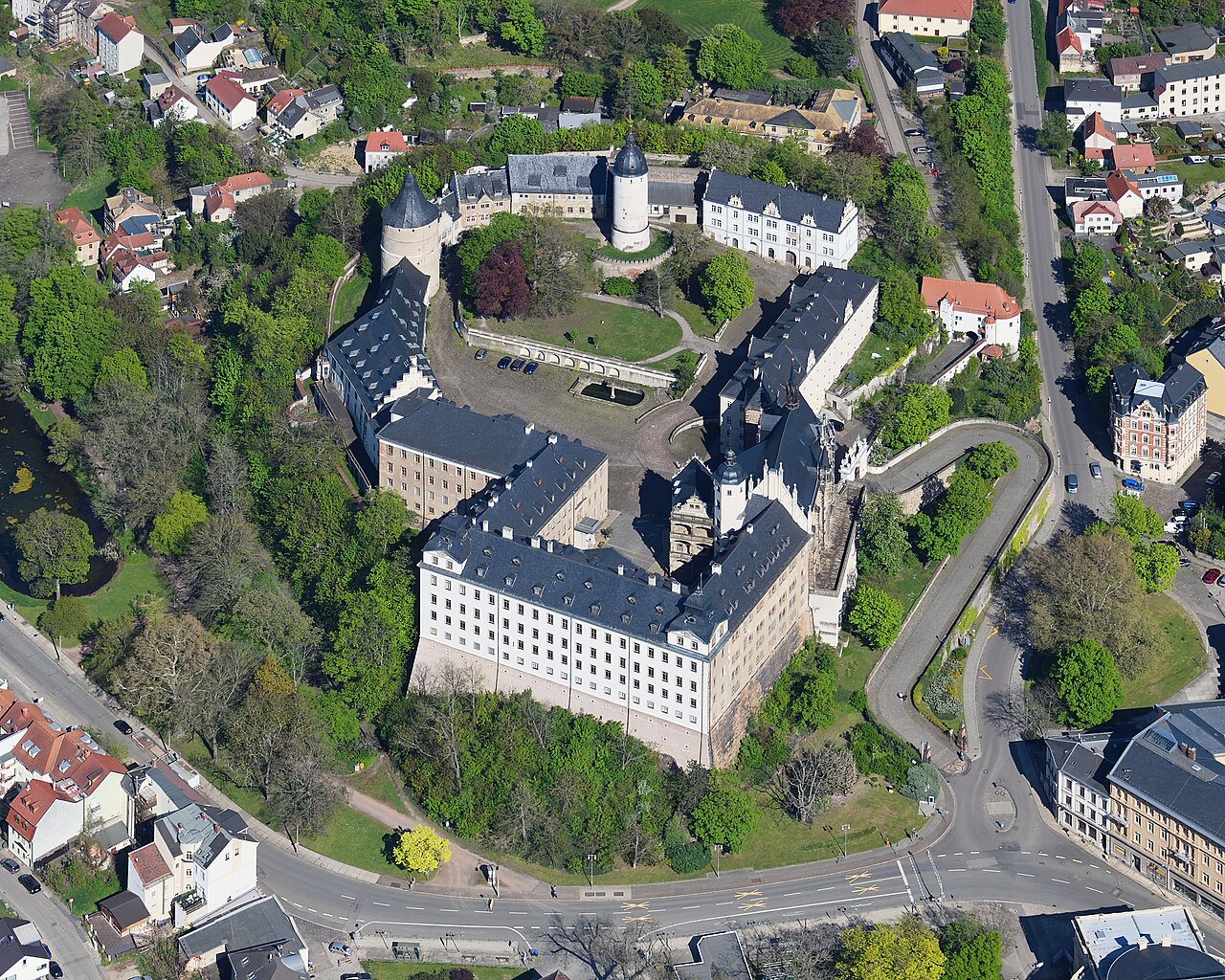
Kohren Castle
Kohren Castle, also historically known as Chorun or Sahlis, stands as a significant medieval ruin located on the strategic Burgberg hilltop in the town of Kohren-Sahlis, within Leipzig county in Saxony, Germany. This imposing hill castle bears witness to centuries of regional history, from its early Slavic roots through its role in local medieval conflicts and noble lineages. Its ruins, dominated by two robust bergfried towers, continue to define the town's skyline and serve as a cultural landmark.
The origins of the settlement at Kohren trace back to the Early Middle Ages, during the period of Sorbian settlement in the region. The area’s importance was recognized as early as the year 974 when Emperor Otto II granted the forested land between the rivers Saale and Mulde to the Bishopric of Merseburg. This early medieval context set the stage for the later establishment of a fortified site that would evolve into Kohren Castle.
Early medieval origins and strategic importance
The earliest indirect evidence of a fortified presence at Kohren comes from the chronicle of Bishop Thietmar of Merseburg, who in 1018 documented a visit to Kohren. This reference suggests that by the early 11th century, a fortified center existed, serving administrative or military functions in the region. The castle’s location on a prominent hill provided commanding views over the surrounding landscape, a key defensive advantage in medieval warfare.
Development under the kohren family and medieval conflicts
By the late 12th century, the castle was under the control of the noble Kohren family, who held it with imperial immediacy in 1190, meaning they were vassals directly under the Holy Roman Emperor rather than local lords. This status reflected the castle's importance in the context of the Ostsiedlung—the eastward expansion and German colonization of Slavic lands.
The early 13th century was marked by conflict when the Kohren family sided with the city of Leipzig against Margrave Dietrich of Meissen in 1216. Following Leipzig’s defeat, Dietrich ordered the destruction of Kohren Castle in 1220. However, the castle was rebuilt by around 1240, as evidenced by surviving architectural elements from this reconstruction period.
Late medieval expansions and ownership changes
In the late 13th century, approximately around 1290, Kohren Castle was expanded with the addition of a second bergfried. This enhancement likely aimed to strengthen the castle’s defenses and symbolize the owners' status, though specific motivations remain unclear. The original western tower dates from the mid-13th century reconstruction phase.
The independent Kohren family line ended in the early 14th century, last mentioned in 1303. The castle subsequently passed through several noble families, including the Schönburgs, the Leisnigs, and the Vögte of Plauen. In 1357, Friedrich von Schönburg transferred Kohren Castle along with nearby Geithain to the Lords of Reuß.
Historical episodes and decline
A notable historical figure associated with Kohren Castle is Kunz von Kaufungen, a knight who stayed at the castle the night before his infamous 1455 abduction of the Wettin princes. After his capture and execution, the castle was reportedly slighted—deliberately damaged to erase his memory and diminish the castle’s military value.
By the late 15th century, the castle passed to the Einsiedel family, who eventually relocated their residence to nearby Gnandstein Castle. This move led to Kohren Castle’s abandonment as a noble residence. By 1568, it was officially described as deserted and uninhabitable.
In the early 17th century, the Einsiedels sold the Kohren and Sahlis estates in 1602. Between 1604 and 1605, the castle’s stones were quarried for local church construction, accelerating its physical decline. During the Thirty Years’ War (1618–1648), the fortress saw brief restoration to meet defensive needs, though the extent and success of these efforts remain unclear. Post-war, some houses were constructed on the site, but these too were eventually abandoned, with the last castle house demolished in 1900.
Architectural features and surviving remains
Kohren Castle was primarily built from stone masonry, a typical material for medieval fortifications, chosen for its durability and defensive strength. The castle’s most prominent surviving features are its two bergfried towers, which served as both watchtowers and last-resort defensive strongholds. Their elevated entrances, positioned well above ground level, were a deliberate defensive design to hinder attackers.
The older western bergfried dates from the mid-13th century, reflecting the castle’s reconstruction after its destruction in 1220. The second bergfried, added around 1290, represents the castle’s late medieval expansion phase. These towers, along with portions of the curtain walls that once enclosed the castle’s inner courtyard and living quarters, still stand as ruins today.
Over time, many sections of the castle’s walls and buildings were dismantled, with stone repurposed for local construction projects, particularly churches. Despite this, the ruins maintain a distinctive silhouette visible from the town below, symbolizing the region’s medieval heritage.
Archaeological investigations and cultural significance
Interest in Kohren Castle’s history and preservation led to archaeological excavations in the 20th century. A local castle association conducted digs in 1928, followed by investigations by the Dresden State Museum of Prehistory in 1965. These studies helped clarify the castle’s construction phases and historical timeline.
The castle’s location near the former Wyhratal railway—now converted into a bike path—illustrates the evolving human landscape around this medieval site. Today, Kohren Castle stands as an important cultural and archaeological landmark, attracting visitors interested in medieval history and architecture.
Visiting kohren castle today
Although Kohren Castle is now a ruin, it remains accessible to the public and offers a tangible connection to the medieval past of Saxony. Visitors can explore the remains of the bergfried towers and walk along the remnants of the curtain walls, gaining insight into the castle’s defensive structures and historical significance.
The site’s hilltop position provides panoramic views of the surrounding countryside, enhancing its appeal for tourists and history enthusiasts alike. Nearby, the bike path along the former Wyhratal railway offers a scenic route connecting to other regional attractions.
While no formal visitor center or extensive facilities exist on site, the castle’s ruins are a poignant reminder of the region’s medieval heritage and the complex history of noble families, warfare, and architectural evolution in Saxony.
Frequently asked questions (FAQ)
- How do I get to Kohren Castle?
- Kohren Castle is located on the Burgberg hill in Kohren-Sahlis, Saxony. It is accessible by local roads, and visitors can reach the site by car or bicycle, with parking available in the town nearby.
- What is the historical significance of Kohren Castle?
- Kohren Castle played a key role in the medieval history of Saxony, serving as a noble residence and fortress. It witnessed conflicts such as the destruction ordered by Margrave Dietrich of Meissen and is linked to the story of Kunz von Kaufungen.
- Can I explore the ruins of Kohren Castle?
- Yes, visitors can explore the ruins, including the two remaining bergfried towers and parts of the curtain walls. The site offers panoramic views and a tangible connection to medieval architecture.
- When was Kohren Castle built?
- The castle was rebuilt around 1240 after its destruction in 1220, with expansions in the late 13th century including a second bergfried tower.
- Is there an entrance fee to visit Kohren Castle?
- Visiting Kohren Castle is free of charge, as it is an open ruin managed by the local municipality.
Information
Current owner
Municipality
Loading map...
Visitor reviews
No reviews yet. Been here? Write the first review and help other travelers!
Write the first reviewVisited this castle? Share your experience
Your review helps other travelers and adds first-hand knowledge to our encyclopedia.