Koberg Castle
Koberg Castle (Kobergs slott) stands as a significant historical monument in Västergötland, Sweden, near the lake Vanderydsvattnet, approximately 10 km south of Trollhättan. This hill castle traces its origins back to the 15th century, making it a notable example of late medieval architecture in the region. The castle's strategic location on elevated terrain overlooking the surrounding landscape reflects the defensive priorities of its original builders.
The earliest recorded owner of Koberg was knight Erik Nipertz, who held the estate during the 15th century. Over the centuries, Koberg Castle passed through the hands of several prominent Swedish noble families, including the royal Vasa family and the distinguished Leijonhufvud (Lewenhaupt) family. These families contributed to the castle's architectural evolution and historical significance.
Architectural evolution and structural features
The castle's construction is characterized by distinct phases corresponding to different historical periods. The oldest eastern section of Koberg dates from the mid-1400s, showcasing the medieval stone masonry typical of that era. This part likely served as the original core of the fortress, featuring thick defensive walls and limited fenestration for protection.
In the early 17th century, specifically the 1620s, the castle expanded with the addition of a middle section. This phase reflects architectural developments during the Renaissance period in Sweden, incorporating more refined stonework and possibly larger windows, indicating a shift towards residential comfort alongside defense.
The western wing was constructed in the late 1700s, during a period when many Swedish castles were adapted for more modern residential use. This addition likely included updated interiors and stylistic elements consistent with late Baroque or early Neoclassical influences, although the exact style of this wing is less documented.
Neo-Renaissance restoration
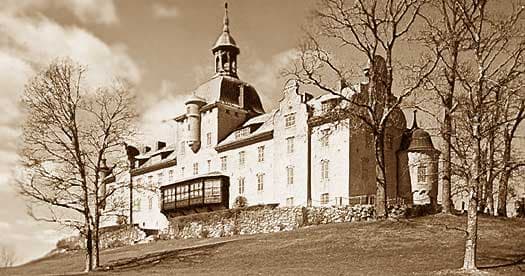
A significant transformation of Koberg Castle occurred in the 1890s, when the main building underwent restoration in the Neo-Renaissance architectural style. This work was designed by the renowned Swedish architect Fredrik Lilljekvist (1863–1932). The restoration introduced stylistic elements such as ornate façades, symmetrical layouts, and decorative details inspired by Renaissance architecture, enhancing the castle's aesthetic appeal while preserving its historical character.
The castle's exterior is notable for its three-storey stone construction, flanked by two robust domed round towers. These towers not only contribute to the castle's imposing silhouette but also reflect traditional medieval defensive features adapted for later periods.
Estate buildings and grounds
Beyond the main castle structure, the Koberg estate includes several auxiliary buildings constructed in the early 20th century. Built between 1900 and 1904, these estate buildings exhibit the Neo-Romantic architectural style, characterized by a romanticized interpretation of medieval and vernacular forms, often featuring decorative timber framing and picturesque rooflines.
The estate's location near lake Vanderydsvattnet adds to its scenic value, providing a natural setting that complements the historic architecture. The surrounding grounds likely include landscaped gardens and parkland typical of noble estates in Sweden.
Historical significance and modern use
Koberg Castle holds cultural importance as a residence of Swedish nobility and royalty. It was the home of Princess Désirée, Baroness Silfverschiöld, and her husband Baron Niclas Silfverschiöld until their deaths in 2026 and 2017 respectively. Their occupancy maintained the castle's status as a private noble residence into the 21st century.
The castle's preservation and continued use reflect the broader trend in Sweden of maintaining historic castles as living heritage sites. While not generally open to the public, Koberg remains a symbol of the region's aristocratic history and architectural heritage.
Architectural and cultural context
Koberg Castle exemplifies the architectural layering typical of many European castles, where medieval fortifications were gradually transformed into stately homes. Its combination of late medieval stonework, Renaissance expansions, and 19th-century Neo-Renaissance restorations illustrates the evolving tastes and needs of its owners over centuries.
The castle's location in Västergötland, a province with a rich medieval history, situates it among other important Swedish castles and historic sites. Its proximity to Trollhättan, a city known for its industrial heritage and waterways, adds to the castle's regional significance.
Frequently asked questions (FAQ)
- How do I get to Koberg Castle?
- Koberg Castle is located in Trollhättan, Sweden, and is easily accessible by car or public transport. If you're driving, follow the signs to Trollhättan, and you will find parking available near the castle.
- What is the historical significance of Koberg Castle?
- Koberg Castle dates back to the late 17th century and is an important example of Swedish Baroque architecture. It has served as a royal residence and has a rich history tied to the Swedish nobility, making it a vital part of Sweden's cultural heritage.
- When was Koberg Castle built?
- Construction of Koberg Castle began in 1681 and was completed in 1703. The castle has undergone several renovations over the years to maintain its grandeur and historical integrity.
- Can I take guided tours of Koberg Castle?
- Yes, guided tours are available at Koberg Castle, providing visitors with in-depth knowledge about its history and architecture. It is advisable to check the castle's official website for tour schedules and availability.
- Why is Koberg Castle famous for its architecture?
- Koberg Castle is renowned for its stunning Baroque style, characterized by its symmetrical layout and intricate detailing. The castle's design reflects the opulence of the period and showcases the artistry of Swedish architects of the time.
- Is it possible to host events at Koberg Castle?
- Yes, Koberg Castle offers facilities for hosting events such as weddings and corporate gatherings. You can contact the castle administration for more information on booking and available services.
- What are the opening hours for Koberg Castle?
- Koberg Castle is typically open to visitors from May to September, with specific opening hours varying throughout the season. It is recommended to check the official website for the most current opening times before your visit.
- What is the best time to visit Koberg Castle?
- The best time to visit Koberg Castle is during the late spring and summer months when the weather is pleasant and the gardens are in full bloom. This period also coincides with the castle's regular opening hours and guided tours.
- Are there any nearby attractions worth visiting?
- Yes, nearby attractions include the scenic Göta Canal and the beautiful Trollhätte Falls, both offering stunning views and recreational activities. Exploring the local area can enhance your visit to Koberg Castle and provide a fuller experience of Trollhättan.
- What are the ticket prices for Koberg Castle?
- Ticket prices for Koberg Castle vary depending on the type of tour and visitor age. It's best to check the official website for the most up-to-date pricing information and any available discounts for families or groups.
Photo gallery

Photo by Unknown authorUnknown author•Public domain
Information
Loading map...
Visitor reviews
No reviews yet. Been here? Write the first review and help other travelers!
Write the first reviewVisited this castle? Share your experience
Your review helps other travelers and adds first-hand knowledge to our encyclopedia.