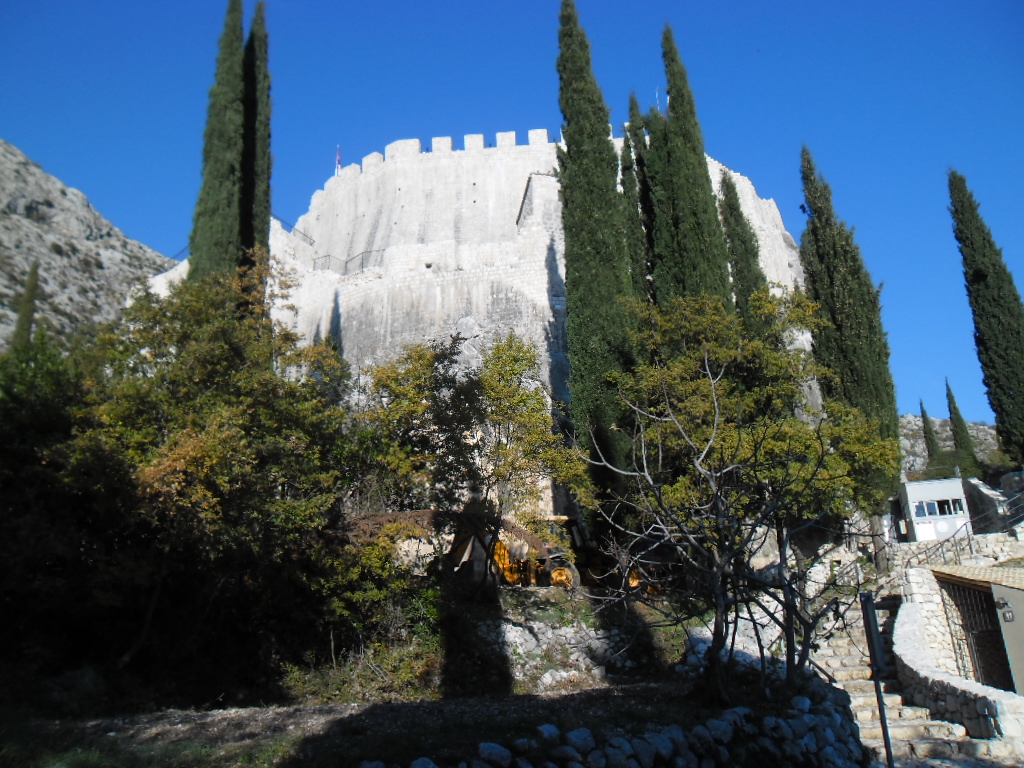
Klobuk Fortress
Klobuk Fortress is a significant medieval stronghold located on the karst plateau of Mirotinske grede, near the village of Klobuk in the municipality of Trebinje, within the Republic of Srpska entity of Bosnia and Herzegovina. This fortress is believed to have been constructed in the 9th century AD, making it one of the older fortifications in the region. Its strategic position on elevated terrain allowed it to command important routes and oversee the surrounding landscape, which was crucial for defense and control during the turbulent medieval period.
Early mentions and medieval significance
The fortress of Klobuk is referenced in the mid-10th century by the Byzantine Emperor and scholar Constantine Porphyrogenitus in his work De Administrando Imperio, where he mentions a town in the parish of Vrm within the county of Travunija. This early mention highlights the fortress's existence and importance during the early medieval period. Throughout the 11th century, Klobuk continued to be a notable site, appearing in historical records during the reign of Archon Stefan Vojislav, a ruler known for his resistance against Byzantine influence in the region.
Ownership transitions and feudal governance
During the medieval era, Klobuk was part of the Nemanjić state until 1321, after which it came under the control of Bosnian rulers. Initially, it was held by the noble family of the Sankovićs. Subsequently, from 1395 to 1442, the fortress was in the possession of the Pavlović family, who seized it from the Sankovićs. In 1442, control passed to Stjepan Vukčić Kosač, a powerful Bosnian nobleman who governed the area before the Ottoman conquest. During the 15th century, Klobuk was administered by a knyaz (local prince) on behalf of the lord, and a castellan served as the military commander responsible for the fortress's defense and garrison.
Ottoman conquest and military role
The fortress fell to the Ottoman Empire in 1477, marking a new chapter in its history. Under Ottoman rule, Klobuk was garrisoned by an Ottoman military crew that remained stationed there until 1878. The fortress played a key role in the Ottoman defense system, especially during the 17th and 18th centuries. After the Peace of Karlovac in 1699, Klobuk gained increased strategic importance as a frontier fortress guarding Ottoman territories against the Venetian possessions in Dalmatia and the neighboring Montenegrin lands.
Military architecture and fortifications
Klobuk's architecture reflects its role as a defensive stronghold. The fortress was built with stone walls adapted to the karst landscape, featuring towers that rose to heights of up to 6 meters, which served as lookout points and defensive positions. Although much of the original structure has deteriorated over time, remnants of walls and towers still stand, providing insight into the fortress's design and construction methods. The layout likely included a central courtyard, surrounded by defensive walls and towers, typical of medieval fortifications in the region.
Cultural heritage and notable features
Within the fortress grounds, there is a notable stećak tombstone, a medieval tombstone characteristic of the region, belonging to the nobleman Vukosav Zemlić. This stećak is situated in front of the site where a church once stood, which was later replaced by a mosque during Ottoman rule. This layering of religious structures reflects the cultural and political shifts that Klobuk experienced over centuries.
Modern condition and preservation
Today, Klobuk Fortress is classified as ruins, with only parts of the towers and some walls remaining visible. Despite its ruined state, it remains an important historical and cultural landmark in the Trebinje region. The fortress attracts visitors interested in medieval architecture, Ottoman military history, and the complex heritage of Bosnia and Herzegovina. Preservation efforts focus on maintaining the existing structures and promoting awareness of the site's significance.
Historical context within the region
Klobuk Fortress's history is intertwined with the broader political and military developments in the western Balkans. Its control shifted among local noble families and larger regional powers, reflecting the contested nature of the area. The fortress's endurance through Byzantine, medieval Serbian, Bosnian, and Ottoman periods illustrates its strategic value and adaptability to changing rulers and military technologies.
Role during the sanjak of herzegovina
Under Ottoman administration, Klobuk was part of the Sanjak of Herzegovina, an important administrative and military district. The fortress served as a frontier post that helped regulate and defend Ottoman interests in the region, especially against Venetian and Montenegrin incursions. Its garrison maintained a military presence that contributed to the empire's control over this border area until the late 19th century.
Resistance against austro-hungarian forces
In 1878, during the Austro-Hungarian occupation of Bosnia and Herzegovina, Klobuk Fortress was a site of fierce resistance by the Ottoman garrison. Although the fortress eventually fell, this resistance highlights its continued military relevance even in the era of modern imperial conflicts. The fortress's location and fortifications provided a defensive advantage that sustained its use well beyond the medieval period.
Frequently asked questions (FAQ)
- What is the historical significance of Klobuk Fortress?
- Klobuk Fortress, located near Trebinje, is a remarkable example of medieval fortifications in Bosnia and Herzegovina. Built in the 15th century, it played a crucial role in defending the region against various invasions, showcasing the strategic military architecture of its time.
- When was Klobuk Fortress constructed?
- The construction of Klobuk Fortress dates back to the early 15th century, specifically around the year 1448. It was built under the rule of the noble family of Herzegovina to protect the area from Ottoman expansion and has since become a symbol of local heritage.
- Can I visit Klobuk Fortress?
- Yes, visitors are welcome to explore Klobuk Fortress. The site offers a fascinating glimpse into the region's history and architecture, making it a popular destination for tourists and history enthusiasts alike.
- What are the opening hours for Klobuk Fortress?
- Klobuk Fortress is typically open to visitors from early spring to late autumn. During this period, it’s advisable to check local listings for the exact opening hours, as they may vary depending on the season and specific events.
- Is it possible to access Klobuk Fortress by public transport?
- Accessing Klobuk Fortress via public transport can be challenging, as services may be limited. However, local taxis and guided tours are available, making it easier for visitors to reach the fortress from Trebinje.
- What is the best time to visit Klobuk Fortress?
- The best time to visit Klobuk Fortress is during the spring and early autumn months when the weather is mild and pleasant. This allows visitors to fully enjoy the outdoor surroundings and the panoramic views from the fortress.
- Are there any nearby attractions to visit?
- Yes, there are several nearby attractions, including the beautiful city of Trebinje and the stunning vineyards of the region. Visitors can also explore the nearby monasteries and natural parks that enhance the historical experience.
- What are the ticket prices for Klobuk Fortress?
- Entry to Klobuk Fortress is generally affordable, with ticket prices typically ranging from a few euros. It's recommended to check for any special discounts or group rates that may be available at the time of your visit.
Loading map...
Visitor reviews
No reviews yet. Been here? Write the first review and help other travelers!
Write the first reviewVisited this castle? Share your experience
Your review helps other travelers and adds first-hand knowledge to our encyclopedia.