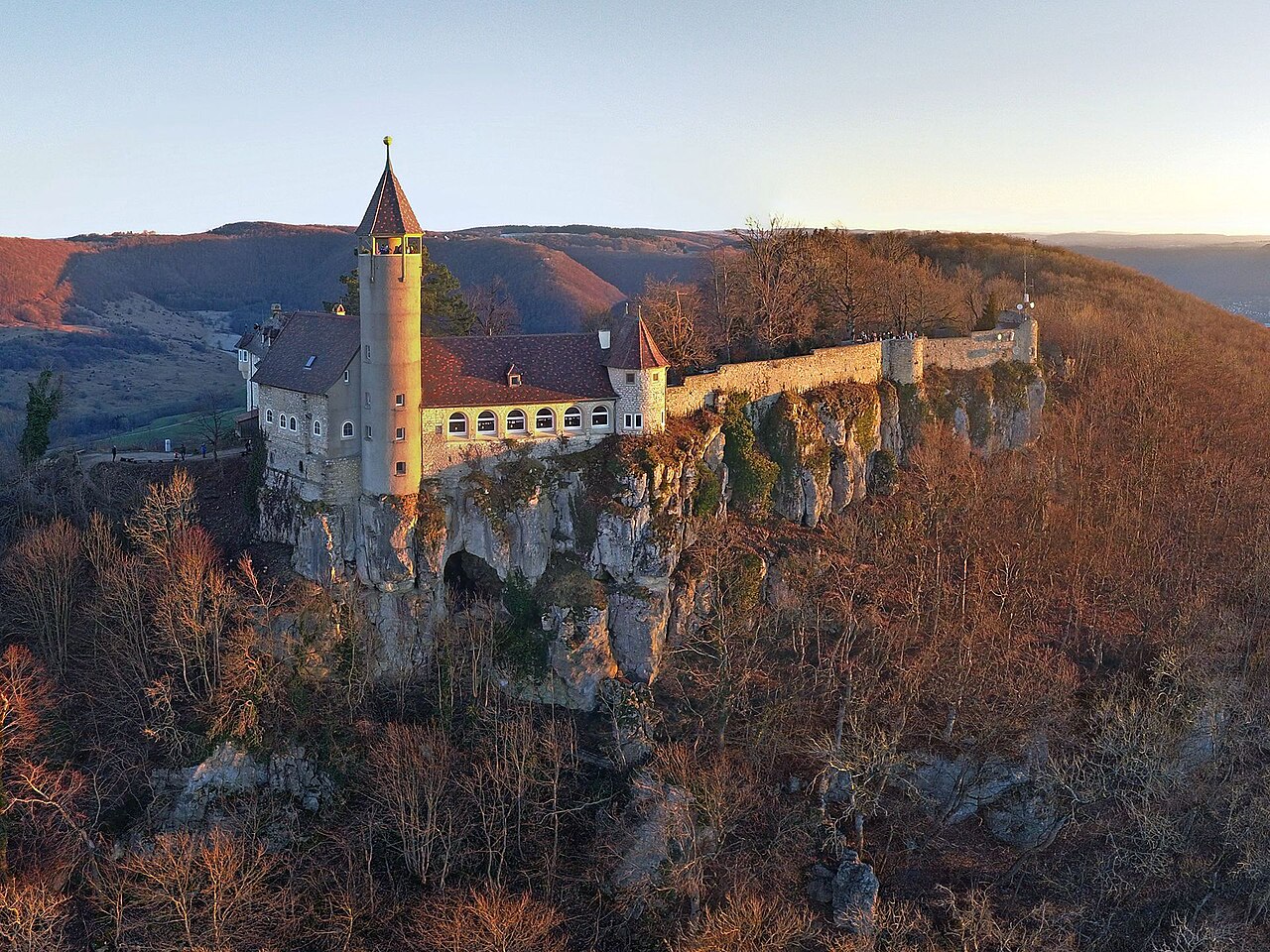
Kirchheim Castle
Kirchheim Castle, located in Kirchheim unter Teck, Germany, stands as one of the finest preserved examples of a Renaissance fortress within the historical territory of the Württemberg duchy. Its origins date back to the mid-16th century, when it was constructed as part of a strategic network of fortifications ordered by Duke Ulrich of Württemberg upon his return from exile. This initiative aimed to strengthen the duchy's defenses against neighboring powers through a series of seven strongholds, with Kirchheim playing a crucial role as a corner bastion integrated into the city's fortifications.
Historical context and construction
The castle's foundation began in 1538 as an extension of the city walls of Kirchheim unter Teck. It was completed in 1566 under the reign of Duke Christoph, Ulrich's son and successor. The structure was designed primarily as a functional defensive building, featuring a massive base supporting two timber floors. Its distinctive irregular diamond-shaped layout comprises four wings, a design that maximized the defensive coverage of the surrounding area.
Originally, the castle was surrounded by a deep moat, now drained, which added to its defensive capabilities. On one side, the fortress remains connected to the city's medieval walls, emphasizing its role as a fortified bastion rather than an isolated palace. Although initially intended for military purposes, the castle also served as a hunting lodge for the ruling family, reflecting its dual function.
Transition from fortress to residence
By the late 16th century, Kirchheim Castle began to shift from a purely military stronghold to a residential palace. This transition was notably marked in 1594, when Frederick I, facing the plague outbreak in the capital city of Stuttgart, relocated his court to Kirchheim. This move underscored the castle's growing importance as a safe haven and administrative center.
Over the following centuries, the castle's military significance diminished, and it increasingly became a place of residence. From 1628 onwards, it served as the home for the widows of various Württemberg dukes. This role was shared with other ducal residences in nearby Nürtingen and Göppingen. The castle's adaptation to residential use included enhancements to its living quarters and the gradual softening of its defensive features.
Later uses and preservation
After the death of Duchess Henriette, Kirchheim Castle experienced a variety of uses reflecting the changing needs of the region. During the Franco-German War of 1870-1871, it was repurposed as a hospital for wounded soldiers, highlighting its continued strategic utility even in modern conflicts.
From 1876 to 1908, the castle's chapel served as the venue for Catholic parish services, indicating its integration into the religious life of the community. Subsequently, between 1911 and 1948, the castle housed the city's vocational school for girls, alongside a kindergarten and residential units, demonstrating its role in education and social services.
In 1947, the state of Baden-Württemberg assigned Kirchheim Castle to the State Economics School for teaching and boarding purposes. This institution, established in 1923, was succeeded by the Pedagogic Institute and School in 1971, which continues to occupy the castle today.
Architectural features and museum
The castle's architecture is a notable example of Renaissance military design adapted for residential comfort. Its four-winged, diamond-shaped plan is rare and reflects the evolving needs of a fortress transitioning into a palace. The original moat, now drained, once enhanced its defensive perimeter, while the connection to the city walls integrated it firmly within Kirchheim's fortifications.
The south-facing grand living spaces on the second floor have been preserved and restored to serve as a palace museum. These rooms are dedicated to the last two prominent residents, Franziska and Henriette, with much of Franziska's original furniture intact. Restoration efforts in 1985 and 1997 carefully returned the interiors to their historical state, offering visitors an authentic glimpse into the castle's residential past.
Interior and furnishings
The museum rooms showcase a variety of period furnishings, artwork, and decorative elements that reflect the lifestyle of Württemberg nobility during the Renaissance and later periods. The preservation of original furniture pieces allows for a detailed understanding of the castle's domestic arrangements and aesthetic preferences of its inhabitants.
State management and public access
Kirchheim Castle is officially recognized as a state monument and is maintained by the State Palaces and Gardens of Baden-Württemberg. The organization oversees its conservation and facilitates public access to the museum areas. The castle's ongoing use as an educational institution coexists with its role as a cultural heritage site, balancing preservation with contemporary function.
Frequently asked questions (FAQ)
- How do I get to Kirchheim Castle?
- Kirchheim Castle is conveniently located in Kirchheim unter Teck, easily accessible by public transport and car. If you are traveling by train, the nearest station is Kirchheim unter Teck, which is about a 15-minute walk from the castle.
- What is the historical significance of Kirchheim Castle?
- Kirchheim Castle dates back to the 13th century and has played a vital role in the region's history. It served as a residence for various noble families and has witnessed significant historical events, making it an important landmark in Baden-Württemberg.
- When was Kirchheim Castle built?
- The construction of Kirchheim Castle began in the early 13th century, with its first documented mention occurring in 1250. Over the centuries, it has undergone various renovations and expansions, reflecting different architectural styles.
- Can I take guided tours of Kirchheim Castle?
- Yes, guided tours are available for visitors to explore the rich history and architecture of Kirchheim Castle. These tours provide valuable insights into the castle's past and its significance in the region, enhancing your overall experience.
- Why is Kirchheim Castle a popular tourist destination?
- Kirchheim Castle attracts visitors due to its stunning architecture, beautiful gardens, and its fascinating history. Additionally, the castle often hosts events and exhibitions, making it a lively attraction for both locals and tourists.
- Is it possible to host events at Kirchheim Castle?
- Yes, Kirchheim Castle offers facilities for hosting various events, including weddings, corporate functions, and cultural events. The picturesque setting and historical ambiance make it a unique venue for special occasions.
- What are the opening hours for Kirchheim Castle?
- Kirchheim Castle is open to visitors from Tuesday to Sunday, typically from 10 AM to 5 PM. However, it is advisable to check the official website for any seasonal changes or special closures before planning your visit.
- What are the ticket prices for visiting Kirchheim Castle?
- Ticket prices for Kirchheim Castle are generally affordable, with discounts available for students and seniors. Family tickets are also offered, making it a great option for a day out with loved ones.
- What is the best time to visit Kirchheim Castle?
- The best time to visit Kirchheim Castle is during the spring and summer months when the gardens are in full bloom and outdoor events are held. Additionally, pleasant weather makes exploring the grounds and nearby attractions much more enjoyable.
- Are there any nearby attractions to Kirchheim Castle?
- Yes, there are several nearby attractions, including the beautiful Teck Mountain and the historic town center of Kirchheim unter Teck. Visitors can also explore local museums and parks, making for a full day of exploration.
Information
Website
Visit websiteSources & official resources
Verify the information above using these authoritative references.
Loading map...
Visitor reviews
No reviews yet. Been here? Write the first review and help other travelers!
Write the first reviewVisited this castle? Share your experience
Your review helps other travelers and adds first-hand knowledge to our encyclopedia.