King John’s Castle, Limerick
King John's Castle stands as a monumental testament to the rich and turbulent history of Limerick, Ireland. Located on King's Island beside the River Shannon, this 13th-century Anglo-Norman fortress occupies a site with origins tracing back to a Viking stronghold established in 922 by the Viking leader Thormodr Helgason, also known as Tomrair mac Ailchi. This early fortification served as a strategic base for Viking raids along the river, marking the beginning of the site's long-standing military significance. By the 10th century, the Viking presence waned as local Irish clans asserted control over the area.
In 1195, the Anglo-Normans, led by John, Lord of Ireland (later King John of England), captured Limerick. Around 1200, John commissioned the construction of the current castle, completed by approximately 1210. The fortress was strategically positioned to guard the frontier between the Gaelic kingdoms to the west and Norman-controlled territories to the east and south. This location underscored the castle's role as a military bulwark and administrative center during the High medieval period. Under Norman rule, Limerick prospered as a vital port and commercial hub. Notably, the castle's north-east tower housed a mint authorized by King John, producing coins that survive today in local museums.
Architectural design and features
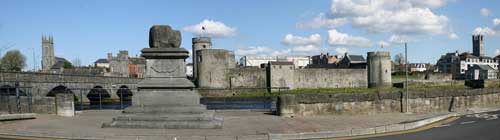
King John's Castle is distinctive for its five-sided layout, defined by robust curtain walls enclosing a rectangular courtyard. The walls' lower sections curve outward, a defensive design intended to deflect projectiles and resist siege engines. Large round towers reinforce both the gatehouse and the curtain walls, extending beyond the wall line to enable defenders to fire along the perimeter, creating overlapping fields of defense. This design exemplifies the military architectural innovations of the High medieval Anglo-Norman period.
Unlike many contemporaneous castles, King John's Castle notably lacks a central keep or donjon. Instead, it relies on its imposing high curtain walls, originally taller than they are today, engineered to withstand attacks from siege engines such as trebuchets and battering rams. The main entrance was once protected by a drawbridge spanning a now dry moat, connected to a barbican—a fortified gateway outpost providing an additional layer of defense.
Within the courtyard, the castle originally contained several essential buildings, including a great hall used for banquets and administrative functions, kitchens, military tents, and stables. While many of these structures have not survived intact, the remains of the great hall are still visible, offering insights into the castle's domestic and ceremonial life.
Historical significance and sieges
The castle and the city of Limerick endured a series of significant sieges, particularly during the 17th century. In 1642, during the Irish Confederate Wars, the castle served as a refuge for Protestant forces fleeing the Irish Rebellion of 1641. These defenders were besieged by Irish Confederate troops under Garret Barry, who employed mining techniques to undermine the castle walls, causing substantial damage. This siege left visible scars on the fortress's walls, necessitating later restoration.
Subsequent sieges occurred during the Cromwellian conquest of Ireland in 1650-51 and the Williamite War in Ireland from 1690-91. The latter conflict ended with the signing of the Treaty of Limerick, a pivotal moment in Irish history. These repeated military engagements underscore the castle's strategic importance across centuries of conflict.
Later use and archaeological discoveries
From 1791, King John's Castle was repurposed as a British military barracks, housing over 400 soldiers. During this period, the castle's towers were modified to accommodate modern artillery, reflecting evolving military technology. In the 20th century, the castle courtyard saw the construction of 22 houses between 1935 and 1989, which were later removed to restore the site's historical integrity.
Archaeological excavations in 1900 and 1990 revealed significant findings, including remains of the earlier Viking settlement, evidence of a pre-Norman village, and artifacts related to the 1642 siege, such as mines and counter-mines used in the attempts to breach the walls. These discoveries have enriched understanding of the site's layered history and its continuous occupation and adaptation over more than a millennium.
Modern restoration and visitor experience
Between 2011 and 2013, the castle underwent a major redevelopment that included the construction of a modern visitor center featuring interactive exhibits and amenities. This center is built above the archaeological remains, offering visitors panoramic views over the courtyard and the River Shannon. The restoration and conservation efforts have preserved the castle's historic fabric while enhancing public engagement with its rich heritage.
Today, King John's Castle stands as a well-preserved example of High medieval Anglo-Norman military architecture, embodying centuries of Irish history from Viking origins through medieval conquest, sieges, and modern restoration. Its strategic location, distinctive architectural features, and layered historical significance make it a premier cultural and heritage site in Limerick and Ireland as a whole.
Frequently asked questions (FAQ)
- How do I get to King John’s Castle?
- King John’s Castle is located in Limerick, easily accessible by public transport and car. If you're coming by train, the castle is a short walk from Limerick City Centre, making it convenient for visitors.
- What is the historical significance of King John’s Castle?
- King John’s Castle, built in the 12th century, is one of the best-preserved medieval castles in Ireland. It played a crucial role in the defense of Limerick and is a testament to the Norman military architecture of the time.
- When was King John’s Castle constructed?
- Construction of King John’s Castle began in 1200 under the orders of King John of England. The castle has undergone various modifications and restorations throughout the centuries, reflecting its historical importance.
- Can I take guided tours of King John’s Castle?
- Yes, guided tours are available at King John’s Castle, providing visitors with insights into its rich history and architectural features. These tours are led by knowledgeable guides who can answer any questions you may have.
- Why is the architecture of King John’s Castle significant?
- The architecture of King John’s Castle showcases the defensive strategies of the Norman era, featuring thick stone walls, towers, and a drawbridge. It is an excellent example of medieval military design and offers visitors a glimpse into the past.
- Is it possible to access King John’s Castle for those with mobility issues?
- Yes, King John’s Castle is committed to accessibility, with facilities in place to assist visitors with mobility issues. Ramps and designated pathways ensure that everyone can enjoy the site and its exhibits.
- What are the opening hours for King John’s Castle?
- King John’s Castle is typically open from 9:30 AM to 5:30 PM daily, with extended hours during the summer months. It’s advisable to check the official website for any seasonal changes or special events.
- What are the ticket prices for visiting King John’s Castle?
- Tickets for King John’s Castle are reasonably priced, with discounts available for children, seniors, and families. Visitors can purchase tickets on-site or online for convenience.
- What are some nearby attractions to King John’s Castle?
- Nearby attractions include the Hunt Museum and Limerick City Gallery of Art, both offering cultural insights into the region. Additionally, visitors can explore the scenic River Shannon and enjoy the vibrant atmosphere of Limerick City.
Information
Loading map...
Visitor reviews
No reviews yet. Been here? Write the first review and help other travelers!
Write the first reviewVisited this castle? Share your experience
Your review helps other travelers and adds first-hand knowledge to our encyclopedia.