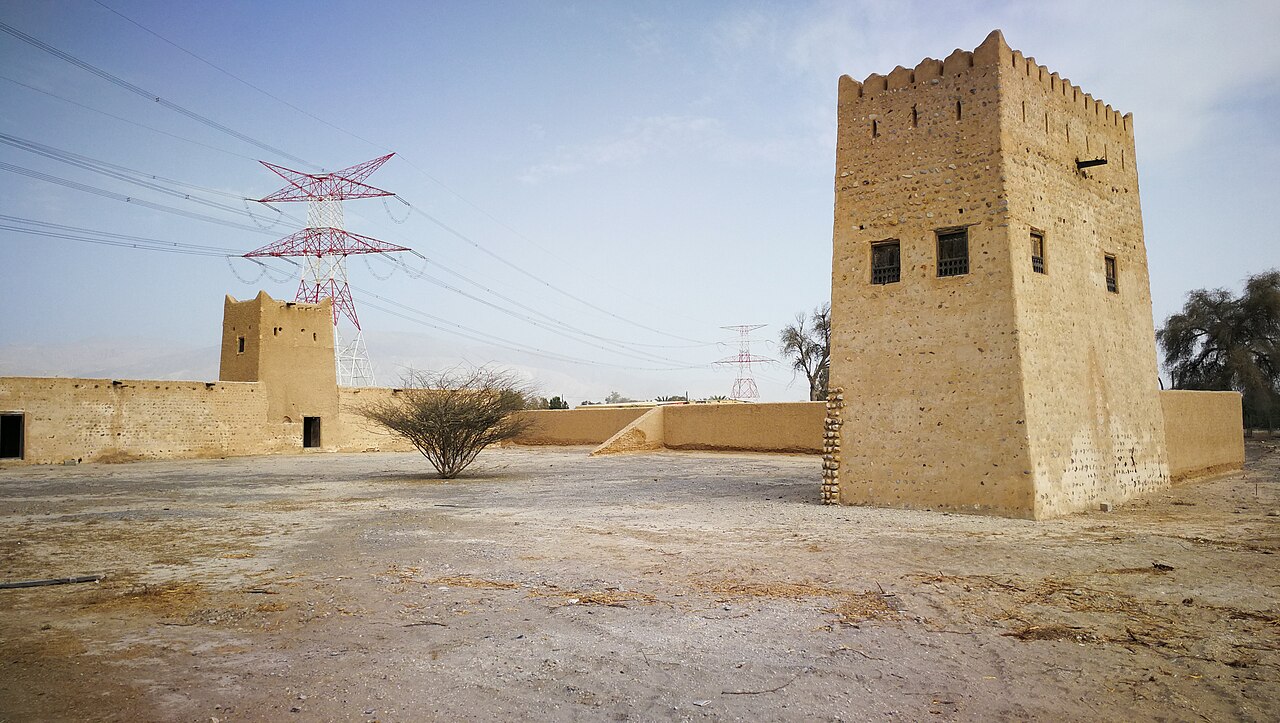
Khatt Towers

Khatt towers in Ras Al Khaimah, United Arab Emirates
Post-Renaissance (17th–18th c.)
Ruins

The Khatt towers are a group of three circular defense towers located in the small town of Khatt, situated within the emirate of Ras Al Khaimah in the United Arab Emirates. These towers date back to the 19th century and likely formed part of a defensive system to protect the local oasis and therapeutic hot springs, which have been valued in the region for their reputed healing properties.

Each tower is built on a circular ground plan, a common design for watchtowers and small fortifications in the Arabian Peninsula during this period. The towers served as lookout points and defensive positions to guard against raids and to secure the valuable water resources and settlements in this arid environment.

Architectural features and layout

The three towers are positioned around the oasis area, with the east tower located on the grounds of a castle-like hotel, which limits public access. The north tower is accessible to visitors, although it is in a state of ruin. The west tower is also in ruins and is noted for its interesting remains; however, it is situated on the grounds of a boys' school and is not open for visitation.

Despite their modest size and relatively simple construction, the towers are significant as examples of the region's traditional defensive architecture. Their cylindrical shape was practical for defense, offering wide fields of view and making them difficult targets for attackers.

Historical context and significance

The 19th century was a period of tribal conflicts and coastal raids in the Arabian Peninsula, and small fortifications like the Khatt towers played a crucial role in local defense strategies. The towers worked in conjunction with the nearby Khatt Fort, creating a network of surveillance and protection for the oasis community.

The oasis itself has long been an important settlement site due to its water resources and the presence of natural hot springs, which attracted inhabitants and travelers alike. Protecting these resources was vital for the survival and prosperity of the local population.

Current condition and accessibility

Today, the Khatt towers are partially preserved, with two of them in a state of ruin. The north tower, while accessible, shows signs of deterioration but remains a point of interest for visitors exploring the historical landscape of Ras Al Khaimah.

The east tower's location within a hotel complex restricts access, and the west tower's placement on school grounds limits public visitation. Despite these challenges, the towers contribute to the cultural heritage of the area and offer insight into the defensive measures employed in the region during the 19th century.

Preservation and cultural heritage

Efforts to preserve such structures are important to maintain the historical fabric of Ras Al Khaimah and to promote understanding of the emirate's past. The towers, though simple, represent the traditional architectural responses to local needs and environmental conditions.

Visitors to the area are encouraged to explore the accessible north tower and learn about the role these towers played in protecting the oasis and its valuable resources. The Khatt towers stand as modest but meaningful reminders of the region's history and its architectural heritage.

Frequently asked questions (FAQ)

What is the historical significance of the Khatt towers?
The Khatt towers were built in the 19th century to protect the oasis and therapeutic hot springs in Khatt, serving as lookout and defensive positions during a period of regional tribal conflicts.
Can visitors access all the Khatt towers?
The north tower is accessible to visitors but is in ruins. The east tower is on hotel grounds and not open to the public, while the west tower is on school property and also inaccessible.
What architectural style are the Khatt towers built in?
The Khatt towers feature a simple circular ground plan typical of defensive towers in the Arabian Peninsula during the 19th century, designed for practical surveillance and defense.
Where are the Khatt towers located?
The Khatt towers are located in the town of Khatt in the emirate of Ras Al Khaimah, United Arab Emirates, near an oasis known for its natural hot springs.
What is the current condition of the Khatt towers?
The towers are in a state of ruin, with the north and west towers showing significant deterioration, while the east tower remains on private hotel grounds.

Information

Tower House

Loading map...

Visitor reviews

No reviews yet. Been here? Write the first review and help other travelers!

Write the first review

Visited this castle? Share your experience

Your review helps other travelers and adds first-hand knowledge to our encyclopedia.

Write a review

(5/5)

0/2000 characters

Your review will be visible after admin approval

Nearby castles

0.3 km

Khatt Fort

Khatt, United Arab Emirates

Khatt Fort is located in the tranquil town of Khatt within the emirate of Ras Al Khaimah, United Arab Emirates. This historic fortress dates back to the 19th century and was strategically built to protect the local oasis and the renowned therapeutic hot springs in the area. The fort's position and design reflect its role in safeguarding vital natural resources and the surrounding community. Historical significance and use Constructed during the 19th century, Khatt Fort served as a defensive structure featuring three watchtowers that provided surveillance over the oasis and nearby lands. It functioned not only as a military fortification but also as the residence of the ruling family of Ras Al Khaimah until the early 1960s. This dual role highlights the fort's importance in both governance and protection during a period of regional tribal and political dynamics. In more recent decades, Khatt Fort was repurposed to house the Ras Al Khaimah National Museum, showcasing the emirate's cultural heritage. However, the museum has since been relocated to the Ras Al Khaimah Fort, and Khatt Fort has been undergoing restoration efforts to preserve its historical fabric. Architectural features and layout The fort is characterized by an irregular ground plan dominated by a robust elliptical tower, which stands as the most prominent architectural feature. This tower likely served as a lookout and defensive stronghold, offering commanding views of the surrounding landscape. The use of an elliptical shape is somewhat unusual and adds a distinctive element to the fort's silhouette. Additional defensive elements include the three watchtowers that complemented the main structure, providing early warning and protection against potential threats. The fort's walls and construction materials reflect traditional building techniques of the region, adapted to the desert environment. Restoration and current status Khatt Fort is currently undergoing restoration to stabilize and conserve its structure. Due to these works, the fort is not open to public visitation at present. Restoration aims to preserve the fort's historical and architectural significance while potentially preparing it for future cultural or educational use. Location and cultural context Situated in the emirate of Ras Al Khaimah, Khatt Fort is part of a region known for its rich history and strategic importance along the Arabian Peninsula's northern coast. The fort's proximity to natural hot springs has long made the area a place of settlement and healing, enhancing the fort's role in protecting these valuable resources. The fort's historical narrative is intertwined with the development of Ras Al Khaimah as a political and cultural center, reflecting the tribal leadership and defensive needs of the 19th and 20th centuries. Visiting information and accessibility Currently, Khatt Fort is closed to visitors due to ongoing restoration. Once completed, it is expected to offer insights into the architectural and historical heritage of Ras Al Khaimah. Visitors interested in the history of the fort and the region may also explore the nearby Ras Al Khaimah Fort and the relocated National Museum for a broader understanding of local heritage.

Modern (19th–20th c.)
Details
0.9 km

Habhab Towers

Khatt, United Arab Emirates

The Habhab Towers are a pair of historic defensive structures located near the village of Habhab, sometimes spelled Habsab, in the emirate of Fujairah within the United Arab Emirates. These towers stand prominently on the hills just south of the town of Khatt, which lies in the neighboring emirate of Ras Al Khaimah. The towers, together with the nearby Habhab Fort, formed a small defensive network designed to protect the local village oasis and its inhabitants. Historical context and purpose While detailed historical records about the Habhab Towers are scarce, architectural and regional evidence suggests that they were constructed in the late 19th or early 20th century. This period was marked by tribal conflicts and the need to safeguard vital resources such as water and agricultural lands in the harsh desert environment. The towers likely served as watchpoints and defensive posts to monitor approaching threats and provide refuge during attacks. The towers' proximity to the Habhab Fort, situated at the foot of the hills, indicates a coordinated defense strategy. The fort itself functioned as a stronghold for local leaders and a center for controlling the surrounding territory. Together, these structures helped secure the oasis village, which was an essential stopover and settlement in the region. Architectural features and construction The Habhab Towers are notable for their simple yet functional design typical of defensive architecture in this part of the Arabian Peninsula. Built primarily from local stone and mudbrick materials, the towers rise several stories high, providing wide vantage points over the surrounding landscape. Their thick walls would have offered protection against small arms fire and projectiles. Each tower features narrow slit windows or embrasures, designed for surveillance and the use of firearms or arrows while minimizing exposure to attackers. The towers' locations on elevated terrain further enhanced their defensive capabilities by allowing early detection of any approaching forces. The Habhab Fort complements the towers with its larger footprint and more complex layout, including defensive walls, internal chambers, and possibly storage areas for provisions and weapons. Although currently undergoing restoration, the fort retains much of its original form, illustrating traditional fortification methods used in the region during the transitional period between tribal fortresses and modern military architecture. Current condition and visitor experience Today, the Habhab Towers stand in an unrestored condition, which some visitors find appealing as it conveys a sense of authenticity and historical atmosphere. The towers are accessible to the public, allowing visitors to explore their rugged interiors and appreciate the strategic vantage points they offer over the surrounding hills and oasis. The nearby Habhab Fort is currently undergoing restoration efforts. While the fort is accessible, the ongoing work may limit some areas. The restoration aims to preserve the fort's structural integrity and potentially enhance its role as a cultural heritage site. Both the towers and the fort provide insight into the defensive architecture of the region during a period of significant social and political change in the Arabian Peninsula. They offer a tangible connection to the traditional ways communities protected vital resources and maintained control over their territories. Geographical and cultural significance Located near the border between the emirates of Fujairah and Ras Al Khaimah, the Habhab Towers and fort occupy a strategic position overlooking the fertile oasis of the village of Habhab. This location was crucial for controlling trade routes and agricultural resources in the region. The structures reflect the historical tribal dynamics and the need for fortified settlements in an area characterized by rugged terrain and limited water sources. They are part of the broader cultural heritage of the UAE, representing the architectural responses to environmental and social challenges faced by communities before the country's modernization. Access and visiting information The Habhab Towers and Habhab Fort are open to visitors without an entrance fee. Their remote location means visitors should plan transportation accordingly, often requiring a vehicle capable of navigating rural roads. The towers' unrestored state allows for an authentic exploration, though visitors should exercise caution due to uneven surfaces and structural fragility. Visiting these sites offers a unique opportunity to experience early 20th-century defensive architecture in the UAE, contrasting with the modern urban developments found elsewhere in the country. They are a valuable destination for those interested in history, architecture, and the cultural landscape of the Arabian Peninsula.

Post-Renaissance (17th–18th c.)
Details
13.9 km
Al Fulayyah — United Arab Emirates castle

Al Fulayyah

, United Arab Emirates

Al Falayah fort is a notable 18th-century bastioned fortress located in Ras Al Khaimah, one of the emirates of the United Arab Emirates. This fort served an important role historically as the summer residence and rest house of the ruling Al Qasimi family, a powerful dynasty that governed the area during the post-Renaissance period. Its strategic position and architectural features reflect the military and residential needs of the time.Historical context and significanceThe Al Qasimi family were influential rulers in the region, known for their naval power and control over parts of the Arabian Gulf. Al Falayah fort was constructed during the 18th century when the Al Qasimi sought to establish fortified residences that could serve both defensive and domestic purposes. The fort's use as a summer retreat highlights its role beyond mere military defense, providing a place of respite from the harsh climatic conditions of the region.Architectural features of Al Falayah fortThe fort is classified as a bastioned fortress, a style characterized by angular bastions projecting from the main walls, designed to provide overlapping fields of fire and improved defense against attackers. The bastions at Al Falayah would have enabled defenders to cover the approaches to the fort effectively, reflecting military architectural trends of the post-Renaissance period adapted to local needs.The structure is built primarily from local materials, including stone and coral, bonded with traditional mortar. The walls are thick and robust, designed to withstand both artillery and the harsh desert environment. The fort includes typical features such as high defensive walls, watchtowers, and a which would have served as a communal space and possibly for military drills or gatherings.Layout and internal structuresInside, the fort contains several chambers used for residential and administrative purposes. These rooms would have accommodated the ruling family and their retinue during their stays. The design balances defensive strength with livability, incorporating ventilation and shaded areas to cope with the hot climate.The role of Al Falayah fort in regional historyAl Falayah fort played a role in the defense network of the Al Qasimi territories, helping to secure Ras Al Khaimah against rival tribes and colonial powers. Its position allowed control over nearby routes and access points, contributing to the stability and governance of the emirate.Though not as large or famous as some other forts in the UAE, Al Falayah remains an important cultural and historical landmark. It provides insight into the architectural adaptations and political landscape of the Arabian Peninsula during the 18th century.Preservation and current statusToday, Al Falayah fort is partially preserved and recognized for its heritage value. Efforts have been made to maintain its structure and promote awareness of its historical significance. Visitors to Ras Al Khaimah can view the fort as part of the region's rich tapestry of forts and castles that illustrate the emirate's past.While access may be limited compared to more prominent tourist sites, Al Falayah fort remains a point of interest for those studying the military architecture and ruling dynasties of the UAE.

Post-Renaissance (17th–18th c.)
Details