Kaysersberg Castle
Kaysersberg Castle, also known locally as Château de Kaysersberg or Schlossberg, stands as a prominent medieval fortress perched on a hillside overlooking the town of Kaysersberg in the Haut-Rhin department of France. Nestled within the region historically called Southern Alsace or the Southern Vosges, this castle holds significant historical and architectural value as a strategic stronghold controlling access through the Vosges Mountains towards Lorraine.
Constructed around 1220 for Albin Woelflin, the imperial bailiff serving Frederick II, Holy Roman Emperor, Kaysersberg Castle was strategically positioned to oversee and secure a vital route connecting the Empire to the Duchy of Lorraine. The castle's ownership shifted in 1227 to the Lords of Horbourg and Ribeaupierre, who maintained its military and administrative functions through the Middle Ages.
Architectural features and construction
The circular keep and curtain walls
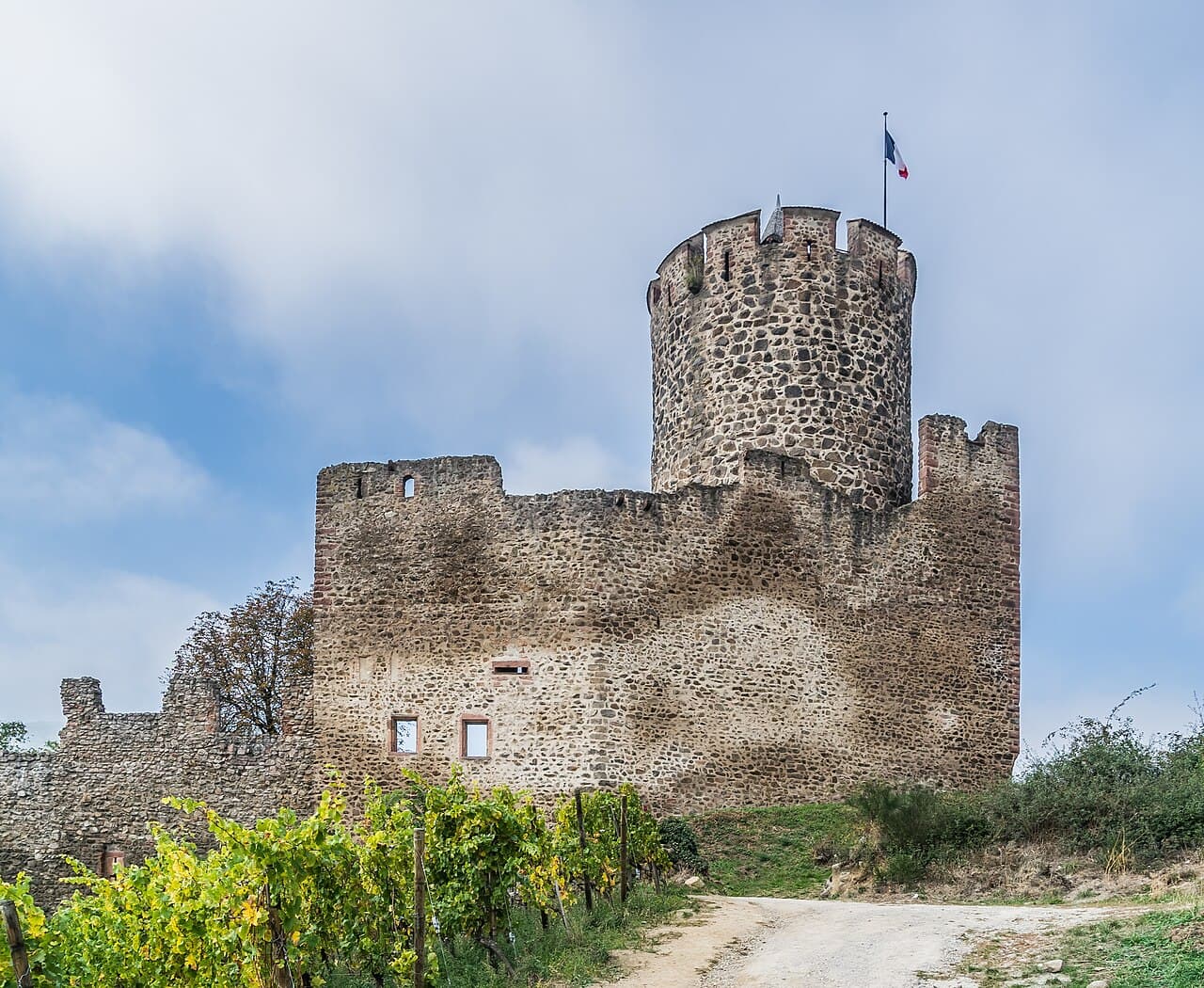
The most striking feature of Kaysersberg Castle is its cylindrical keep, one of the earliest of its kind in the Upper Rhine valley, comparable to the one at Château de Pflixbourg. The keep measures approximately 11 meters in diameter with impressively thick walls up to 4.42 meters, designed primarily for defense. Originally, the keep's entrance was located high above ground level, accessible likely by ladder, a common defensive feature of medieval bergfrieds. In the 19th century, this entrance was modified to a ground-level doorway.
The keep's interior was divided into four levels: a dark dungeon at ground level, a first floor standing nine meters high accessed through an arched doorway, a storage floor, and a roof platform. The roof was originally covered but later adapted in the late Middle Ages to accommodate artillery, featuring embrasures and firing slits for cannons and firearms.
The curtain walls enclosing the keep evolved over time. Initially, the keep was integrated into the curtain wall, but after 1261, a new wall was built to enclose the keep fully, allowing a continuous circuit of defensive walls. Following a fire in the 14th century, the enceinte was heightened to approximately 4 meters, enhancing its defensive capabilities.
Residential and defensive structures
The castle's main residential buildings were situated along the eastern curtain wall, including a three-story house built around 1380 and a larger building featuring a cellar and two upper floors. A small round structure added in the 15th century between the keep and residences remains of uncertain purpose.
Defensive adaptations in the 15th century responded to the advent of artillery and firearms. The crenellations were modified with wooden shutters, merlons were equipped with firing slits, and the round walk was fully covered. The eastern entrance was protected by a barbican with a drawbridge, and large gun openings such as a cruciform cannon opening and a circular firing hole were incorporated near the gate. Two neck ditches further fortified vulnerable approaches.
Historical significance and timeline
Early history and strategic role
Built during the late medieval period, Kaysersberg Castle played a critical role in controlling the route through the Vosges Mountains. Its location allowed the Holy Roman Empire to monitor and regulate movement between Alsace and Lorraine, a contested border region. The castle was first documented in 1227 when King Henry VII, son of Frederick II, acquired rights to the fortress, which was either newly completed or under construction.
Throughout the 13th century, the castle witnessed regional conflicts, including sieges by the Bishop of Strasbourg in 1246 and 1247 and occupation by the Duke of Lorraine in 1248. After 1261, ownership passed to Rudolf of Habsburg, who undertook significant upgrades and granted the castle as a fief to allies, reinforcing its military and administrative importance.
Later medieval and early modern period
In the 14th century, the castle served as the residence of the imperial provost or bailiff. A fire damaged the castle during this century, leading to the raising of the curtain wall. The 15th century brought modernization of defenses to accommodate new artillery technology, although the castle's military significance gradually diminished, and stationed personnel were reduced.
During the German Peasants' War (1524-1525), the castle was besieged, sustaining damage. It was later restored in 1583 by Lazarus von Schwendi, a baron and owner of nearby Hohlandsbourg Castle. Archaeological evidence suggests the castle was abandoned by the end of the 16th century.
Following the French Revolution, the castle was declared a national asset and sold to François Joseph Boecklin de Boecklinsau, who converted the grounds into vineyards. Ownership later passed to the Bastard family. The castle's ruins have been protected as a historic monument since 1841, with further protections added in 1995. Ownership transferred from the French state to the local community by 2016.
The castle ruins today and visitor experience
Today, Kaysersberg Castle stands as a well-known ruin accessible to the public. It sits at an altitude of approximately 295 meters, dominating the town from about 50 meters above. Visitors can explore the remains of the triangular upper castle (Oberburg) and the larger lower castle (Unterburg), separated by a dividing wall.
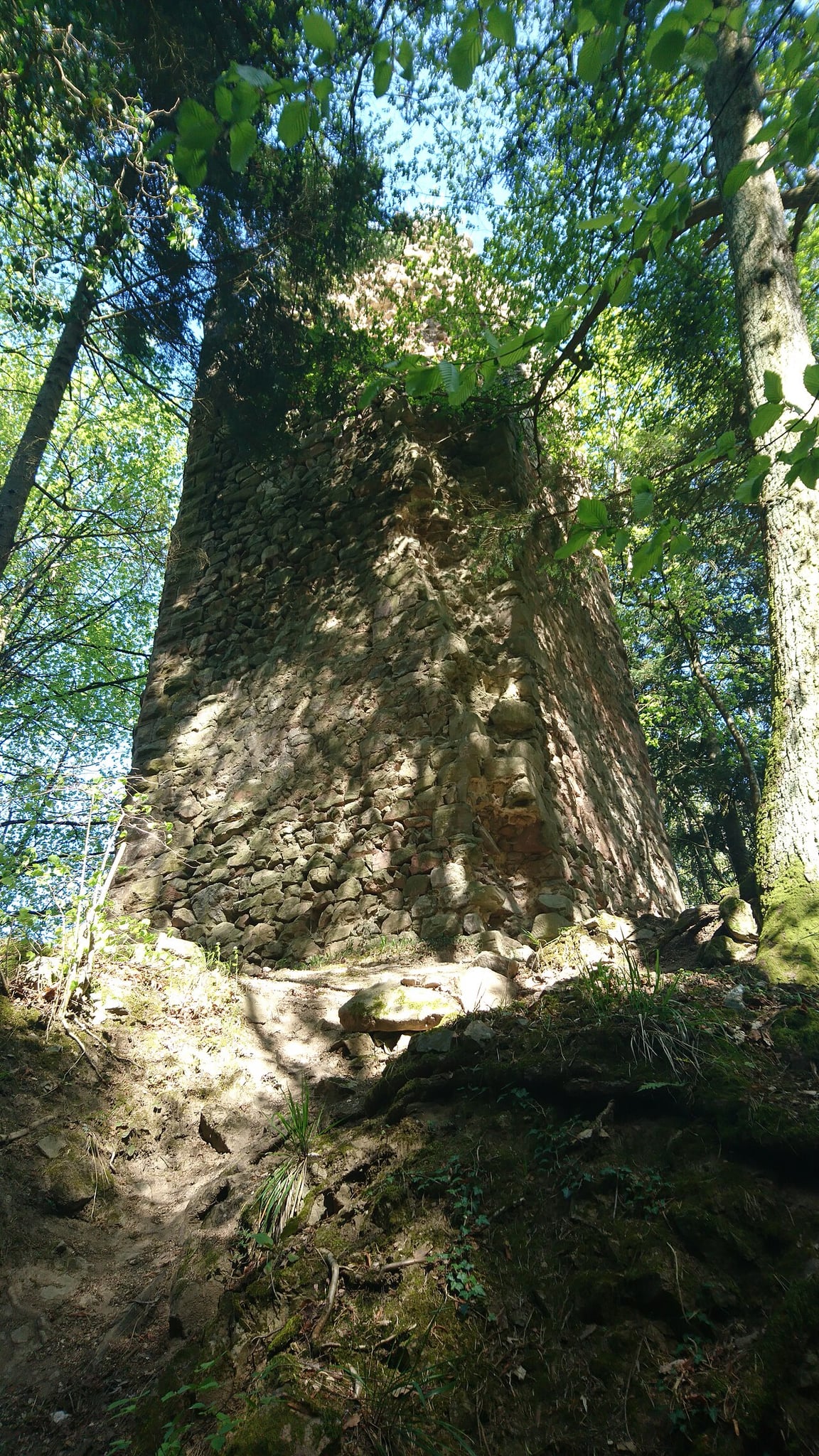
The upper castle features the imposing circular bergfried rising nearly 25 meters with walls over four meters thick. The ring wall surrounding this section reaches about 7.5 meters in height, with a distinctive shield wall at the northern tip standing 14 meters tall but unusually thin. Stone corbels suggest the former presence of wooden battlements and a covered round walk.
The lower castle's polygonal ring wall encloses an area of roughly 2.8 hectares, with archaeological remains of former buildings and a wooden battlement walk. The eastern gate from the 13th century is now closed to visitors, and the western gate is sealed.
Visitors can ascend the castle ruins via two staircases and a path through the vineyards from the historic town center. Climbing the 122-step staircase to the keep platform rewards with panoramic views of Kaysersberg, the valley entrance, the surrounding vineyards, and on clear days, the distant Black Forest in Germany.
Architectural materials and construction techniques
The castle was primarily built from local greywacke stone, with larger blocks reserved for significant structures such as the bergfried. Granite was used for cornerstones and door or window surrounds, providing durability and aesthetic contrast. Rubble masonry filled in less critical areas. Excavations in the 1990s employed tree-ring dating to clarify construction phases, revealing the development sequence of the ring walls.
The castle's outer defenses are integrated with the town's fortifications, creating a cohesive medieval defensive system still visible in the surviving walls and overall site layout.
Cultural and heritage importance
Kaysersberg Castle is a valuable cultural monument representing the military architecture and feudal history of the Upper Rhine region. Its distinctive circular keep is a rare example of early medieval military design. The castle's strategic location and historical role in regional conflicts highlight its importance in the political and military landscape of medieval Alsace and Lorraine.
As a protected historic site, the castle attracts visitors interested in medieval history, architecture, and panoramic views of the Alsace countryside. Its ruins offer insight into the evolution of castle fortifications in response to changing military technologies from the 13th to the 16th centuries.
Frequently asked questions (FAQ)
- How do I get to Kaysersberg Castle?
- Kaysersberg Castle is located in the Alsace region of France, easily accessible by car or public transport. The nearest train station is in Kaysersberg, from which you can enjoy a scenic walk up to the castle.
- What is the historical significance of Kaysersberg Castle?
- Kaysersberg Castle dates back to the 13th century and played a vital role in the defense of the region during the Middle Ages. It offers insights into the feudal history of Alsace and showcases the strategic importance of the location.
- When was Kaysersberg Castle built?
- Construction of Kaysersberg Castle began in 1260 and was completed in the late 13th century. The castle was built to protect the town and its inhabitants from external threats, reflecting the turbulent history of the area.
- Can I visit Kaysersberg Castle year-round?
- Yes, Kaysersberg Castle is open to visitors year-round, but certain areas may be closed during winter months for safety reasons. It's advisable to check the official website for any seasonal updates or closures.
- Why is Kaysersberg Castle a popular tourist attraction?
- Kaysersberg Castle is popular for its stunning panoramic views of the surrounding Alsace landscape and its rich history. The picturesque ruins are a perfect backdrop for photography, making it a favorite spot for visitors.
- Is it possible to explore the interior of Kaysersberg Castle?
- While much of Kaysersberg Castle is in ruins, visitors can explore the castle grounds and enjoy the views from various vantage points. Guided tours may be available to provide additional historical context.
- What are the opening hours for Kaysersberg Castle?
- Kaysersberg Castle typically opens at 9 AM and closes at sunset, but hours may vary depending on the season. Always check the latest information online before your visit to ensure you plan accordingly.
- Are there nearby attractions to visit after Kaysersberg Castle?
- Yes, there are several nearby attractions, including the charming village of Kaysersberg itself, with its cobblestone streets and traditional Alsatian architecture. Additionally, the Route des Vins d'Alsace offers beautiful vineyards and wine tasting opportunities.
- What are the ticket prices for Kaysersberg Castle?
- Visiting Kaysersberg Castle is free of charge, allowing everyone to enjoy its historical significance and beautiful surroundings. However, if you choose to take a guided tour, there may be a fee, so it's best to verify in advance.
Photo gallery

Information
Website
Visit websiteSources & official resources
Verify the information above using these authoritative references.
Loading map...
Visitor reviews
No reviews yet. Been here? Write the first review and help other travelers!
Write the first reviewVisited this castle? Share your experience
Your review helps other travelers and adds first-hand knowledge to our encyclopedia.