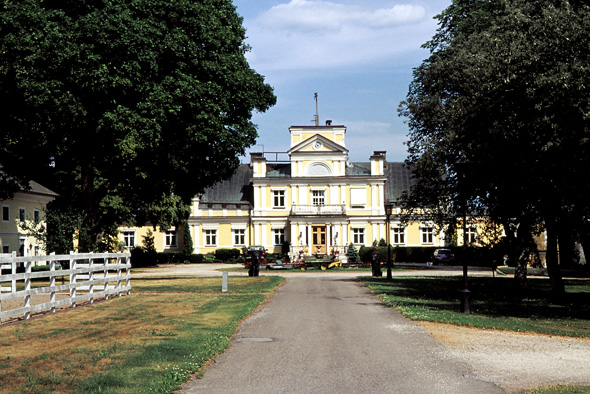
Kavlås Castle
Kavlås Castle, located in Tidaholm, Sweden, is a notable example of a Post-Renaissance manor house that has retained its historical significance and family ownership since its construction in 1775. The castle was commissioned by Baron von Essen and remains under the stewardship of the same family, reflecting a continuous lineage that adds to its cultural heritage.
Historical background and origins
The estate on which Kavlås Castle stands was first documented in the late 14th century, indicating its long-standing importance in the region. Over the centuries, the estate evolved from its medieval origins into the grand manor visible today. The transition from earlier structures to the current castle marks significant shifts in architectural styles and the social status of its owners.
Architectural features and style
Kavlås Castle is characterized by its three-storey construction, typical of aristocratic residences from the 18th century. The building exhibits elements consistent with Post-Renaissance architecture, a period that often involved a blend of classical influences with emerging neoclassical tendencies. The castle's façade and internal layout reflect this transitional style, with an emphasis on symmetry, proportion, and restrained decorative details.
Structural layout
The castle's structure is composed of a main residential building with a balanced arrangement of windows and doors, contributing to its elegant appearance. The interior likely includes formal reception rooms, private chambers, and service areas arranged to support the lifestyle of the noble family. While specific interior details are less documented, the castle's external form suggests a well-planned manor house typical of Swedish aristocratic estates of the period.
Estate grounds and surroundings
The castle is set within an estate that historically would have included gardens, farmland, and possibly ancillary buildings such as stables and servants' quarters. The surrounding landscape contributes to the castle's prominence in the region and underscores its function as a center of local power and agriculture.
Ownership and legacy
Since its construction, Kavlås Castle has remained in the possession of the von Essen family, a fact that highlights the estate's importance as a hereditary seat. This continuous ownership has helped preserve the castle's historical integrity and maintain its role within the local community. The family's stewardship also suggests a commitment to conserving the estate's architectural and cultural heritage.
Preservation and current status
Kavlås Castle is currently well preserved, retaining much of its original structure and appearance. Its condition allows visitors and scholars to appreciate the architectural qualities of a late 18th-century Swedish manor. The castle's preservation contributes to the understanding of Sweden's aristocratic residential architecture during the Post-Renaissance period.
Visiting information and cultural significance
While Kavlås Castle remains a private estate, its historical and architectural value makes it a point of interest for those studying Swedish manor houses and aristocratic history. The castle exemplifies the evolution of noble residences from medieval estates to refined 18th-century manors, offering insights into the social and cultural transformations of the time.
Overall, Kavlås Castle stands as a significant monument within the Swedish architectural landscape, representing the enduring legacy of noble families and the stylistic transitions of the Post-Renaissance era.
Frequently asked questions (FAQ)
- What is the historical significance of Kavlås Castle?
- Kavlås Castle, built in the late 16th century, is a remarkable example of Renaissance architecture in Sweden. It served as a noble residence and played a crucial role in the region's history, reflecting the power and influence of the local aristocracy.
- When was Kavlås Castle built?
- Kavlås Castle was constructed between 1580 and 1590. It has undergone various renovations over the centuries to preserve its historical integrity and architectural beauty.
- What are the opening hours for Kavlås Castle?
- Kavlås Castle is open to visitors from April to October, typically from 10 AM to 5 PM on weekdays and 10 AM to 6 PM on weekends. It’s advisable to check the official website for any seasonal changes or special events that may affect these hours.
- Can I visit Kavlås Castle year-round?
- While the castle is primarily open from April to October, it can be visited year-round by appointment for special tours or events. Contact the castle administration for more information on off-season visits.
- Is Kavlås Castle accessible for visitors with disabilities?
- Yes, Kavlås Castle strives to accommodate all visitors, including those with disabilities. The castle offers accessible pathways and facilities, but it’s best to reach out in advance for specific needs or assistance.
- What are the ticket prices for visiting Kavlås Castle?
- Ticket prices for Kavlås Castle are generally around 100 SEK for adults, with discounts available for students and seniors. Children under the age of 12 can enter for free, making it an affordable destination for families.
- When is the best time to visit Kavlås Castle?
- The best time to visit Kavlås Castle is during the summer months, from June to August, when the weather is pleasant and the gardens are in full bloom. Additionally, special events and guided tours are often scheduled during this peak season.
- What nearby attractions can I explore after visiting Kavlås Castle?
- After visiting Kavlås Castle, you can explore the charming town of Tidaholm, which offers several shops, cafes, and parks. The scenic landscapes of the surrounding area also provide opportunities for hiking and enjoying nature.
Information
Loading map...
Visitor reviews
No reviews yet. Been here? Write the first review and help other travelers!
Write the first reviewVisited this castle? Share your experience
Your review helps other travelers and adds first-hand knowledge to our encyclopedia.