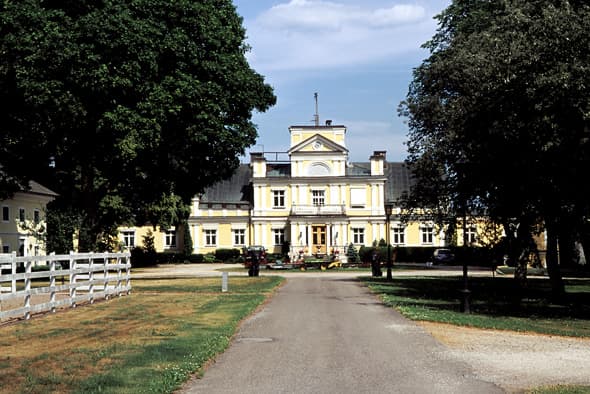
Dagsnäs Castle
Dagsnäs Castle is a historic estate located near Falköping in the region of Västergötland, Sweden. Situated approximately 9 km south of Skara and close to the scenic Lake Hornborga, the castle stands as a notable example of a post-Renaissance hill castle with architectural and cultural significance dating back several centuries.
The earliest recorded history of the Dagsnäs estate traces back to the 15th century, when it was owned by the Gumsehuvud family. Over the centuries, ownership transferred through prominent Swedish noble families including the Thott, Soop, Kafle, and Uggla families, reflecting the estate's importance within the regional aristocracy.
Architectural development and main building
The current main building of Dagsnäs Castle was constructed between 1772 and 1782 under the direction of Per Tham, a noted antiquarian and cultural patron who acquired the estate in 1762. This period corresponds to the post-Renaissance era, and the castle’s architecture embodies characteristics typical of this time, with a robust stone construction that replaced any earlier wooden structures.
Per Tham's vision transformed the estate into a cultural center in Västergötland, attracting intellectuals and artists of the period. The castle’s layout includes a central stone building with balanced proportions and classical details that align with late 18th-century Swedish aristocratic architecture.
Restoration by Helgo Zettervall
In 1874, the castle underwent significant restoration according to plans devised by Helgo Zettervall, a prominent Swedish architect known for his work on historic buildings and churches. Zettervall’s restoration preserved the castle’s structural integrity while enhancing its aesthetic appeal, contributing to the castle’s current appearance. His work often blended historic styles with contemporary needs, ensuring the castle remained functional and visually impressive.
Historical significance and cultural heritage
Dagsnäs Castle is not only architecturally significant but also culturally important due to its role as a regional hub for arts and antiquarian interests during the 18th and 19th centuries. Per Tham’s stewardship established the castle as a center for cultural exchange, scholarly pursuits, and preservation of regional heritage.
The estate’s grounds are notable for housing several Viking Age runestones relocated from surrounding areas, which contribute to its archaeological and historical value. These runestones include:
- Vg 59 from Norra Härene
- Vg 67 from Saleby
- Vg 122 from Abrahamstorp
- Vg 184 from Smula
- Vg 186 from Timmele
These artifacts provide insight into the region’s Viking past and are an integral part of the castle’s heritage presentation.
Location and surroundings
Dagsnäs Castle is strategically positioned on a hill overlooking Lake Hornborga, an area known for its natural beauty and rich birdlife, including migratory cranes. The castle’s elevated location classifies it as a hill castle, which historically offered defensive advantages as well as commanding views of the surrounding landscape.
The proximity to Skara, one of Sweden’s oldest cities, situates the castle within a historically vibrant region that was central to medieval Swedish politics and culture.
Architectural features and estate layout
The castle complex includes the main stone building, ancillary structures, and extensive grounds that have been shaped over centuries. The main building features traditional elements such as symmetrical façades, classical window arrangements, and a robust stone foundation typical of late 18th-century Swedish architecture.
The estate grounds are landscaped to complement the castle, with areas dedicated to the display of the runestones and other historical artifacts. The preservation of these elements offers visitors a tangible connection to Sweden’s medieval and Viking heritage.
Runestones and archaeological importance
The presence of multiple runestones on the castle grounds makes Dagsnäs a significant site for those interested in Viking history and runic inscriptions. These stones were carefully moved from their original locations in the surrounding countryside to protect and showcase them.
Each runestone bears inscriptions that provide valuable information about the people, events, and beliefs of the Viking Age in this part of Sweden. The castle thus serves both as a historical residence and an open-air museum for ancient Scandinavian culture.
Current status and visitor information
Dagsnäs Castle remains well preserved and retains much of its historical character. While it is primarily a private estate, the castle and its grounds are occasionally accessible to visitors during special events or by arrangement, offering a glimpse into Sweden’s aristocratic and Viking past.
The castle’s combination of post-Renaissance architecture, historical runestones, and scenic location near Lake Hornborga makes it a unique destination for history enthusiasts, archaeologists, and tourists exploring Sweden’s cultural heritage.
Frequently asked questions (FAQ)
- When was Dagsnäs Castle built and by whom?
- Dagsnäs Castle was built between 1772 and 1782 by Per Tham, a noted antiquarian and patron who purchased the estate in 1762.
- What is the architectural style of Dagsnäs Castle?
- The castle reflects post-Renaissance architectural elements typical of late 18th-century Swedish aristocratic stone buildings, with later restoration work by architect Helgo Zettervall in 1874.
- Are there any Viking artifacts at Dagsnäs Castle?
- Yes, several Viking Age runestones from the surrounding region have been relocated to the castle grounds, including notable stones from Norra Härene, Saleby, Abrahamstorp, Smula, and Timmele.
- Where is Dagsnäs Castle located?
- Dagsnäs Castle is located near Falköping in the Västergötland region of Sweden, about 9 km south of the historic city of Skara.
- Is Dagsnäs Castle open to the public?
- The castle is primarily a private estate but may be accessible to visitors during special events or by prior arrangement.
Photo gallery

Information
Sources & official resources
Verify the information above using these authoritative references.
Loading map...
Visitor reviews
No reviews yet. Been here? Write the first review and help other travelers!
Write the first reviewVisited this castle? Share your experience
Your review helps other travelers and adds first-hand knowledge to our encyclopedia.



