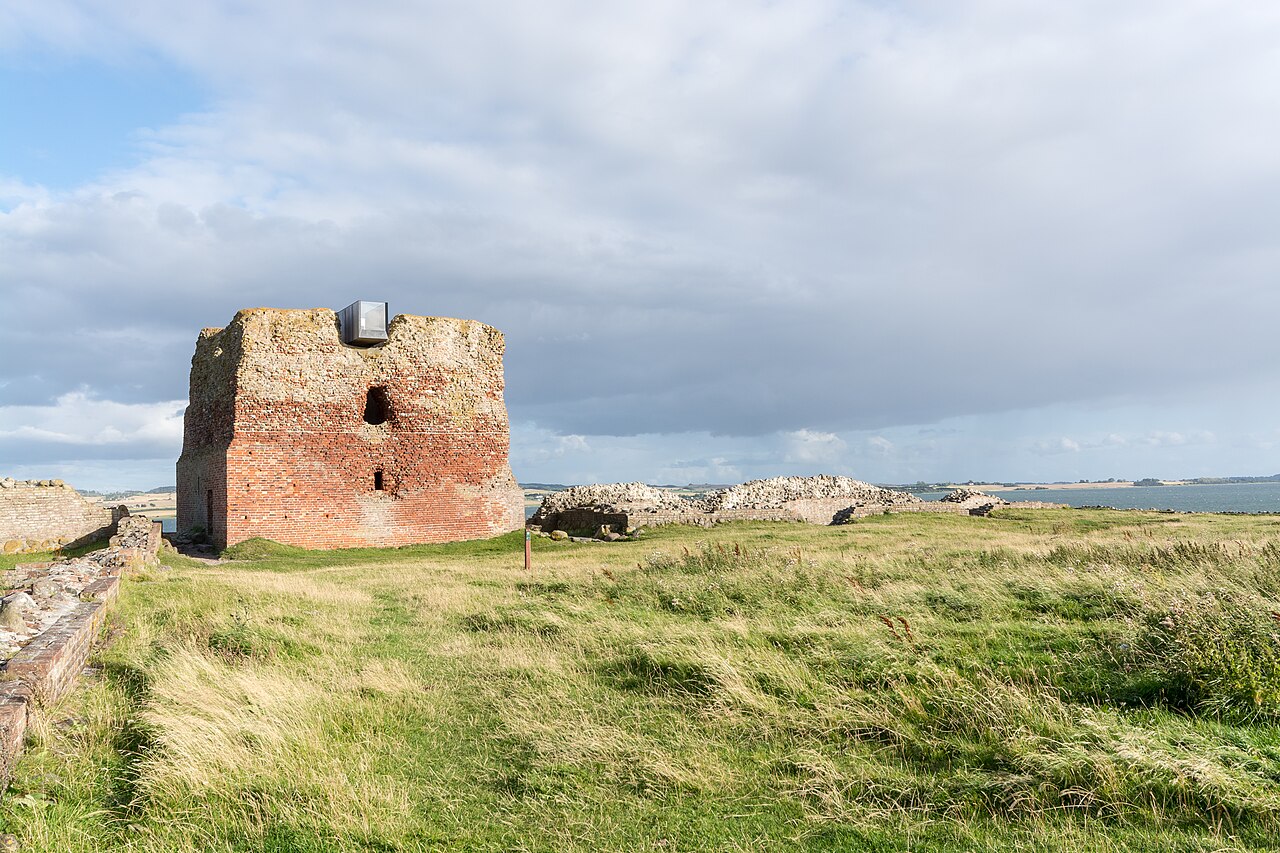
Katholm Castle
Katholm Castle stands as a significant example of Renaissance architecture in Denmark, located near the town of Grenaa on the Djursland peninsula. This manor house, built between 1588 and 1591, has a rich history rooted in Danish nobility and agricultural tradition. Originally a farm dating back to the 15th century, Katholm was transformed into a manor by Christian Fasti in 1545, marking the beginning of its development into the castle known today.
Early construction and architectural features
The construction of Katholm Castle was initiated by Thomas Fasti, Christian's son, who completed the east wing in 1588 and the north wing in 1591. These wings form part of the castle's distinctive three-winged layout, built primarily of red brick in a simple yet elegant Renaissance style. The castle is situated on a castle bank surrounded by an artificial lake, featuring a moat that emphasizes its defensive origins.
Architectural highlights include two capped corner towers and a staircase in the central courtyard, all dating from the original construction period. The east wing is notable for its Dutch gable with curved contours, characteristic of Renaissance design influences from the Low Countries. The west wing, added later in 1622 by Albret Skeel, features a crow-stepped gable and is lower in height, contributing to the castle's harmonious but varied silhouette.
Ownership history and expansions
After Thomas Fasti's death in 1600, his widow Christence Bryske continued to reside at Katholm until her death in 1611. The estate then passed through several hands, including Christence's brother and his sons, who eventually sold Katholm in 1616 to Albret Skeel, a prominent nobleman who served as Admiral of the Realm and was a member of the Privy Council. Skeel expanded the estate by adding the west wing and developing a large farm south of the castle.
The estate remained with the Skeel family for several generations until it passed through marriage to the Sehested family in the late 17th century. In 1690, Katholm was acquired by Palle Krag, a distinguished military officer noted for his service in the Scanian War and the Great Northern War. Following Krag's death in 1723, the manor changed ownership multiple times, including to Major-General Poul Rosenørn and his family.
Financial difficulties in the 19th century led to state intervention, and Katholm was taken over by the government in 1823. It was sold at public auction in 1839 to First Lieutenant Adolph Wilhelm Dinesen, a public figure and politician. The Dinesen family maintained ownership for several decades, with notable descendants including Wilhelm Dinesen, father of famous writer Karen Blixen.
In the 20th century, the estate was acquired by the Collet family, who have continued to manage and preserve Katholm. Despite a devastating fire in 1935 that damaged the farm buildings, the Collets rebuilt and modernized the estate facilities, ensuring Katholm's continued operation as a working manor.
Architectural layout and estate features
Katholm Castle's layout consists of three primary wings arranged around a central courtyard that opens to the south. A masonry bridge crosses the moat, connecting the castle to the remains of the farm complex, including a barn from 1618 and a stable from 1619. These agricultural buildings reflect the manor's longstanding role as a center of farming activity.
The castle's red brick construction and Renaissance design elements, such as the curved Dutch gable and crow-stepped gable, illustrate the architectural trends of late 16th-century Denmark influenced by northern European styles. The two corner towers provide both defensive and aesthetic functions, while the courtyard staircase adds a functional and decorative focal point to the estate's interior space.
Cultural significance and current status
Katholm Castle remains a privately owned estate, currently held by Marie Therese Collet, representing the fourth generation of the Collet family at the manor since 2007. The estate encompasses approximately 1170 hectares, maintaining its status as a significant agricultural and historical property in the region.
Its preservation of Renaissance architectural features alongside later additions and agricultural buildings offers valuable insight into the evolution of Danish manor houses and noble estates over several centuries. Katholm's continuous occupation and adaptation reflect broader trends in Danish history, including noble lineage, military service, and agricultural development.
Visitors and scholars alike can appreciate Katholm for its combination of architectural charm, historical depth, and its role within Denmark's cultural landscape. The castle's proximity to Grenaa and the scenic Djursland area adds to its appeal as a heritage site.
Frequently asked questions (FAQ)
- What is the historical significance of Katholm Castle?
- Katholm Castle is a remarkable example of 16th-century Renaissance architecture in Denmark, showcasing the rich history of noble estates in the region. Originally built as a fortified manor, it has played a crucial role in local governance and culture over the centuries.
- When was Katholm Castle constructed?
- Katholm Castle was constructed in the late 16th century, with its foundations laid in 1585. The castle has undergone various modifications and restorations since its inception, reflecting the architectural trends of different periods.
- What are the opening hours for Katholm Castle?
- Katholm Castle is typically open to visitors from April to October, with specific hours varying throughout the week. It is advisable to check the official website for the most current opening times and any special event schedules.
- Can I take guided tours of Katholm Castle?
- Yes, guided tours are available for visitors who wish to learn more about the history and architecture of Katholm Castle. These tours provide in-depth insights and are a great way to explore the castle's rich heritage.
- Is it possible to visit Katholm Castle year-round?
- While Katholm Castle is primarily open to visitors during the warmer months, special arrangements may be made for group tours off-season. It's best to contact the castle administration for detailed information regarding winter visits.
- What are the ticket prices for visiting Katholm Castle?
- Ticket prices for Katholm Castle can vary based on the season and type of tour chosen. Generally, there are discounts for children, seniors, and groups, making it accessible for a wide range of visitors.
- When is the best time to visit Katholm Castle?
- The best time to visit Katholm Castle is during the spring and summer months when the gardens are in full bloom, and guided tours are readily available. Additionally, special events and exhibitions are often hosted during this time, enhancing the visitor experience.
- Are there any nearby attractions to visit along with Katholm Castle?
- Yes, there are several nearby attractions, including beautiful nature reserves and historical sites in Grenaa. Visitors can also enjoy local beaches and charming coastal towns, making it a perfect day trip destination.
- How do I get to Katholm Castle?
- Katholm Castle is conveniently located near Grenaa, and can be accessed by car or public transportation. There are ample parking facilities available, and local bus services connect the castle with the surrounding areas.
Information
Website
Visit websiteSources & official resources
Verify the information above using these authoritative references.
Loading map...
Visitor reviews
No reviews yet. Been here? Write the first review and help other travelers!
Write the first reviewVisited this castle? Share your experience
Your review helps other travelers and adds first-hand knowledge to our encyclopedia.