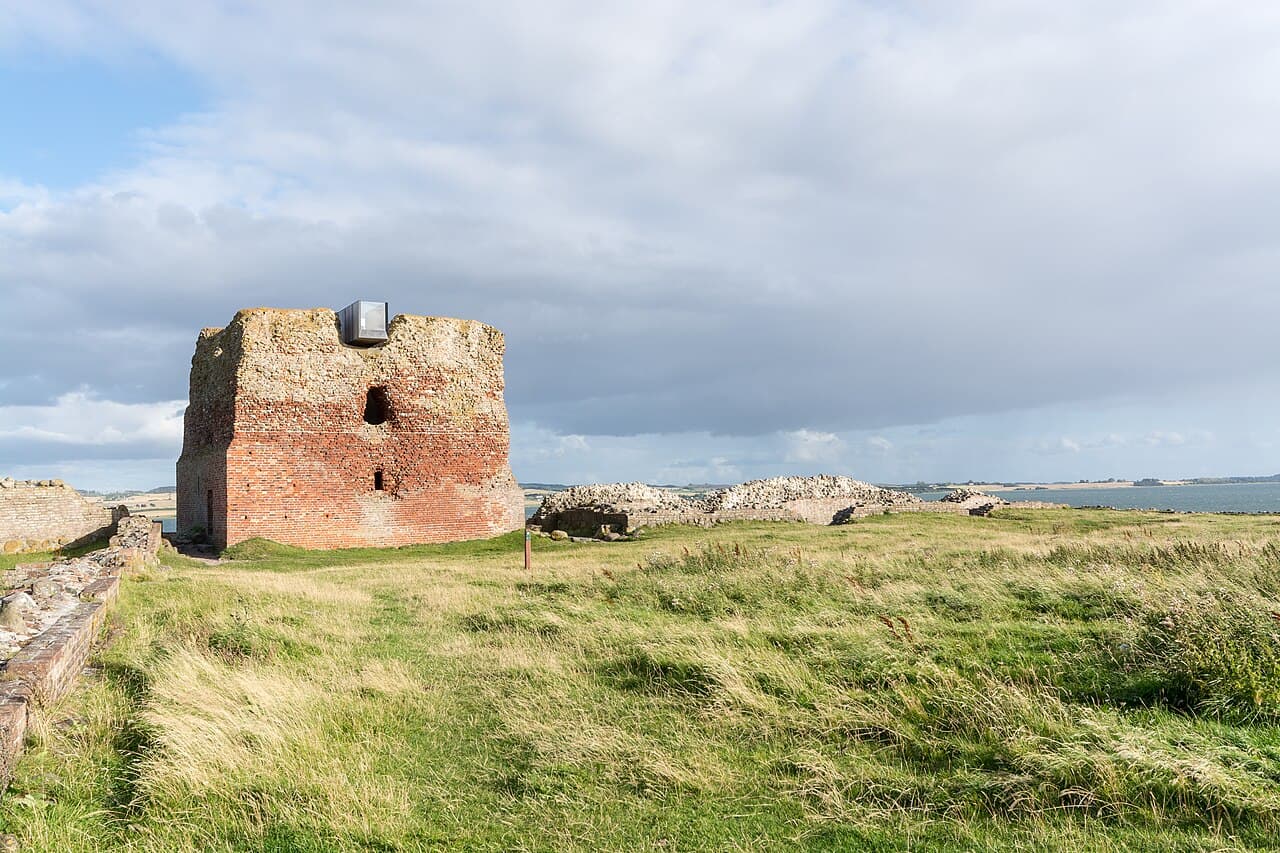
Kalø Castle stands as a significant late-medieval hill castle ruin near Rønde, Denmark, embodying the turbulent history of Danish royal power and regional control. Founded in 1313 by King Erik Menved, the fortress was strategically constructed on a small island in Kalø Bay to serve as a stronghold against local rebellions by nobles and peasants. The castle's location and design reflect its original purpose as a military fortress and symbol of royal authority in northern Jutland.
The castle was connected to the mainland by an impressive 500-meter-long artificial causeway made from cobblestones and earth, raised approximately 1.2 meters above sea level. This causeway remains the longest and best-preserved medieval embankment of its kind in Denmark, highlighting the ingenuity and labor invested in the castle's construction. The fortress was surrounded by deep moats, earthen mounds, and outer ring walls, forming a multi-layered defensive system typical of the era's military architecture.
Historical context and royal significance
Kalø Castle was part of a network of fortresses erected by the Danish crown to consolidate power during a period marked by frequent peasant uprisings and noble resistance. The castle's initial role was to act as a "forced castle," a term denoting fortifications built to intimidate and subdue the local population through a visible royal presence.
Despite its early destruction ordered by the nobility in 1320 under King Christoffer II, the castle was swiftly rebuilt, likely under the reign of either Christoffer II or his successor Valdemar Atterdag. By the early 1340s, Kalø had regained much of its former stature, continuing to serve as a key royal stronghold.
Throughout the 14th and 15th centuries, Kalø Castle changed hands among various nobles through pledges and mortgages. Notable holders included Gert af Holsten and Claus Limbek, until it was redeemed by Queen Margrethe I in 1407. From then on, it functioned primarily as a lens castle, a royal administrative center governed by appointed nobles.
Notable historical events
One of the castle's most famous episodes occurred in the early 16th century, when King Christian II imprisoned the future Swedish king, Gustav Vasa, at Kalø from 1518 to 1519. Gustav Vasa's daring escape, disguised as a peasant, is a celebrated moment in Scandinavian history, underscoring the castle's role not only as a military fortress but also as a state prison.
Following the 1660 revolution that established an absolute monarchy in Denmark under King Frederick III, Kalø Castle's strategic importance declined sharply. In 1661, Frederick III granted the castle to Ulrik Frederik Gyldenløve, who oversaw the dismantling of the now obsolete fortress in 1662. The building materials were repurposed for the construction of Charlottenborg Palace in Copenhagen, demonstrating a common practice of recycling medieval masonry for newer royal projects.
Architectural features and construction
Kalø Castle's architecture reflects typical medieval Danish brick construction techniques, with thick walls designed for defense and longevity. The main surviving structure is the hovedtårnet or main tower, which features robust brickwork and was central to the castle's defense and administration.
The castle's layout included multiple defensive layers: a surrounding moat, an outer ring wall, and earthen mounds, all constructed through extensive manual labor by local peasants, often under duress. The causeway linking the island fortress to the mainland is a remarkable engineering feat for its time, facilitating controlled access while maintaining defensive advantages.
Another notable remnant is the fruerstuen, a chamber whose exact historical function is partially documented and preserved in fragmentary form. The ruins also display broken sections of the ring walls, outlining the castle's original perimeter and defensive strategy.
Preservation and modern interventions
In the 19th and 20th centuries, efforts to preserve Kalø Castle's ruins began in earnest. The first major conservation project was led by architect C. M. Smidt in 1903, focusing on stabilizing the remains and preventing further decay. Restoration work has continued intermittently, including repairs after damage sustained during World War II from German military exercises.
Recent additions to the site include a removable staircase installed inside the main tower in 2016, enhancing visitor access while respecting the site's archaeological integrity. The castle ruins are now part of the Mols Bjerge National Park, established in 2009, which protects the surrounding natural landscape and integrates the historical site into a broader heritage and environmental conservation framework.
The castle grounds and surrounding landscape
The castle sits within a protected area of approximately 170 hectares, encompassing adjacent forests such as Hestehave Skov and Ringelmose Skov. The landscape around Kalø Castle offers insight into the medieval environment and the strategic importance of its coastal location.
Within the castle grounds lies a historic riding ground near the causeway, marked by a commemorative stone honoring the restoration work of architect C. M. Smidt. Historically, the ruins served secondary uses, including grazing land for cattle and sheep, illustrating the evolving relationship between the site and local communities over centuries.
Cultural and heritage significance
Kalø Castle ruins are a valuable cultural landmark in Denmark, representing the intersection of medieval military architecture, royal history, and local heritage. The site offers visitors a tangible connection to Denmark's feudal past and the complex dynamics of power, rebellion, and governance that shaped the region.
Today, the castle is owned by the Danish State and managed as a protected historical monument, attracting tourists, historians, and archaeologists interested in its well-preserved defensive structures and rich historical narratives.
Frequently asked questions (FAQ)
- How do I get to Kalø Castle Ruins?
- Kalø Castle Ruins is located near Rønde, Denmark, easily accessible by car or public transport. The nearest bus stop is within walking distance, and there is ample parking available for visitors. A scenic walk from the parking area to the ruins offers beautiful views of the surrounding landscape.
- What is the historical significance of Kalø Castle?
- Kalø Castle, built in the late 14th century, played a crucial role in Denmark's history as a royal fortress. It was strategically positioned to control trade routes and protect the region during conflicts. The ruins today provide insight into Denmark's medieval architecture and military history.
- When was Kalø Castle constructed?
- Kalø Castle was constructed around 1380 during the reign of King Oluf II. It was built to serve as a stronghold and has witnessed numerous historical events over the centuries. The ruins you see today are remnants of this once-mighty fortress.
- Can I explore the castle ruins freely?
- Yes, visitors are welcome to explore the ruins of Kalø Castle at their own pace. There are no admission fees, allowing you to enjoy the historical site and its stunning views without any cost. However, please be respectful of the site and follow any posted guidelines.
- Why is Kalø Castle a popular tourist attraction?
- Kalø Castle is a popular tourist attraction due to its rich history and picturesque location overlooking the Kalø Vig. The breathtaking scenery combined with the historical significance makes it a perfect spot for photography and leisurely walks. It's an ideal destination for history enthusiasts and nature lovers alike.
- Is it possible to visit Kalø Castle all year round?
- Yes, Kalø Castle Ruins are open to visitors year-round. However, accessibility may be affected during inclement weather or winter months, so it's advisable to check local conditions before your visit. The best time to visit is during spring and summer when the weather is milder.
- What are the opening hours for Kalø Castle Ruins?
- Kalø Castle Ruins do not have specific opening hours, as they are accessible at all times. Visitors can enjoy the site during daylight hours for the best experience. Remember to plan your visit so you can appreciate the beauty of the ruins and the surrounding nature.
- Are there any nearby attractions to visit?
- Yes, there are several nearby attractions including the scenic beaches of Mols Bjerge National Park and the charming town of Rønde. You can also explore other historical sites and enjoy outdoor activities in the area. It's a great opportunity to make a full day of exploration in this beautiful part of Denmark.
- What are the ticket prices for visiting Kalø Castle?
- There is no admission fee to visit Kalø Castle Ruins, making it an affordable option for all visitors. The absence of ticket prices allows you to fully enjoy the history and scenery without any financial burden. Donations to help maintain the site are always appreciated.
Photo gallery

Information
Loading map...
Visitor reviews
No reviews yet. Been here? Write the first review and help other travelers!
Write the first reviewVisited this castle? Share your experience
Your review helps other travelers and adds first-hand knowledge to our encyclopedia.



