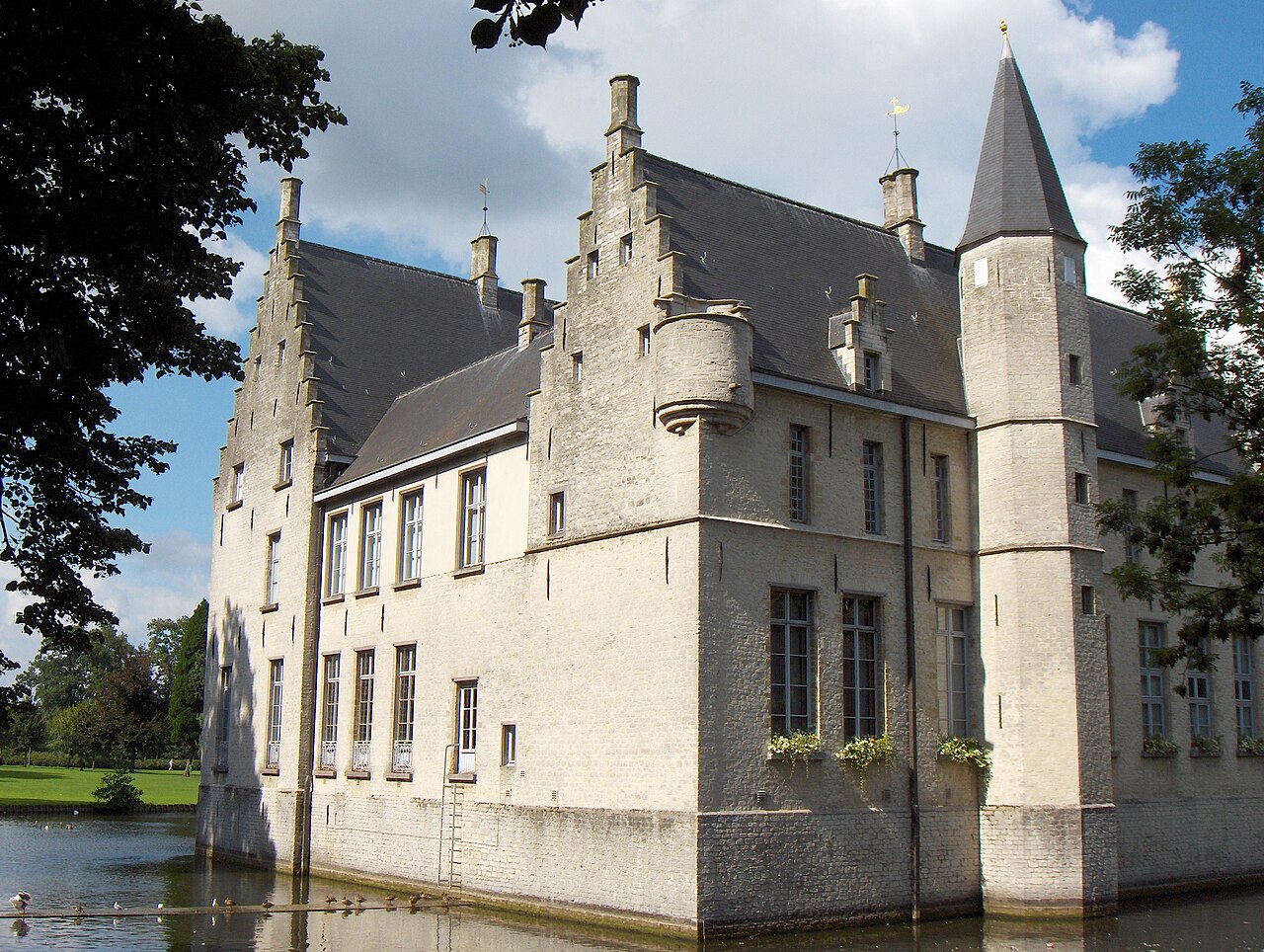
Kasteel Cortewalle
Kasteel Cortewalle stands as a remarkable example of a moated castle with origins tracing back to the 15th century, making it one of the oldest castles in the Belgian Waasland region. Its distinctive Flemish Renaissance architectural style is characterized by the use of white sandstone and elegant structural features that reflect the artistic and cultural trends of the late medieval period in Flanders. The castle's name derives from the original location known as Ten Wallen, which evolved into the French Cour-ten Walle, hence the modern name Cortewalle.
Located in Beveren, East Flanders, Belgium, Kasteel Cortewalle has a rich history intertwined with prominent local families and significant historical figures. Originally constructed by the Triest family in the early 15th century, the castle was initially called Hof ter Walle. Its strategic design as a four-winged manor house surrounded by a water moat highlights its dual function as both a defensive stronghold and a noble residence.
The castle's historical narrative is deeply connected to the Flemish Renaissance period, with architectural and stylistic elements that underscore this era's influence. Over the centuries, Kasteel Cortewalle transitioned through various noble families, including the Goubau family in the 17th century and later the Counts of Brouchoven de Bergeyck from 1787 until the mid-20th century. These families contributed to the castle's evolution, adapting its structure and interiors to reflect changing tastes and functional needs.
Architectural features and layout
The castle is notable for its rectangular courtyard formed by two parallel two-story wings with stepped gables on the southeast and northwest sides, connected by lower wings on the southwest and northeast. The oldest part of the castle is the south wing, dating from around 1416, which includes an octagonal stair tower and remnants of two small turrets, emphasizing its medieval defensive origins.
The main entrance is located on the northeast wing, featuring a pointed-arch portal flanked by slender octagonal turrets topped with pointed slate roofs. The northwest wing houses the castle chapel, distinguished by neo-Gothic pointed-arch windows added during 19th-century renovations. The entire structure is built directly on a water moat, reinforcing its original defensive purpose, with all roofs uniformly covered in slate shingles.
Adjacent to the manor on the northeast side is a former coach house (remise) and an orangery situated on an island accessible by an early 20th-century iron suspension bridge. The remise is constructed of brick on a bluestone base with bluestone pilasters and a hipped slate roof. Its original round-arched carriage doors were converted into windows to preserve the historical appearance.
Historical evolution and ownership
The castle's origins date back to the early 15th century when the Triest family established it as a fortified residence. In the early 17th century, it likely served as the birthplace of Antonius Triest, who became the fifth bishop of Bruges in 1616, marking the castle's connection to significant ecclesiastical history.
Ownership passed to the Goubau family in the 17th century, who maintained the estate until it transferred by marriage in 1787 to the Counts of Brouchoven de Bergeyck. This family was responsible for notable 19th-century modifications, including removing the original Renaissance cross-mullioned windows and installing a neo-Gothic portal. Interior renovations introduced wood paneling, stucco work, and decorative elements that enhanced the castle's aesthetic appeal.
Between 1908 and 1910, further changes were made to enlarge the ground floor and reduce the courtyard size, reflecting the evolving needs of the estate's inhabitants. The castle remained in the Brouchoven de Bergeyck family until 1960, after which it was left empty and its furnishings auctioned off in 1961. The municipality of Beveren acquired the property in 1966 and has since undertaken restoration efforts.
Interior design and notable rooms
The interior of Kasteel Cortewalle predominantly reflects 19th and early 20th-century styles, featuring wood paneling, intricate carpentry, and detailed stucco work. The vestibule floor is laid with a striking black and white marble checkerboard pattern, while a stained-glass dome provides natural illumination to the entrance hall.
Among the notable rooms is the Verlatzaal, named after the artist Charles Verlat, which houses paintings depicting hunting scenes and boasts a white marble fireplace. The Blauwe Kamer is distinguished by its blue damask wall coverings, and the Vlaamse Kamer features stained-glass windows adorned with heraldic designs, underscoring the castle's aristocratic heritage.
Grounds and surrounding landscape
Kasteel Cortewalle is set within a public park of approximately 10 hectares, designed as a landscape garden that combines native and exotic tree species. The park includes lime, summer oak, and beech trees, alongside exotic species such as the Japanese pagoda tree, Judas tree, and American sweetgum. A large circular flowerbed graces the remise island, enhancing the estate's picturesque quality.
Additional estate features include several ancillary buildings, such as an ice cellar and quarters for the gardener and stableman, constructed during the 19th-century renovations. A finely built kennel for hunting dogs was restored in 2009, preserving this unique aspect of the castle's history.
Cultural significance and current use
Since its acquisition by the municipality of Beveren, Kasteel Cortewalle has been repurposed for cultural and public functions. It serves as a venue for cultural events, exhibitions, and houses a museum dedicated to local history. Importantly, since 2000, the castle has been the repository for the consolidated family archives of the Brouchoven de Bergeyck, which were meticulously gathered and cataloged after being scattered post-1961.
The castle has been officially protected as a historic monument since September 8, 1971, ensuring the preservation of its architectural and cultural heritage for future generations. Its well-preserved state and rich history make it a significant landmark in the region, attracting visitors interested in medieval architecture, Flemish Renaissance art, and Belgian noble history.
Frequently asked questions (FAQ)
- What is the historical significance of Kasteel Cortewalle?
- Kasteel Cortewalle is a remarkable example of medieval architecture in Belgium, dating back to the 15th century. It has served various purposes throughout its history, including as a noble residence and a symbol of local power, which adds to its cultural importance in the region.
- When is the best time to visit Kasteel Cortewalle?
- The best time to visit Kasteel Cortewalle is during the spring and early autumn months when the weather is mild and the gardens are in full bloom. These seasons provide a picturesque backdrop for exploring the castle and its surroundings.
- Can I tour Kasteel Cortewalle inside?
- Yes, guided tours of Kasteel Cortewalle are available, allowing visitors to explore its historic interiors and learn about its fascinating history. Be sure to check the schedule ahead of your visit, as tour availability may vary throughout the year.
- What are the opening hours for Kasteel Cortewalle?
- Kasteel Cortewalle is typically open to visitors from Tuesday to Sunday, with specific hours varying by season. It is advisable to check the official website for the most current opening times before planning your visit.
- Is it possible to access Kasteel Cortewalle with a wheelchair?
- Yes, Kasteel Cortewalle is committed to accessibility, and efforts have been made to accommodate visitors with mobility challenges. Some areas may present difficulties due to the castle's historical structure, so it's recommended to contact the staff for specific accessibility information.
- What are the ticket prices for Kasteel Cortewalle?
- Ticket prices for Kasteel Cortewalle are generally affordable, with discounts available for students, seniors, and children. It's best to check the official website for the latest pricing details and any special offers.
- Are there any nearby attractions to visit while at Kasteel Cortewalle?
- Absolutely! While visiting Kasteel Cortewalle, you can also explore nearby attractions such as the beautiful parks and gardens in Beveren, or take a short trip to the city of Antwerp, which is rich in history and culture. These nearby sites provide additional opportunities for a full day of exploration.
Information
Website
Visit websiteSources & official resources
Verify the information above using these authoritative references.
Loading map...
Visitor reviews
No reviews yet. Been here? Write the first review and help other travelers!
Write the first reviewVisited this castle? Share your experience
Your review helps other travelers and adds first-hand knowledge to our encyclopedia.