Kaninë Castle — Albania castle

Kaninë Castle

Kaninë Castle: historic hilltop fortress in Vlore, Albania
Kaninë, Vlore, Albania
Early Medieval (5th–10th c.)
Ruins

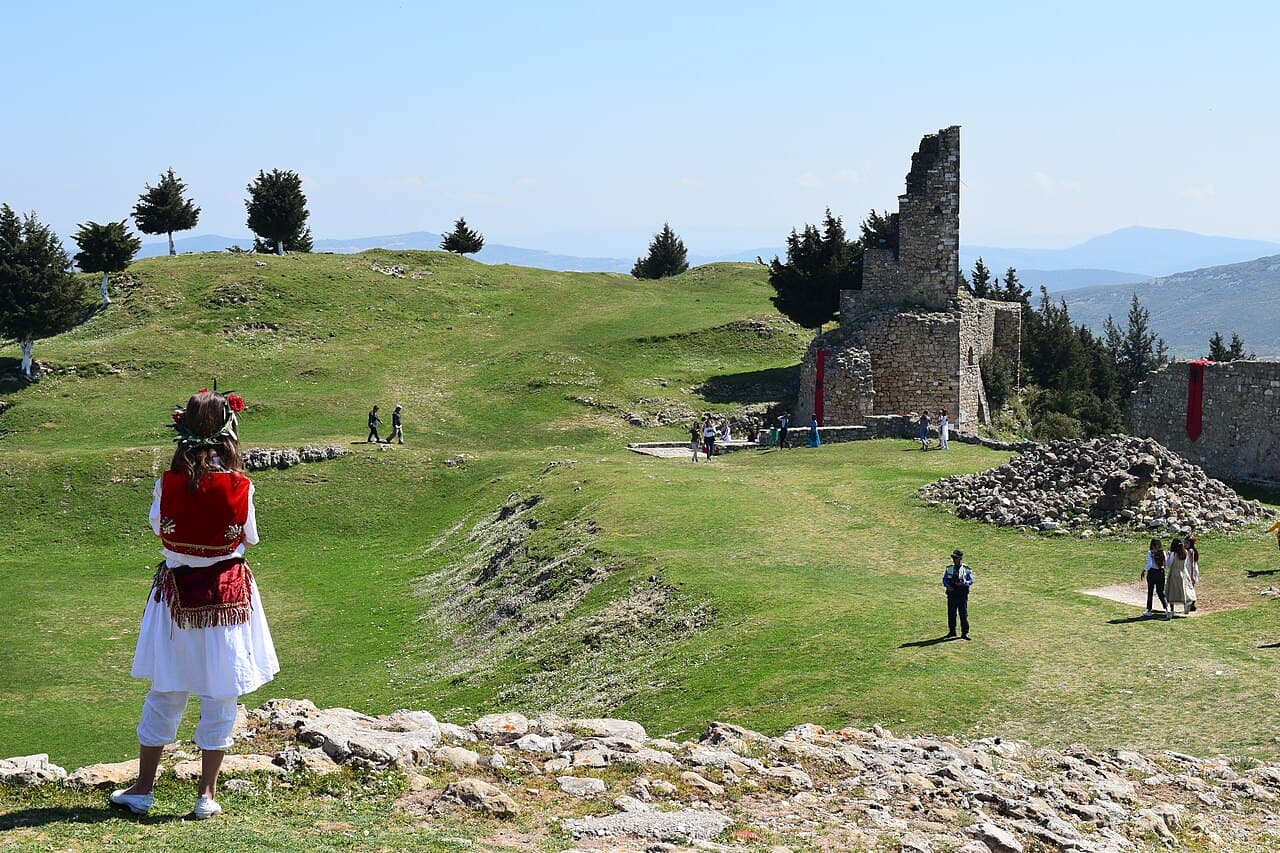
Kaninë Castle, locally known as Kalaja e Kaninës, is a prominent hilltop fortress located in the village of Kaninë, within the Vlore region of Albania. This historic site occupies a strategic position on a three-pronged hill approximately 380 meters above sea level, offering commanding views over the Bay of Vlorë and the surrounding landscape. Its origins trace back to an ancient settlement established in the 3rd century BCE, making it one of the oldest known fortified sites in the Vlore area.

Ancient origins and early medieval transformation

The site originally served as an important coastal center for the Illyrian tribe known as the Amantes. By the 4th century CE, the settlement had evolved into a fortified castle town under Byzantine influence. The most significant early reconstruction occurred during the reign of Byzantine Emperor Justinian I between 527 and 565 CE, when the fortress was known as "Kionin." This renovation was part of Justinian's extensive program to reinforce the empire's defensive network in the Epirus region, encompassing nearly one hundred fortifications.

Medieval and early modern military significance

Throughout the medieval period, Kaninë Castle played a vital role in regional power struggles. In the 13th century, it served as a stronghold for the Angevin Kingdom of Albania, reflecting its strategic importance. Subsequently, in the 14th century, the fortress became a central seat of the Principality of Valona, governing the surrounding territories until the Ottoman conquest in 1417.

During Ottoman rule, the castle's military relevance persisted. In 1530, Sultan Suleiman the Magnificent ordered repairs and fortifications that renewed its defensive capabilities. Despite this, the construction of a new fortress at nearby Vlorë in 1537 gradually diminished Kaninë's strategic value. The fortress witnessed conflict during the Venetian-Ottoman wars, notably when Venetian forces captured it in 1690, only for it to be retaken by the Ottomans a year later.

The castle was ultimately abandoned in the 19th century, suffering further damage from Italian bombings during World War I and the Vlora War in 1920.

Architectural features and fortifications

Layout and defensive structures

Kaninë Castle covers an area of approximately 3.5 hectares, enclosed by defensive walls extending roughly one kilometer. The fortress is divided into three main sections by transverse walls, with the uppermost section forming the citadel on the highest hill prong. This citadel was fortified with three towers providing protection at the summit.

Historically, the fortress had four gates controlling access and internal movement. The best-preserved gate is on the southern side, featuring a robust hexagonal tower standing 3.4 meters tall. This gate includes a 2.85-meter-wide entrance with a sectional arch, double walls, and an internal wooden beam for enhanced security.

Towers and defensive innovations

The fortress's towers exhibit a variety of shapes, including circular, polygonal, triangular, and quadrangular forms, reflecting different construction phases and architectural influences. The earliest surviving towers are small triangular buttresses, similar to those found at the castles of Berat and Butrint. Seven towers remain today, two of which are triangular.

Historical records from 1688 indicate that Kaninë originally had fourteen towers, including semicircular towers resembling those on the Butrint acropolis. These semicircular and triangular towers feature stone walls interspersed with bricks and tiles, showcasing ancient building techniques and reuse of materials. Later polygonal towers include small turrets and resemble 13th-century fortified structures from Durrës.

Internal structures and historical usage

Although most internal buildings have not survived, Ottoman traveler Evliya Çelebi described various functional structures within the fortress, such as residential houses, soldiers' quarters, ammunition storage, and water supply facilities. These indicate that Kaninë functioned as a self-sufficient military installation capable of supporting its garrison during sieges or extended conflicts.

In the northern part of the citadel, modern concrete structures and a bunker remain from the communist era (1960s-1980s), reflecting the site's continued military significance into the 20th century.

Access and visitor information

Access to Kaninë Castle is possible via a footpath from the south or a road leading to a small car park from the north. A small ticket booth at the southern entrance charges a modest fee for entry to the citadel, while the lower settlement area appears freely accessible. The absence of fences or gates suggests the site may be open outside official hours.

Visitors to Kaninë Castle can enjoy expansive views over the Bay of Vlorë and the surrounding countryside, making it a rewarding destination for those interested in history, architecture, and panoramic landscapes.

Frequently asked questions (FAQ)

How do I get to Kaninë Castle?
Kaninë Castle is accessible via a footpath from the south or a road leading to a small car park from the north. Visitors can choose either route depending on their preference and mobility.
What is the historical significance of Kaninë Castle?
Kaninë Castle has origins dating back to the 3rd century BCE as an ancient settlement and was later transformed into a Byzantine fortress under Emperor Justinian I. It played key roles during the Angevin Kingdom, the Principality of Valona, and the Ottoman era.
Are there any remaining structures to see at Kaninë Castle?
Visitors can see the fortress's defensive walls, several towers of various shapes, and a well-preserved southern gate with a hexagonal tower. Some modern concrete structures from the communist period also remain in the citadel area.
Is Kaninë Castle suitable for visitors interested in panoramic views?
Yes, the castle's hilltop location at 380 meters elevation provides stunning views over the Bay of Vlorë and the surrounding countryside, making it an excellent spot for photography and sightseeing.
Can I visit Kaninë Castle year-round?
While specific opening hours are not well documented, the site appears to be accessible year-round with no fences or gates restricting entry outside official hours. Visitors should check locally for any seasonal restrictions.

Photo gallery

Kaninë Castle
Click to view

Photo by Nikol Likja•CC BY-SA 4.0

1 photo • Click any image to view in full screen

Information

Hill Castle

Loading map...

Visitor reviews

No reviews yet. Been here? Write the first review and help other travelers!

Write the first review

Visited this castle? Share your experience

Your review helps other travelers and adds first-hand knowledge to our encyclopedia.

Write a review

(5/5)

0/2000 characters

Your review will be visible after admin approval

Nearby castles

15 km

Gjon Bocari Castle

Tragjas, Albania

Gjon Bocari Castle is a notable 16th-century Renaissance fortress located in Tragjas, Albania. Constructed initially by the prominent Boçari family, who played a significant role in the region, the castle was expanded further during the 17th century. This castle exemplifies the military architectural style of its period, combining practical fortification elements with the Renaissance emphasis on symmetry and proportion. Historical background and family legacy The Boçari family, one of the principal Albanian families in Tragjas, commissioned the construction of the castle as a stronghold to assert their influence and protect their lands. The family's prominence continued through the centuries, with notable descendants such as Markos Botsaris, a celebrated figure in Albanian and Greek history, and Katerina Botsari Kito Bocari. The castle not only served as a military bastion but also as a symbol of the family's status and power in the region. Architectural features and fortifications The castle is characterized by its rectangular layout, with robust stone walls measuring approximately 1.25 metres in thickness and rising to a height of 5.5 metres. These walls enclose a central courtyard, a common feature in Renaissance military architecture, allowing defenders to regroup and manage supplies during sieges. Defensive elements Arrowslits designed for artillery openings are integrated into the walls, indicating an adaptation to the evolving warfare technology of the time, particularly the use of firearms and cannons. These openings allowed defenders to fire upon attackers while remaining protected behind the thick walls. The northern and eastern corners of the castle are reinforced with large towers, which served as vantage points for surveillance and defensive strongholds during attacks. These towers would have provided overlapping fields of fire and enhanced the castle's ability to withstand prolonged sieges. Construction materials and techniques The castle was constructed primarily from locally sourced stone, a durable material that contributed to the fortress's longevity. The masonry techniques reflect Renaissance craftsmanship, with carefully fitted stones and mortar ensuring structural stability. Significance in regional history Gjon Bocari Castle stands as a testament to the turbulent history of the Albanian coast during the Renaissance period, a time marked by frequent conflicts and shifting allegiances. The castle's fortifications reflect the need for strong defensive positions against both Ottoman incursions and local rivalries. Its preservation allows insight into the military strategies and architectural responses to the changing nature of warfare in the 16th and 17th centuries in this part of the Balkans. Current condition and preservation The castle remains partially preserved, with significant portions of the walls and towers still standing. Its condition offers valuable opportunities for archaeological study and cultural tourism, contributing to the understanding of Renaissance fortifications in Albania. Visiting information and cultural importance While not widely known internationally, Gjon Bocari Castle is an important cultural landmark for the local community and visitors interested in Renaissance military architecture and Albanian history. Efforts to maintain and promote the site can enhance its role as an educational resource and tourist destination.

Renaissance (15th–17th c.)
Details
40.5 km

Himarë Castle

Himarë, Albania

Himarë Castle, locally known as Kalaja e Himarës, is situated in the village of Himarë, within the Vlorë County of Albania. This historic site occupies a prominent 240-meter-high rocky hill overlooking the Adriatic Sea, offering commanding views of the surrounding coastline. The location has been continuously significant since Antiquity, originally known as Chimarra. Historical background and significance The hilltop site of Himarë Castle was inhabited since ancient times, serving as a strategic settlement during the classical and Hellenistic periods. Under Roman and later Byzantine rule, the site evolved into a fortified castle-village, combining defensive structures with residential buildings. The castle's position was crucial for controlling maritime routes along the Adriatic coast and for local defense against invasions and pirate raids. Throughout the medieval period, the fortress played a role in regional conflicts, although it never developed into a large military stronghold. Instead, it functioned primarily as a fortified village with a close-knit community living within its walls. Architectural features and fortifications The surviving remains of Himarë Castle include the foundations of a round tower located on the northern end of the hill, which would have served as a lookout and defensive position. Portions of the curtain walls are still visible, although much of the original masonry has been lost or incorporated into later buildings. The castle had two gates that controlled access to the settlement, but their exact locations are difficult to identify due to subsequent construction and decay. The curtain walls were constructed to follow the natural contours of the rocky hill, creating an irregular perimeter that maximized defensive advantage. The walls were relatively modest in thickness and height compared to larger fortresses, reflecting the castle's role as a village defense rather than a major military fortress. Ruined buildings and Byzantine churches Within the castle's enclosure, many of the structures are now in ruins, having been abandoned over centuries. Among these are several Byzantine-era churches, identifiable by their architectural style and remnants of frescoes. These churches indicate the religious and cultural life of the castle's inhabitants during the Middle Ages. The layout of the village includes narrow cobbled alleys winding between the ruined houses and public buildings, providing a glimpse into the daily life of the medieval community. The overall impression is of a once-thriving fortified settlement that gradually declined and was eventually deserted. Visiting Himarë Castle today Himarë Castle is freely accessible to visitors and offers a unique experience of exploring an abandoned fortified village rather than a traditional castle with intact walls and towers. The site is ideal for those interested in history, archaeology, and panoramic views. Walking through the castle ruins, visitors can enjoy the atmosphere of the ancient settlement and appreciate the spectacular views of the Adriatic Sea and the surrounding landscape. The combination of natural beauty and historical significance makes it a rewarding destination for travelers exploring the Albanian Riviera. While the castle lacks extensive restoration or visitor facilities, its authenticity and rugged charm provide an evocative glimpse into Albania's medieval past.

Late Medieval (14th–15th c.)
Details
42.8 km

Zharë Castle

Tepelenë, Albania

Zharë Castle, locally known as Kalaja e Zharës, is an early medieval fortress situated between the villages of Turan and Veliqot in the county of Gjirokastër, Albania. Positioned strategically on a hill overlooking the valley of the Vjosë river, this castle occupies a commanding location that would have provided control over the surrounding landscape and river routes. Dating back to the 4th to 6th centuries AD, Zharë Castle is believed to have been constructed during the period of the Byzantine Empire, potentially under the reign of Emperor Justinian I. This timing places the castle within the early medieval period, a time when the Byzantine Empire was actively fortifying its territories against various invasions and internal unrest. The castle's origins as a military fortification are supported by its architectural features and archaeological findings. Architectural layout and defensive features The castle has an elongated, elliptical plan adapted to the natural shape of the hill it occupies. Although much of the structure has not survived intact, the remains allow visitors to discern the original defensive walls that once enclosed the fortress. These walls would have been constructed to withstand sieges and protect the inhabitants from attackers. Within the castle's perimeter, archaeological research has uncovered the site of a cistern, an essential feature for water storage during prolonged sieges. The presence of this cistern highlights the strategic planning involved in the castle's design, ensuring a sustainable water supply for its garrison. At the northern end of the castle stands the remains of a square tower, which likely served as a lookout and defensive strongpoint. At the southern and highest point of the castle is a D-shaped tower, a design common in Byzantine military architecture, providing both defensive strength and a commanding view over the surrounding terrain. Historical context and significance Zharë Castle was part of the broader network of fortifications the Byzantine Empire established along its western frontiers to secure key routes and protect against incursions from various groups including Slavs and other tribes. Its location near the Vjosë river valley was strategic for controlling movement through this important corridor in southern Albania. While detailed historical records specifically mentioning Zharë Castle are scarce, its architectural style and dating align it with the defensive efforts during the reign of Justinian I (527–565 AD), who famously undertook a vast program of fortress construction and restoration across the empire. This suggests the castle played a role in the military and administrative control of the region during a turbulent period. Current condition and accessibility Today, Zharë Castle is in a state of ruins, with only partial remains of its walls and towers visible. Despite its modest preservation, the site offers visitors a glimpse into early medieval military architecture and the historical landscape of the region. The castle is freely accessible to the public. A dirt road leads directly from the paved road below up to the heart of the castle grounds, making it relatively easy to visit. Although the ruins themselves may not be as visually striking as larger or more intact castles, the location provides impressive views of the Vjosë river valley and the surrounding hills. Tepelenë Castle, a more prominent fortress, is located nearby and often attracts visitors interested in the area's rich history. Archaeological research and preservation Archaeological investigations have been limited but have confirmed the castle's early medieval origins and its function as a military fortification. The findings of the elliptical layout, towers, and cistern contribute valuable information to the understanding of Byzantine frontier defenses in this part of the Balkans. Preservation efforts have been minimal, and the site remains largely in its natural ruined state. Visitors should be aware that facilities are limited, and the site is best suited for those interested in history, archaeology, and scenic views rather than extensive tourist infrastructure.

Early Medieval (5th–10th c.)
Details

