Kaja Castle Ruins
Kaja Castle ruins stand as a testament to the turbulent history and architectural evolution of medieval fortifications in Austria. Located near the town of Hardegg, the castle occupies a commanding hilltop position overlooking the Dyje (Thaya) River valley within the scenic Thayatal National Park. Established in the 12th century by the noble von Chiowe family, also known as von Kaja, the fortress served as a significant stronghold for regional aristocracy throughout the High Medieval period.
The first documented mention of Kaja Castle dates back to 1196, when Duke Friedrich I authenticated important documents there before a gathering of nobles and knights, highlighting its role as a center of regional power and governance. The castle's lords maintained close ties with influential Austrian noble houses such as the Babenbergs and the Kuenrings. In the late 13th century, the castle's owners supported King Přemysl Otakar II of Bohemia, who was a notable guest at the fortress.
Historical significance and ownership
Throughout its history, Kaja Castle changed hands multiple times, reflecting the shifting political landscape of medieval Austria. In 1360, the castle was sold by Niklas von Kaja to Duke Rudolf IV of Austria. By 1376, it was pledged to the counts of Maidburg-Hardegg. During this period, Count Burkhard II, chancellor to Emperor Charles IV, died at the castle, underscoring its importance as a noble residence.
In the late 14th century, the fortress fell into the hands of Johann and Heinrich von Leipa, who transformed it into a base for robber knights. These brothers inflicted terror on the surrounding villages, using the castle as a stronghold for their raids. The castle's turbulent history continued during the Hussite Wars (1425-1427), when it was seized and plundered by Hussite forces.
After the Hussite Wars, around 1430, the castle was awarded by the emperor to Ulrich von Eyczing for his loyalty. The von Eyczing family undertook significant fortification efforts, adapting the castle's defenses to the evolving military technologies of the time. However, by the early 16th century, the family moved their primary residence to Niederfladnitz Castle, though Kaja retained some familial significance until Erasmus I von Eyczing died there in 1546.
Ownership passed to the Trautson family in 1588 through marriage, but they did not reside at Kaja, leading to gradual neglect. The castle suffered severe damage during the Thirty Years' War (1618-1648), and by 1672, contemporary depictions showed it as a ruin. The Auersperg family acquired the site in 1781, providing minimal maintenance.
Architectural features and fortifications
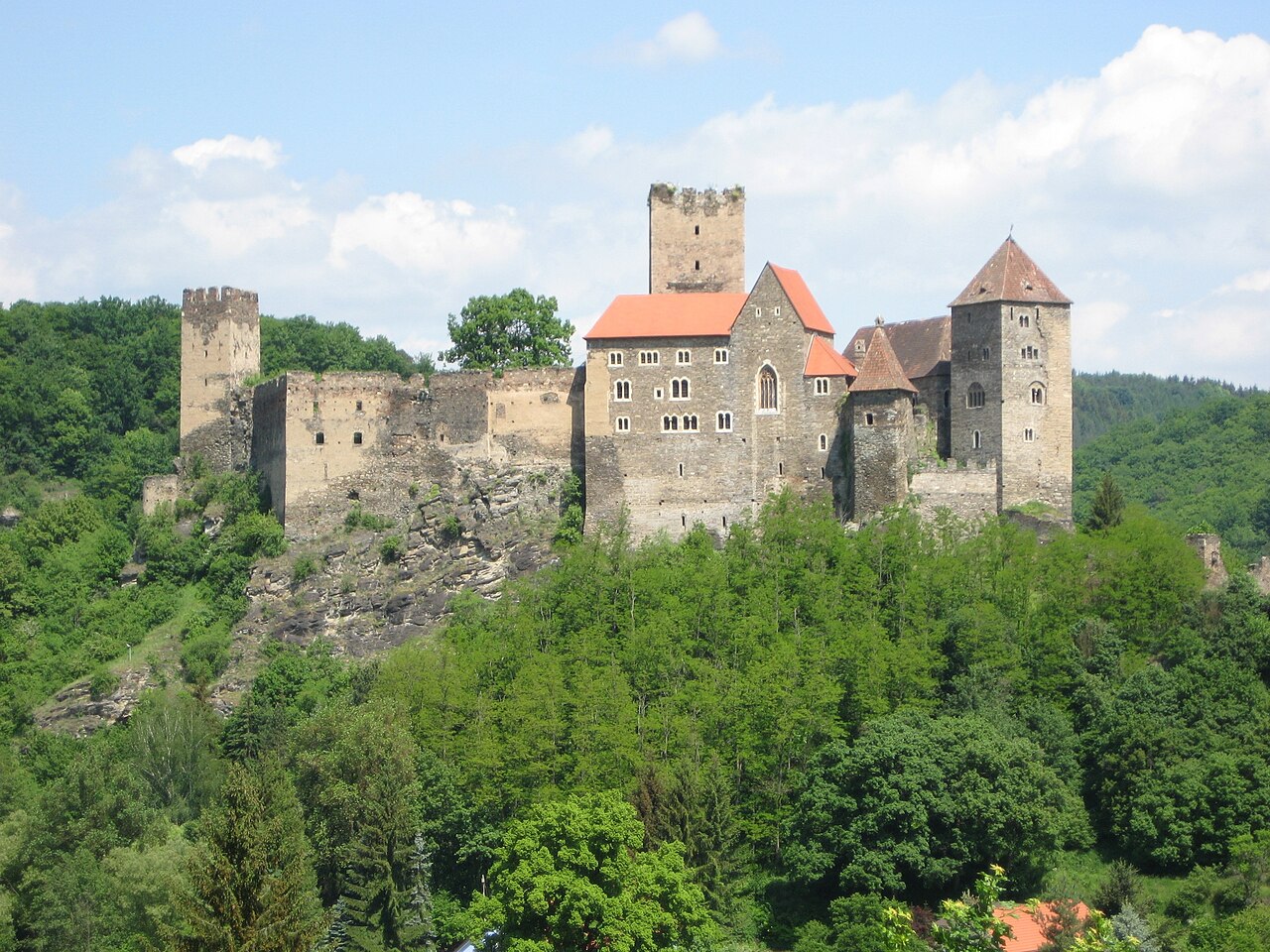
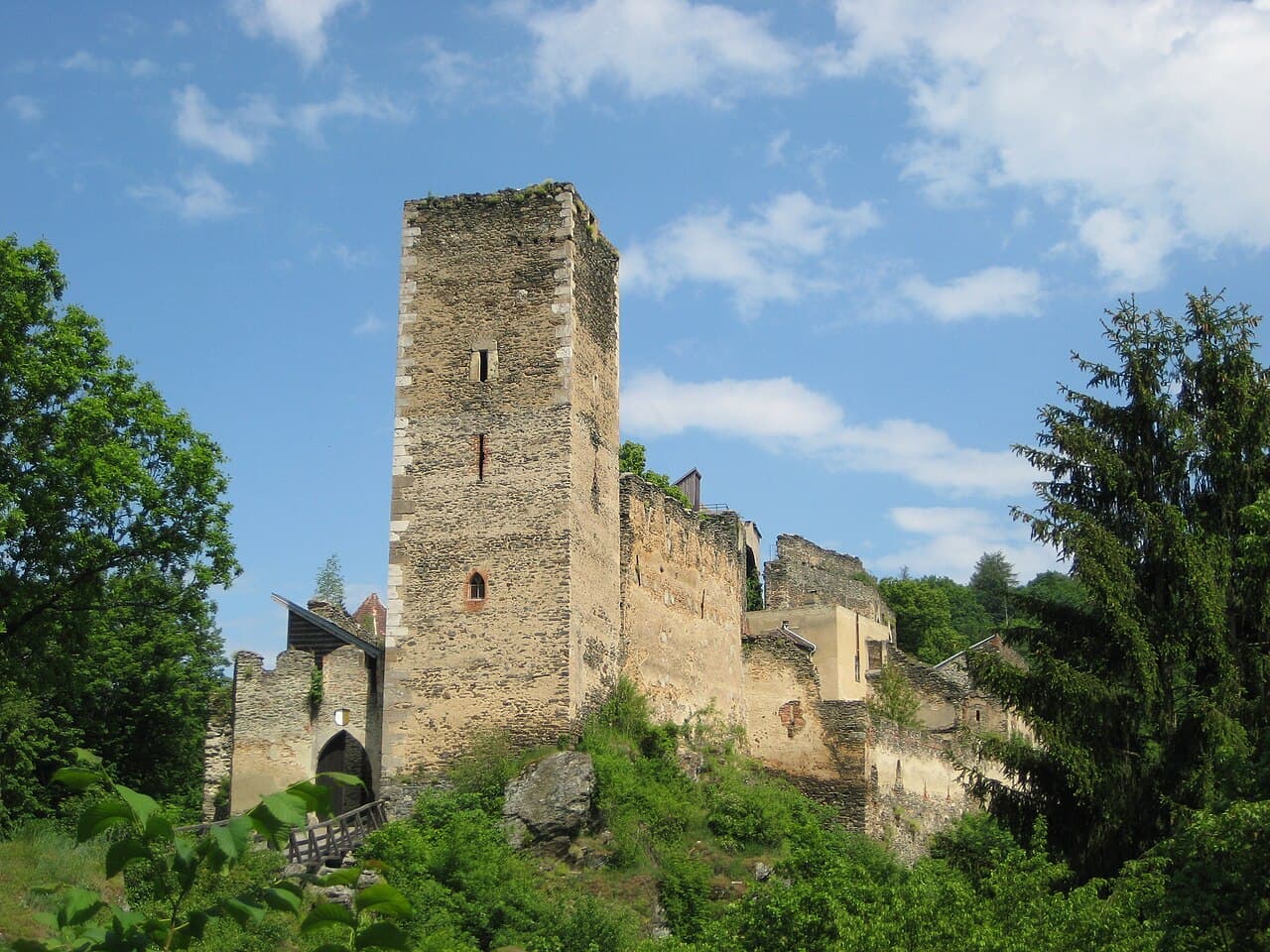
Kaja Castle is a classic example of a hill castle strategically placed on a rocky promontory with steep cliffs providing natural defense on most sides. The castle's layout centers around a citadel set on a raised stone platform. This core enclosure includes a 14th-century residential building identifiable by its fireplaces and is flanked by two stone towers dating from the 13th century. The eastern tower predates the western one, reflecting phased construction.
The citadel is surrounded by a defensive ring wall that limits access to a single western entrance. Outside this wall lies a small outer courtyard to the east and south, where space constraints led to a tight cluster of residential and utility buildings. Beyond this area, remnants of a second ring of walls from the 15th century incorporate bastion-style elements, demonstrating the adoption of contemporary military architectural advances.
During the 15th century, the castle's gate defenses were enhanced with a portcullis and a drawbridge, significantly improving security. The 16th century saw the abandonment of many buildings on the eastern side of the outer castle, replaced by a narrow residential wing that includes a 95-meter deep well, providing a crucial water supply during sieges.
On the western side, a larger residential building contains the knight's hall, notable for its wooden beam ceiling and paired windows, reflecting the castle's status as a noble residence. Adjacent to this is the bergfried or main tower, positioned near the castle's sole gate, serving as a final defensive refuge.
A small chapel constructed in the 16th century indicates ongoing religious activity within the castle precincts. The construction throughout predominantly uses rubble stone masonry, a typical medieval building technique involving rough, irregular stones bonded with mortar.
Decline, preservation, and current state
Following its damage in the Thirty Years' War, Kaja Castle gradually fell into disuse and ruin. By the late 17th century, it was depicted as a ruin, and although the Auersperg family took ownership in the 18th century, they provided only minimal maintenance. The 19th century brought some neo-Gothic restorations and structural reinforcements aimed at slowing the castle's deterioration.
After World War II, ownership passed to the Waldstein-Wartenberg family. Since 1969, a preservation association has managed the site, focusing on stabilizing the ruins and maintaining key structures such as the knight's hall for cultural events. The castle ruins today present a well-preserved example of medieval fortification evolution, with visible layers of construction from the 12th to the 16th centuries.
Surrounded by natural vegetation and integrated into the protected landscape of Thayatal National Park, the ruins offer visitors a glimpse into Austria's medieval past and the architectural ingenuity of its noble builders. The site remains an important cultural heritage landmark, illustrating the complex history of feudal power, military conflict, and architectural adaptation over several centuries.
Frequently asked questions (FAQ)
- How do I get to Kaja Castle ruins?
- Kaja Castle ruins are located near Hardegg in Lower Austria. Visitors can reach the site by car or local transport, followed by a short walk through Thayatal National Park to the hilltop ruins.
- What is the historical significance of Kaja Castle?
- Kaja Castle played a key role as a medieval stronghold from the 12th century, witnessing ownership changes, robber knight occupation, Hussite sieges, and military upgrades over centuries.
- Can I visit the interior of the castle ruins?
- Visitors can explore the accessible parts of the ruins, including the knight's hall, towers, and defensive walls. Some areas may be restricted for safety reasons, so guided tours are recommended.
- When is the best time to visit Kaja Castle ruins?
- The best time to visit is during spring to early autumn when the weather is favorable, and the surrounding Thayatal National Park is lush and accessible.
- Are there any facilities or guided tours available at Kaja Castle?
- A preservation association manages the site and occasionally organizes guided tours and cultural events in the knight's hall. Facilities are limited, so visitors should plan accordingly.
Photo gallery

Information
Current owner
Waldstein-Wartenberg family
Loading map...
Visitor reviews
No reviews yet. Been here? Write the first review and help other travelers!
Write the first reviewVisited this castle? Share your experience
Your review helps other travelers and adds first-hand knowledge to our encyclopedia.