Hardegg Castle
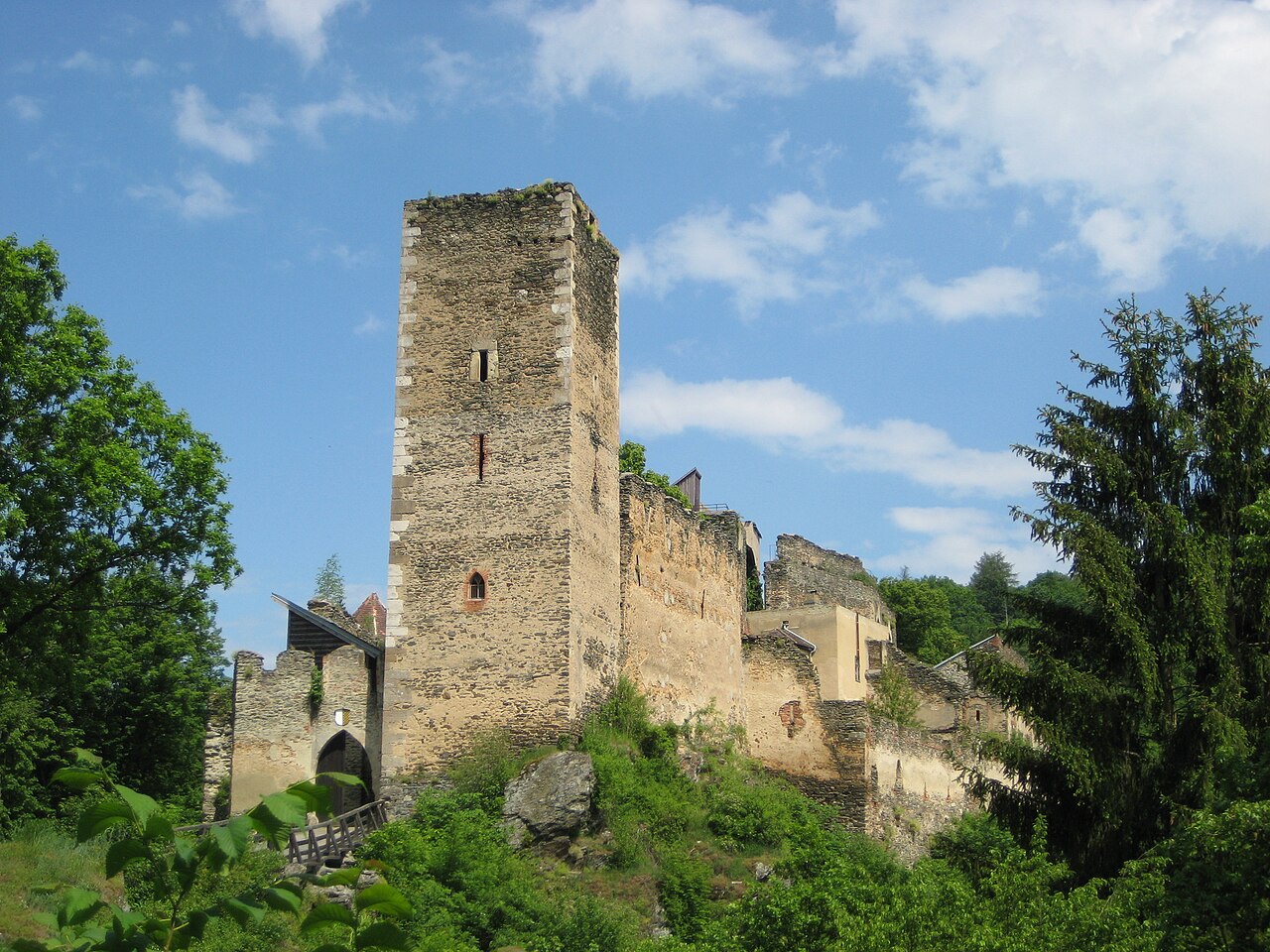
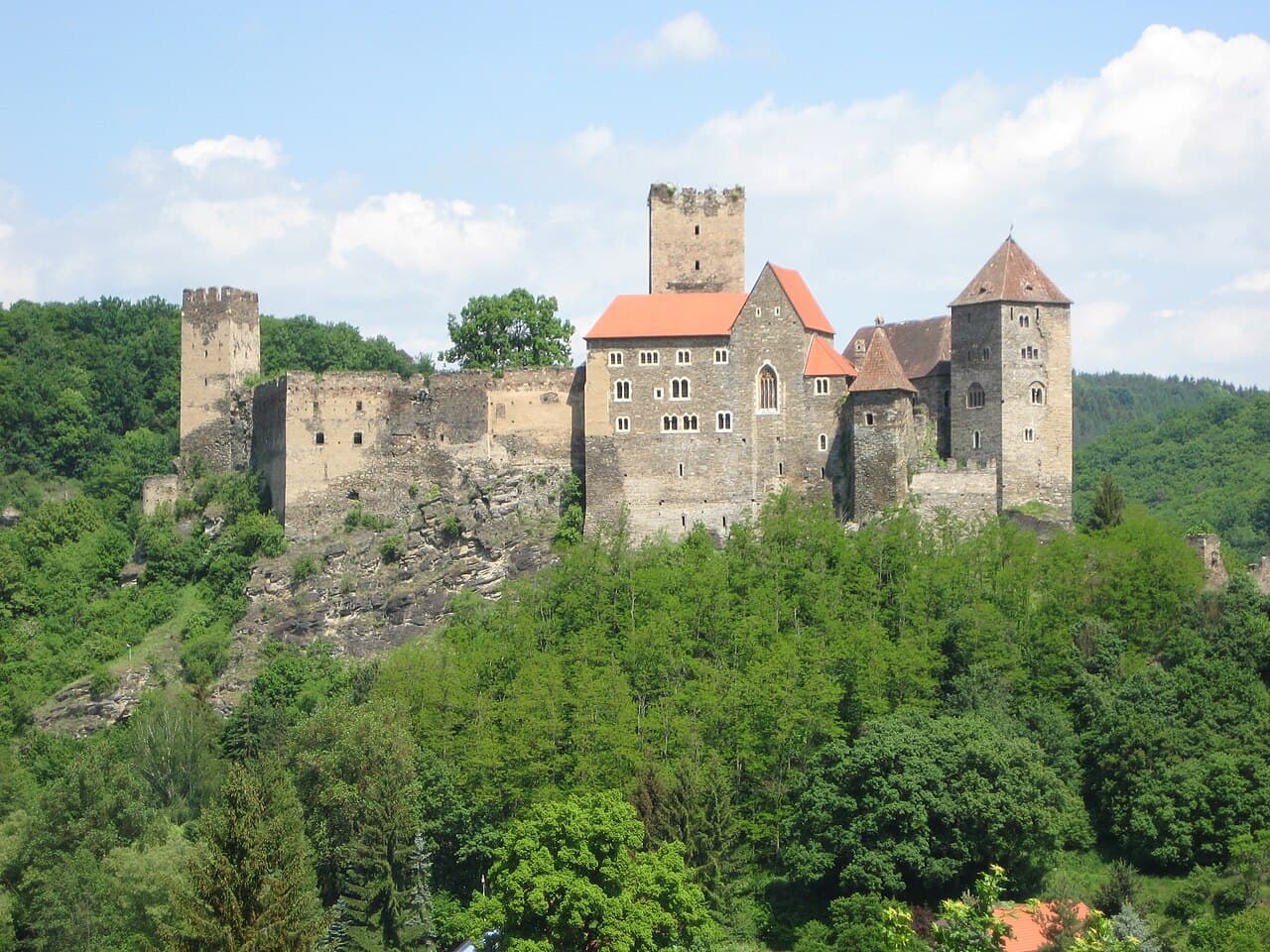
Hardegg Castle, locally known as Burg Hardegg, is a remarkable late medieval hill castle situated in the town of Hardegg in the province of Lower Austria, Austria. Positioned strategically on a hill overlooking the Thaya River—which forms a natural border between Austria and the Czech Republic—this fortress has played a pivotal role in the region's border defense and noble administration since its earliest mention in the 12th century.
The castle's documented history begins in 1145, when it was first referenced in a donation record witnessed by a noble named Otto von Hardeck. It is believed to have been founded earlier by the Counts of Plain as a modest border stronghold. The location was critical as it marked the northern frontier of the March of Bohemia, necessitating robust fortifications to repel incursions from the north. Over the centuries, Hardegg Castle evolved from a simple fortress into a complex defensive and residential structure, reflecting the political and military needs of the region.
Medieval expansion and political significance
During the 14th century, the castle underwent significant enlargement under the ownership of the Counts of Maidburg/Magdeburg. This expansion transformed Hardegg into the largest castle in the Lower Austrian region near the Enns River. At its zenith, the fortress boasted seven gates and six towers, showcasing its formidable defensive capabilities and architectural sophistication. The castle served not only as a military bastion but also as the administrative center for the County of Hardegg, which was first documented as a town in 1290.
By the late 15th century, the Counts of Hardegg had risen in prominence to the point of achieving Imperial immediacy (reichsunmittelbar), meaning they were subject directly to the Holy Roman Emperor rather than any intermediate feudal lord. This elevated status underscored the castle's and the county's growing importance within the empire. After the death of Count Michael of Hardegg and Magdeburg in 1499 without heirs, the castle and its lands passed to the powerful Habsburg dynasty.
The Habsburgs granted Hardegg Castle to the Prueschenk family from Stettenberg, elevating them to Imperial Counts of Hardegg and Machland. This family further enhanced the estate's economic and political stature. Notably, in 1502, Heinrich Prueschenk obtained the right to mint silver coins, a privilege reflecting the estate's economic significance. Ulrich von Hardegg (1483–1535), a member of this noble lineage, expanded his influence by purchasing the County of Glatz in 1501 and forging marital alliances with Silesian nobility through his marriage to Sidonia von Münsterberg-Oels in 1515.
Decline and partial restoration
Ownership of Hardegg Castle changed hands several times until the mid-17th century, when it was acquired by the Khevenhüller-Metsch family. This noble family, later elevated to Sovereign Princes, resided at Hardegg until 1730, when they shifted their primary residence to nearby Riegersburg Castle. Following their departure, Hardegg Castle gradually fell into disuse and began to deteriorate.
In 1764, after a devastating fire ravaged the town of Hardegg, the local population was permitted to quarry stones and timber from the abandoned castle to aid in rebuilding their homes. This practice accelerated the castle's decline, leaving it largely in ruins. The castle's strategic and residential functions had effectively ended, and it remained a ruin for over a century.
A revival effort commenced in 1878 under Prince Johann Carl Khevenhüller-Metsch, a notable figure who had served as a companion to Emperor Maximilian of Mexico. He initiated a partial reconstruction of the castle, including the insertion of a family crypt beneath the castle chapel. The restoration was guided by the architect Carl Gangolf Kayser, who had been the court architect for Emperor Maximilian. This phase of renovation also saw the establishment of a museum dedicated to the emperor within the castle, enhancing its cultural significance.
Architectural features and layout
Hardegg Castle's architecture reflects its evolution from a medieval fortress to a noble residence with defensive capabilities. The castle complex includes a prominent tower, a residential palace (palatium), and a chapel, each constructed and modified across different historical periods. The castle's defensive structures originally featured multiple towers and gates, designed to protect the inhabitants and control access.
The use of local stone and traditional medieval masonry techniques contributed to the castle's imposing walls and battlements. The hilltop location provided commanding views over the Thaya valley, allowing defenders to monitor movements along the border. The castle's layout was typical of hill castles built for both defense and residence, integrating living quarters with fortifications.
The family crypt beneath the chapel, added during the late 19th-century restoration, is an architecturally significant feature designed by Kayser. It serves as a mausoleum for the Khevenhüller-Metsch family and adds a layer of historical depth to the castle's interior spaces.
Modern significance and visitor experience
Today, Hardegg Castle stands as a partially restored historic monument and is accessible to visitors for a fee. While some areas of the castle remain inaccessible, the site offers a compelling glimpse into Austria's medieval heritage and the complex history of border fortifications. Visitors can explore the castle's towers, chapel, and parts of the residential areas, gaining insight into the architectural and historical significance of the site.
The castle's location near other notable fortresses such as Riegersburg Castle, Karlslust, and Fronsburg, as well as the Czech ruin Nový Hřadek, situates it within a broader landscape rich in medieval military architecture. This makes Hardegg Castle an important destination for enthusiasts of history, architecture, and Central European heritage.
Its proximity to the Czech Republic is marked by a bridge built in 1874 over the Thaya River, connecting Hardegg with the neighboring Czech village of Čížov. This cross-border link symbolizes the castle's enduring role as a frontier site, now transformed from a military bastion to a cultural landmark fostering international connection.
Frequently asked questions (FAQ)
- When was Hardegg Castle originally built and by whom?
- Hardegg Castle was first mentioned in 1145 and was likely founded earlier by the Counts of Plain as a border fortress to protect the northern frontier of the March of Bohemia.
- What architectural features make Hardegg Castle significant?
- The castle features multiple towers, gates, a residential palace, and a chapel with a family crypt, showcasing typical late medieval hill castle design with strong defensive and residential elements.
- Can visitors access all parts of Hardegg Castle?
- Some areas of Hardegg Castle remain inaccessible to visitors, but key sections such as the towers, chapel, and parts of the residential palace are open for exploration.
- What is the historical importance of Hardegg Castle in the region?
- Hardegg Castle served as a major border fortress and administrative center, achieving Imperial immediacy in the late 15th century and playing a significant role in the defense and governance of Lower Austria.
- How can visitors reach Hardegg Castle and what are the nearby attractions?
- The castle is located in the town of Hardegg, Lower Austria, near the Czech border with a bridge connecting to the Czech village of Čížov. Nearby castles include Riegersburg, Karlslust, and Fronsburg.
Photo gallery

Information
Sources & official resources
Verify the information above using these authoritative references.
Loading map...
Visitor reviews
No reviews yet. Been here? Write the first review and help other travelers!
Write the first reviewVisited this castle? Share your experience
Your review helps other travelers and adds first-hand knowledge to our encyclopedia.