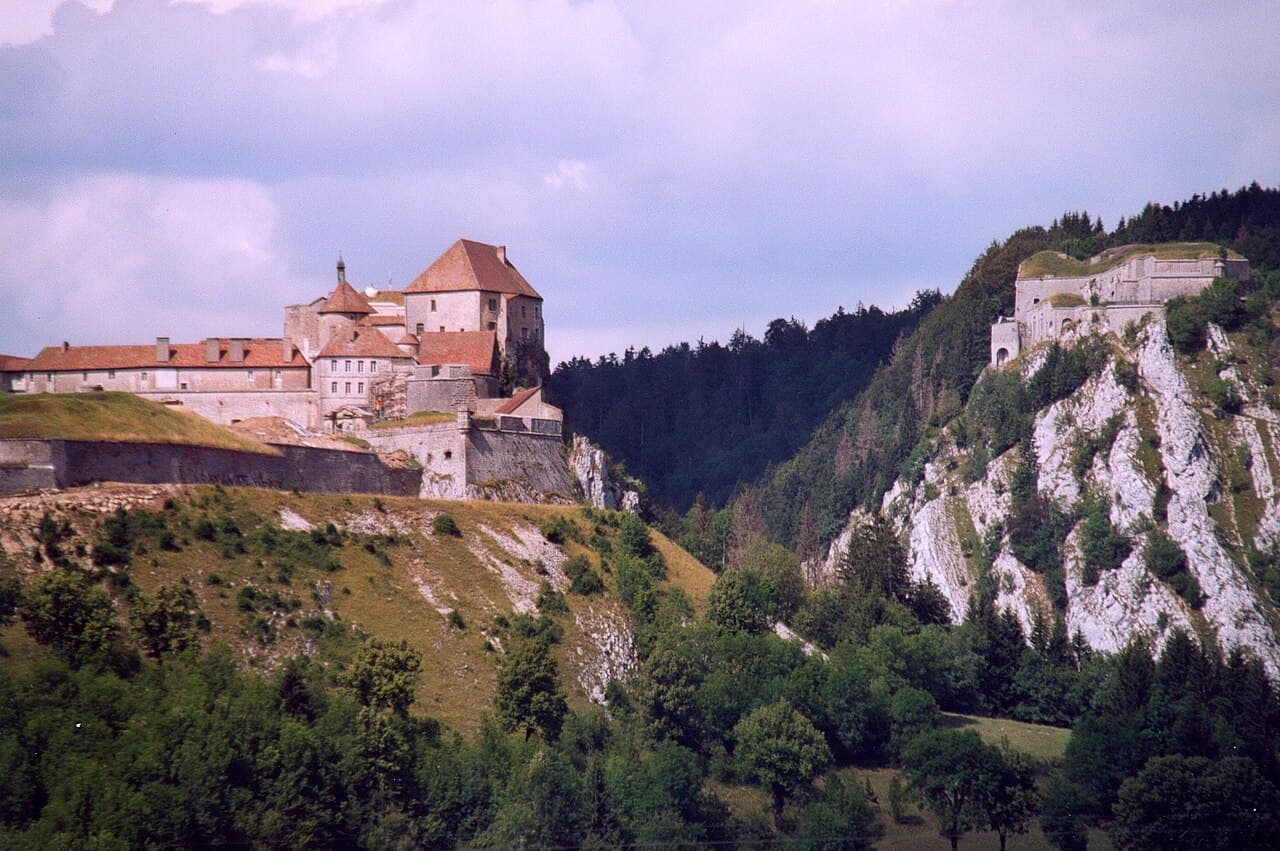
Joux Castle — France castle

Joux Castle

Joux Castle in La Cluse-et-Mijoux, France
La Cluse-et-Mijoux, Bourgogne-Franche-Comte, France
Restored

Joux Castle, located in the commune of La Cluse-et-Mijoux in the Bourgogne-Franche-Comté region of eastern France, is a remarkable example of a hill castle with a long and storied history. Perched strategically on a rocky outcrop overlooking the valley, it has served both as a military fortress and a prison over the centuries. The castle's location near the Jura Mountains made it a key defensive site controlling important trade and military routes between France and Switzerland.

Historical background and significance

The origins of Joux Castle date back to the Middle Ages, with initial construction believed to have begun in the 11th century. Over time, it underwent numerous expansions and fortifications, reflecting the evolving military architecture from the medieval period through the early modern era. It was an important stronghold for the Dukes of Burgundy and later came under French control.

Throughout its history, the castle played a significant role in regional conflicts, including the Thirty Years' War and various Franco-Swiss disputes. Its formidable defenses made it a challenging target for invading forces. In the 19th century, the castle was converted into a state prison, holding notable prisoners such as the Italian revolutionary Félix Faure and the infamous bandit Cartouche.

Architectural features and fortifications

Joux Castle is a classic example of a hill castle with layered defenses designed to maximize the natural terrain. The castle complex includes a keep, curtain walls, bastions, and a deep moat. Its thick stone walls and elevated position provided excellent vantage points for surveillance and defense.

The castle's keep is a prominent feature, serving as the last refuge during sieges. The walls are punctuated by numerous arrow slits and battlements, allowing defenders to repel attackers effectively. The entrance is protected by a fortified gatehouse and a drawbridge spanning the moat, adding layers of security.

Inside, the castle contains various chambers, including a great hall, living quarters, and prison cells. The architecture reflects successive periods of construction, with medieval stonework alongside later additions from the Renaissance and post-medieval periods. The castle's design demonstrates the transition from purely military fortifications to a more complex fortress capable of withstanding artillery attacks.

Restoration and current condition

Today, Joux Castle is restored and well-preserved, allowing visitors to explore its extensive grounds and architectural features. Restoration efforts have focused on maintaining the castle's historic character while ensuring structural stability. The castle is open to the public, offering guided tours that highlight its military history, architectural evolution, and notable prisoners.

The site also hosts cultural events and exhibitions that celebrate the region's heritage. Its commanding views of the surrounding landscape and well-maintained facilities make it a popular destination for tourists interested in medieval history and castle architecture.

Visiting information

Visitors to Joux Castle can enjoy exploring the castle's courtyards, battlements, and interior rooms. The castle provides educational panels and guided tours that explain its historical significance and architectural details. The surrounding area offers scenic hiking trails and opportunities to learn about the natural environment of the Jura Mountains.

Access to the castle is typically available during regular opening hours, and ticket prices are reasonable, making it accessible to a wide range of visitors. The castle's location in Bourgogne-Franche-Comté also makes it a convenient stop for those touring the region's rich cultural landmarks.

Frequently asked questions (FAQ)

How do I get to Joux Castle?
Joux Castle is located in La Cluse-et-Mijoux, France, and can be accessed by car or public transport. If you're driving, the castle is situated near the D105 road, with ample parking available. For public transport, you can take a train to the nearest station and then a local bus to reach the castle.
What is the historical significance of Joux Castle?
Joux Castle dates back to the 11th century and has played a crucial role in the defense of the region. It has witnessed numerous historical events, including battles and sieges, making it a significant site for understanding the history of the Franche-Comté region. The castle is also known for its role in the military strategies of various rulers over the centuries.
When was Joux Castle built?
Construction of Joux Castle began in the 11th century, and it was expanded over the following centuries. Its strategic location and robust architecture were designed to withstand sieges, contributing to its long-standing presence throughout history. The castle has undergone several renovations, reflecting different architectural styles over time.
Can I visit Joux Castle year-round?
Yes, Joux Castle is open to visitors year-round, although opening hours may vary by season. It is advisable to check the official website or contact the castle administration for specific visiting hours and any seasonal events. Guided tours are available to enhance your experience.
Why is Joux Castle considered an architectural wonder?
Joux Castle is celebrated for its impressive fortifications and unique architectural design, which incorporates elements from various periods. The castle features thick walls, towers, and a stunning view of the surrounding landscape, showcasing medieval military architecture. Its preservation allows visitors to appreciate the craftsmanship and strategic planning of its builders.
Is it possible to take guided tours of Joux Castle?
Yes, guided tours are available at Joux Castle, providing visitors with in-depth knowledge about its history and architecture. These tours are conducted by knowledgeable guides who share fascinating stories and insights about the castle's past. It's recommended to book in advance, especially during peak tourist seasons.
What are the ticket prices for visiting Joux Castle?
Ticket prices for Joux Castle are generally affordable, with discounts available for children, students, and seniors. Family packages are also offered to make visits more economical. Check the official website for the most current pricing and any special offers.
What is the best time to visit Joux Castle?
The best time to visit Joux Castle is during the spring and early autumn when the weather is pleasant, and the surrounding landscapes are at their most beautiful. Visiting during these months allows for a more enjoyable outdoor experience and often fewer crowds. Special events and exhibitions may also be held during these seasons.
Are there any nearby attractions to Joux Castle?
Yes, there are several nearby attractions worth exploring, including the picturesque Lac de Joux and various hiking trails in the Jura Mountains. The region is rich in natural beauty and offers opportunities for outdoor activities. Additionally, nearby historical towns provide a charming backdrop for a full day of sightseeing.

Photo gallery

Joux Castle
Click to view

Photo by The original uploader was Calips at French Wikipedia.•CC BY-SA 1.0

1 photo • Click any image to view in full screen

Information

Hill Castle

Sources & official resources

Verify the information above using these authoritative references.

Loading map...

Visitor reviews

No reviews yet. Been here? Write the first review and help other travelers!

Write the first review

Visited this castle? Share your experience

Your review helps other travelers and adds first-hand knowledge to our encyclopedia.

Write a review

(5/5)

0/2000 characters

Your review will be visible after admin approval

Nearby castles

0.6 km

Fort of Joux

La Cluse-et-Mijoux, France

The Fort of Joux, also known as Chateau de Joux, is a remarkable hill castle located on the Pelouse plateau in La Cluse-et-Mijoux, within the Doubs department of the Bourgogne-Franche-Comté region in eastern France. Commanding the strategic mountain pass known as the Cluse de Pontarlier, it has played a pivotal role in regional defense and trade control since its origins in the early medieval period. The castle’s commanding position allowed it to regulate a vital route between the County of Burgundy and Switzerland, making it an important military and economic asset throughout its extensive history. Originally a wooden watchtower referenced as "Iors" by the ancient Sequani tribe and "Miroaltum" by the Romans, the site first appears in written records in 1039 in the Vita Mathildis. The initial wooden structure was replaced by a stone fortress in the 11th and 12th centuries under the lords of Joux, descendants of Burgundian princes. This transformation marked the beginning of the castle’s enduring presence as a fortified stronghold. Medieval origins and strategic importance The medieval fortifications of the Fort of Joux were designed to control the crucial Cluse de Pontarlier mountain pass, a gateway facilitating trade and military movements between Burgundy and Switzerland. The castle’s lords leveraged this position to collect tolls and regulate the salt trade, a valuable commodity at the time. Over the centuries, ownership passed through several noble families, including the houses of Joux, Blonay, Vienne, and Hochberg. In 1454, Philip the Good, Duke of Burgundy, acquired the fort and fortified it further to serve as a border post. The castle became a focal point of territorial disputes between the Burgundian dukes and the Neuchâtel families, conflicts that were eventually resolved by royal arbitration and international diplomacy, culminating in decisions made at the Congress of Vienna in 1815. Renaissance to early modern transformations The fort’s military significance continued through the Thirty Years’ War, during which French forces captured it in 1639. It briefly fell under Spanish control before being permanently returned to France by the Treaty of Nijmegen in 1678. Following this, the fort underwent major modernization under the direction of the celebrated military engineer Vauban between 1678 and 1693. Vauban’s renovations introduced bastioned fortifications, artillery casemates, and enhanced defensive walls designed to withstand the evolving artillery technology of the time. He also deepened the fort’s well to an impressive 147 meters, ensuring a reliable water supply during sieges. These enhancements transformed the medieval castle into a formidable fortress capable of enduring prolonged attacks. The fort as a prison and 18th-19th century developments From the late 18th century until 1815, the Fort of Joux served as a state prison, housing several notable prisoners. Among them were the revolutionary leader Mirabeau in 1775, the Haitian revolutionary Toussaint Louverture from 1802 until his death in 1803, and the German writer Heinrich von Kleist in 1807. The prison also detained Chouans and Spanish officers from the independence wars. During the 19th century, the fort saw continued military use and modernization. Repairs and new constructions included the neo-Gothic Devil’s Tower built in 1843 and the transformation of the fort into a Séré de Rivières system stronghold under Captain Joffre between 1879 and 1881. This phase introduced Mougin casemates equipped with heavy artillery, further enhancing the fort’s defensive capabilities. Role in 19th and 20th century conflicts The Fort of Joux played a defensive role during the Franco-Prussian War of 1870-71 and was integrated into the Maginot Line’s Jura sector in the interwar period, serving as an artillery platform. During World War II, German forces occupied the fort, installing additional defenses and removing metal from the site. Despite these challenges, the fort has been preserved as a cultural heritage site and was officially classified as a French historic monument in 1996. Architectural features and fortifications The Fort of Joux’s architecture reflects its long history and multiple phases of construction. The oldest surviving elements date from the 11th century, including the medieval donjon and parts of the third enceinte’s west wall. These early structures were built using local stone from the nearby Chaffoy quarry. Medieval fortifications initially featured square towers, later supplemented by round towers in the 13th century. Notable towers include the Mirabeau tower, named after the famous prisoner, the Grammont tower with its distinctive bossed stone base and Fontaine Ronde tuff upper section, and the horseshoe-shaped "la Rondelle" tower constructed between 1393 and 1405. Vauban’s 17th-century upgrades introduced the fourth and fifth enceintes with bastioned walls, hornworks, dry moats, and covered walkways designed to resist artillery attacks. The fourth enceinte features a guardhouse adorned with King Louis XIV’s double L monogram and sun emblem. The main gate, or "porte d’honneur", is decorated with limestone from Vuillecin and military trophies symbolizing the Dauphin’s light cavalry and Swiss pikemen, alongside heraldic emblems of the Spanish Franche-Comté and France. The fort’s extensive water management system includes the large well, several cisterns, and a network that channels water through the Fontaine Ronde beneath Pontarlier to the Loue river. The well, once the deepest in France at 147 meters, is now partially filled but remains one of the deepest in the country. 19th-century and later fortifications In the 19th century, the fort’s defenses were further reinforced with the addition of artillery batteries, including the Rochette battery, and the installation of Mougin casemates with massive cast iron plates protecting 155 mm Bange guns. A spiral staircase with a 30-meter central lift shaft connects the donjon courtyard to underground galleries, facilitating movement and logistics within the fortress. The fort also features multiple drawbridges of different periods, including medieval counterweight, 17th-century flèche (arrow-shaped), and 19th-century retractable designs. Defensive elements such as dry moats, a ha-ha ditch, and covered walkways with specialized staircases named pas de canard (duck step), pas de souris (mouse step), and pas d’âne (donkey step) enhance its defensive complexity. Cultural significance and present-day status Today, the Fort of Joux stands as a testament to centuries of military architecture and regional history. It preserves key elements from its medieval origins, Vauban’s bastioned fortifications, and 19th-century Séré de Rivières enhancements. The site once housed a museum of arms showcasing nearly 600 rare weapons from the 18th to the 20th centuries, including a rare 1717 rifle and First Empire guard bearskin caps, though this collection has since been relocated to Pontarlier. Recognized as a French historic monument, the fort attracts visitors interested in military history, architecture, and the stories of its notable prisoners. Its well-preserved structures and strategic location provide valuable insights into the evolution of fortification design from the medieval period through modern times.

High Medieval (11th–13th c.)
Details
17.1 km

Les Clées Castle

Les Clées, Switzerland

Les Clées Castle stands as a remarkable example of a high medieval hill castle strategically positioned atop a rocky promontory overlooking the village of Les Clées in Switzerland. Constructed probably in the 11th century, this fortress played a pivotal role in controlling the vital passage through the Jura Mountains, specifically guarding the Jougne Pass. Its commanding location allowed the castle's occupants to monitor and regulate traffic along this important trade route, collecting tolls and ensuring military dominance over the region. The castle’s origins are closely tied to the Counts of Geneva, who initially held the site. By the early 12th century, Les Clées Castle had gained notoriety not only as a military stronghold but also as a refuge for bandits who preyed on travelers and intercepted goods passing through the narrow mountain passage. This reputation prompted Pope Innocent II in 1134 to attempt to prohibit the castle's reconstruction, reflecting its contentious role in regional power dynamics. Despite papal intervention, the fortress remained a significant seat of authority and control. Throughout the 13th and 14th centuries, the castle’s ownership shifted, moving from the Counts of Geneva to the influential House of Savoy. By 1262, Count Peter II of Savoy was officially recognized as the possessor, marking the beginning of Savoyard dominance. The castle became part of an extensive jurisdiction that included protection of religious institutions such as the abbey of Romainmôtier and oversight of nearby territories like the Vallée de Joux. The Savoy family fortified their control further by acquiring lands and granting official franchises to the settlement at Les Clées in 1359. Historical significance and political role Les Clées Castle was not only a military bastion but also an economic hub. Local bourgeois families were granted privileges related to commerce and maintenance of the castle. In 1326 and 1351, these families received rights to weigh wool bales and collect tolls, responsibilities that underscored the castle’s dual function as a defensive stronghold and a center of trade regulation. They were also charged with the upkeep of the castle’s main hall and the security of its gates and windows, highlighting the integration of civil administration with military defense. The castle underwent significant renovations in 1444 under Duke Louis I of Savoy, who commissioned repairs to the defensive walls to bolster its fortifications. However, the castle’s military importance was dramatically challenged during the Burgundian Wars. On 22 October 1475, troops of the Swiss Confederation seized Les Clées Castle, executing the garrison and setting fire to the town. This event marked a turning point in the castle’s history, signaling the decline of Savoyard influence in the region and the rise of Swiss control. Architectural features and castle layout The castle’s design reflects typical medieval fortification principles, adapted to its hilltop setting. The surviving remains include defensive stone walls that formed the outer perimeter, enhanced during the 15th-century renovations. Within these walls stood a main hall (halle), which served as the administrative and social heart of the fortress. The hall was maintained by the local toll collectors, emphasizing the castle’s role in commerce and governance. Key structural elements still visible today include the ruins of the keep (Burgfried), which functioned as the last line of defense and a lookout point. The castle hill or Burghügel remains a prominent feature, along with the entrance gates that controlled access to the fortress. These components illustrate a well-organized defensive system centered on a fortified tower and enclosed courtyard, designed to withstand sieges and control the surrounding territory. Chapel and religious aspects The castle chapel predates the 14th century and was an integral part of the complex, serving the spiritual needs of the castle’s inhabitants. It underwent reconstruction between 1738 and 1740, reflecting changes in architectural styles and religious practices over the centuries. The chapel’s presence underscores the castle’s role not only as a military and economic center but also as a religious site. Post-medieval history and transformation Following the Bernese conquest of the Vaud region in 1536, Les Clées Castle continued to function as a toll collection point, though its strategic importance waned as traders increasingly favored alternative routes through the Jura. By the early 19th century, the castle had fallen into ruin, reflecting broader shifts in military technology and trade patterns that rendered many medieval fortresses obsolete. In 1831, the site was purchased by Reverend Walter Holiday, who undertook a unique transformation of the ruins into a residential building. Rejecting local architectural plans, Holiday remodeled the castle based on designs by an English builder, embodying the 19th-century romantic fascination with medieval ruins. This adaptation preserved key structural elements while converting the fortress into a picturesque home, blending historical legacy with contemporary use. Cultural heritage and preservation Today, Les Clées Castle is recognized as a Swiss heritage site of national significance. The ruins, including the defensive walls, keep, gates, and chapel, offer valuable insights into medieval military architecture and regional history. The castle’s commanding position above the village continues to symbolize its historical role in overseeing trade and defense in the Jura Mountains. Visitors to the site can explore the remnants of the fortress and appreciate the layered history that spans from its early medieval origins through its 19th-century romantic restoration. Les Clées Castle stands as a testament to the complex interplay of military strategy, economic control, and cultural transformation over nearly a millennium.

High Medieval (11th–13th c.)
Details
18.1 km

Champvent Castle

Champvent, Switzerland

Champvent Castle stands prominently on a hill overlooking the expansive valley of the Thièle River in the canton of Vaud, Switzerland. This fortress is among the best-preserved medieval castles in the region, retaining much of its original character from the High Medieval period. Constructed around 1250, it exemplifies the architectural and military innovations introduced to the area by the Dukes of Savoy during the 13th century. The castle's design is distinctive for its rectangular enclosure fortified by four circular corner towers, a layout inspired by French fortified castles that were widely adopted in French-speaking Switzerland. This architectural plan has its roots in Byzantine military architecture and was introduced to Western Europe during the time of the Crusades. Typically, such castles were built on flat terrain to facilitate the regular geometric layout. However, Champvent Castle is uniquely perched on elevated ground, an exception that highlights the builder's commitment to contemporary stylistic trends. Architectural features and layout The castle's rectangular enceinte encloses a central courtyard, with the residential buildings abutting the inner side of the curtain walls. Originally, the fortress included a gatehouse defended by an oriel with machicolations, allowing defenders to target attackers directly below the walls. One of the round towers was later converted into a dungeon, reflecting evolving defensive and residential needs over time. The curtain walls and towers were constructed with thick stone masonry, designed to withstand sieges and artillery of the period. The castle's elevated position provided strategic oversight of the valley, enhancing its defensive capabilities. Historical background and ownership The earliest records of a seigneury at Champvent date back to around 1100. The village itself is mentioned in early 12th-century manuscripts and likely belonged to the kings of Upper Burgundy. The lords of Grandson were established in the region before the 12th century and founded a significant seigneury encompassing Champvent and several surrounding villages such as Mathod, Suscévaz, Essert, Orges, Vugelles-la-Mothe, Vuiteboeuf, Sainte-Croix, and Bullet. At the start of the 13th century, Ebal IV, Lord of Grandson and La Sarraz, divided his properties among his heirs. Champvent returned to his son Henri de Grandson, who is credited with building the castle around 1250. The seigneury expanded due to the Grandson family's active colonization efforts in the Vaudois Jura region. Champvent remained under the Grandson family's control until 1336. Subsequently, the castle and lordship passed to the Duchy of Burgundy. In 1476, during the Burgundian Wars, the castle was burned following the Battle of Grandson. After 1536, the fortress was rebuilt and became private property, marking a transition from a military stronghold to a noble residence. Cultural and architectural significance Champvent Castle is a prime example of medieval military architecture in the Vaud region, showcasing the influence of French and Byzantine design principles. Its preservation offers valuable insights into the defensive strategies and residential arrangements of 13th-century noble fortresses. The castle's layout, with round towers at each corner and a rectangular curtain wall, reflects a deliberate adoption of contemporary architectural fashions, despite the challenging topography. This adherence to style over pure practicality underscores the importance of symbolic and aesthetic considerations in medieval castle construction. Restoration and current condition Today, Champvent Castle is well-preserved, retaining much of its original structure and medieval character. Over the centuries, the interior buildings have undergone modifications to accommodate changing tastes and living standards, yet the fortress's core defensive features remain intact. The castle is a significant heritage site in the canton of Vaud, attracting visitors interested in medieval history, architecture, and the legacy of the noble families who shaped the region. Visitor information and accessibility Champvent Castle's elevated location offers spectacular views of the Thièle valley and surrounding Jura landscapes. Visitors can explore the castle's courtyard, towers, and defensive walls, gaining a tangible sense of medieval fortification design. While specific visiting hours and ticket prices vary, the castle is generally accessible to the public during designated times, often with guided tours available to provide historical context and architectural insights. Frequently asked questions When was Champvent Castle built?Champvent Castle was constructed around 1250 by Henri de Grandson during the High Medieval period. What architectural style does Champvent Castle represent?The castle features a French-inspired fortified design with Byzantine influences, typical of 13th-century Western European crusader architecture. Is Champvent Castle open to visitors?Yes, the castle is open to the public, often with guided tours and special events, though visiting hours may vary seasonally. What is unique about Champvent Castle's location?Unlike most castles with similar layouts built on flat terrain, Champvent Castle is uniquely situated on a hill, combining strategic elevation with a regular rectangular plan. Who were the original owners of Champvent Castle?The castle was built and owned by the Grandson family, a powerful noble house in the Vaud region during the 12th and 13th centuries. What happened to the castle during the Burgundian Wars?It was burned in 1476 after the Battle of Grandson but was rebuilt after 1536 and transitioned into private ownership.

High Medieval (11th–13th c.)
Details

