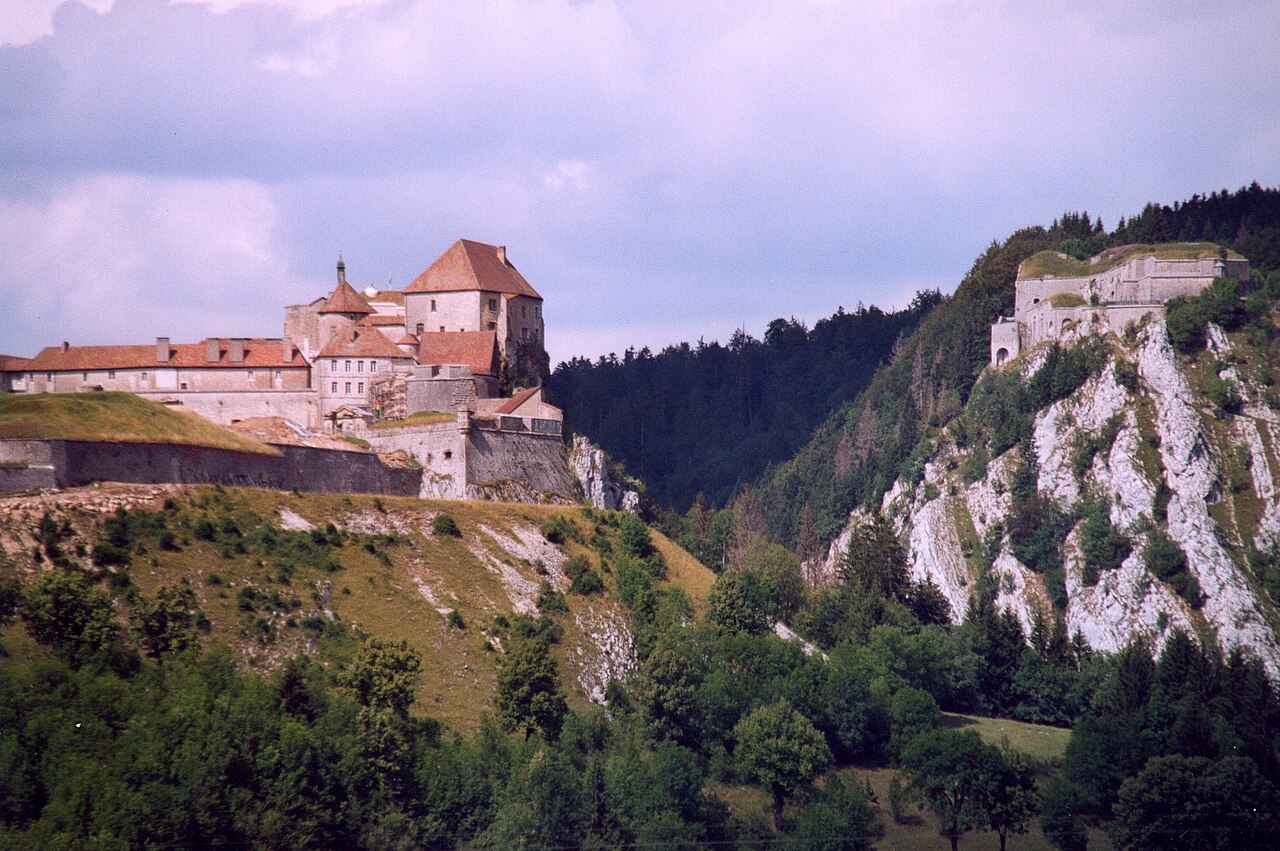
Fort of Joux
The Fort of Joux, also known as Chateau de Joux, is a remarkable hill castle located on the Pelouse plateau in La Cluse-et-Mijoux, within the Doubs department of the Bourgogne-Franche-Comté region in eastern France. Commanding the strategic mountain pass known as the Cluse de Pontarlier, it has played a pivotal role in regional defense and trade control since its origins in the early medieval period. The castle’s commanding position allowed it to regulate a vital route between the County of Burgundy and Switzerland, making it an important military and economic asset throughout its extensive history.
Originally a wooden watchtower referenced as "Iors" by the ancient Sequani tribe and "Miroaltum" by the Romans, the site first appears in written records in 1039 in the Vita Mathildis. The initial wooden structure was replaced by a stone fortress in the 11th and 12th centuries under the lords of Joux, descendants of Burgundian princes. This transformation marked the beginning of the castle’s enduring presence as a fortified stronghold.
Medieval origins and strategic importance
The medieval fortifications of the Fort of Joux were designed to control the crucial Cluse de Pontarlier mountain pass, a gateway facilitating trade and military movements between Burgundy and Switzerland. The castle’s lords leveraged this position to collect tolls and regulate the salt trade, a valuable commodity at the time. Over the centuries, ownership passed through several noble families, including the houses of Joux, Blonay, Vienne, and Hochberg.
In 1454, Philip the Good, Duke of Burgundy, acquired the fort and fortified it further to serve as a border post. The castle became a focal point of territorial disputes between the Burgundian dukes and the Neuchâtel families, conflicts that were eventually resolved by royal arbitration and international diplomacy, culminating in decisions made at the Congress of Vienna in 1815.
Renaissance to early modern transformations
The fort’s military significance continued through the Thirty Years’ War, during which French forces captured it in 1639. It briefly fell under Spanish control before being permanently returned to France by the Treaty of Nijmegen in 1678. Following this, the fort underwent major modernization under the direction of the celebrated military engineer Vauban between 1678 and 1693.
Vauban’s renovations introduced bastioned fortifications, artillery casemates, and enhanced defensive walls designed to withstand the evolving artillery technology of the time. He also deepened the fort’s well to an impressive 147 meters, ensuring a reliable water supply during sieges. These enhancements transformed the medieval castle into a formidable fortress capable of enduring prolonged attacks.
The fort as a prison and 18th-19th century developments
From the late 18th century until 1815, the Fort of Joux served as a state prison, housing several notable prisoners. Among them were the revolutionary leader Mirabeau in 1775, the Haitian revolutionary Toussaint Louverture from 1802 until his death in 1803, and the German writer Heinrich von Kleist in 1807. The prison also detained Chouans and Spanish officers from the independence wars.
During the 19th century, the fort saw continued military use and modernization. Repairs and new constructions included the neo-Gothic Devil’s Tower built in 1843 and the transformation of the fort into a Séré de Rivières system stronghold under Captain Joffre between 1879 and 1881. This phase introduced Mougin casemates equipped with heavy artillery, further enhancing the fort’s defensive capabilities.
Role in 19th and 20th century conflicts
The Fort of Joux played a defensive role during the Franco-Prussian War of 1870-71 and was integrated into the Maginot Line’s Jura sector in the interwar period, serving as an artillery platform. During World War II, German forces occupied the fort, installing additional defenses and removing metal from the site. Despite these challenges, the fort has been preserved as a cultural heritage site and was officially classified as a French historic monument in 1996.
Architectural features and fortifications
The Fort of Joux’s architecture reflects its long history and multiple phases of construction. The oldest surviving elements date from the 11th century, including the medieval donjon and parts of the third enceinte’s west wall. These early structures were built using local stone from the nearby Chaffoy quarry.
Medieval fortifications initially featured square towers, later supplemented by round towers in the 13th century. Notable towers include the Mirabeau tower, named after the famous prisoner, the Grammont tower with its distinctive bossed stone base and Fontaine Ronde tuff upper section, and the horseshoe-shaped "la Rondelle" tower constructed between 1393 and 1405.
Vauban’s 17th-century upgrades introduced the fourth and fifth enceintes with bastioned walls, hornworks, dry moats, and covered walkways designed to resist artillery attacks. The fourth enceinte features a guardhouse adorned with King Louis XIV’s double L monogram and sun emblem. The main gate, or "porte d’honneur", is decorated with limestone from Vuillecin and military trophies symbolizing the Dauphin’s light cavalry and Swiss pikemen, alongside heraldic emblems of the Spanish Franche-Comté and France.
The fort’s extensive water management system includes the large well, several cisterns, and a network that channels water through the Fontaine Ronde beneath Pontarlier to the Loue river. The well, once the deepest in France at 147 meters, is now partially filled but remains one of the deepest in the country.
19th-century and later fortifications
In the 19th century, the fort’s defenses were further reinforced with the addition of artillery batteries, including the Rochette battery, and the installation of Mougin casemates with massive cast iron plates protecting 155 mm Bange guns. A spiral staircase with a 30-meter central lift shaft connects the donjon courtyard to underground galleries, facilitating movement and logistics within the fortress.
The fort also features multiple drawbridges of different periods, including medieval counterweight, 17th-century flèche (arrow-shaped), and 19th-century retractable designs. Defensive elements such as dry moats, a ha-ha ditch, and covered walkways with specialized staircases named pas de canard (duck step), pas de souris (mouse step), and pas d’âne (donkey step) enhance its defensive complexity.
Cultural significance and present-day status
Today, the Fort of Joux stands as a testament to centuries of military architecture and regional history. It preserves key elements from its medieval origins, Vauban’s bastioned fortifications, and 19th-century Séré de Rivières enhancements. The site once housed a museum of arms showcasing nearly 600 rare weapons from the 18th to the 20th centuries, including a rare 1717 rifle and First Empire guard bearskin caps, though this collection has since been relocated to Pontarlier.
Recognized as a French historic monument, the fort attracts visitors interested in military history, architecture, and the stories of its notable prisoners. Its well-preserved structures and strategic location provide valuable insights into the evolution of fortification design from the medieval period through modern times.
Frequently asked questions (FAQ)
- How do I get to the Fort of Joux?
- The Fort of Joux is located in La Cluse-et-Mijoux, France, and can be easily accessed by car or public transport from nearby cities. The nearest major city is Besançon, which is approximately 30 kilometers away. There are also local bus services that connect to the castle, making it convenient for visitors.
- What are the opening hours of the Fort of Joux?
- The Fort of Joux is open to visitors from April to October, typically from 10 AM to 6 PM. During the off-season, hours may vary, so it's best to check the official website or contact the fort directly for the most current information. Guided tours are available and may have specific time slots.
- Can I purchase tickets in advance for the Fort of Joux?
- Yes, tickets for the Fort of Joux can be purchased in advance online through the official website. It is recommended to book in advance, especially during peak tourist seasons, to ensure availability for guided tours. On-site ticket purchases are also available.
- When was the Fort of Joux built?
- The Fort of Joux has a rich history, originally constructed in the 11th century. It has undergone various renovations and expansions over the centuries, particularly during the 17th and 18th centuries. The fort played a significant role in military history, serving as a strategic defense point.
- Why is the Fort of Joux historically significant?
- The Fort of Joux is historically significant as it has served various roles throughout its long history, including as a military fortress and a prison. It played a crucial part in the defense of the region against invasions and was associated with notable historical figures. Its architecture reflects the evolution of military design over the centuries.
- Is the Fort of Joux accessible for visitors with disabilities?
- The Fort of Joux has taken steps to improve accessibility for visitors with disabilities, including designated parking and certain areas that are wheelchair accessible. However, due to the fort's historical structure, some parts may have limitations. It is advisable to contact the fort in advance to inquire about specific accessibility options.
- What is the best time to visit the Fort of Joux?
- The best time to visit the Fort of Joux is during the spring and summer months when the weather is pleasant and the surrounding landscapes are in full bloom. This period also includes various events and guided tours that enhance the visitor experience. Early mornings or late afternoons can be less crowded, providing a more relaxed visit.
- Are there any nearby attractions to visit after the Fort of Joux?
- Yes, there are several nearby attractions to explore after visiting the Fort of Joux. The picturesque town of Mijoux offers beautiful hiking trails, and the Jura Mountains provide stunning natural scenery. Additionally, the city of Besançon, with its rich history and cultural sites, is just a short drive away.
Information
Website
Visit websiteSources & official resources
Verify the information above using these authoritative references.
Loading map...
Visitor reviews
No reviews yet. Been here? Write the first review and help other travelers!
Write the first reviewVisited this castle? Share your experience
Your review helps other travelers and adds first-hand knowledge to our encyclopedia.