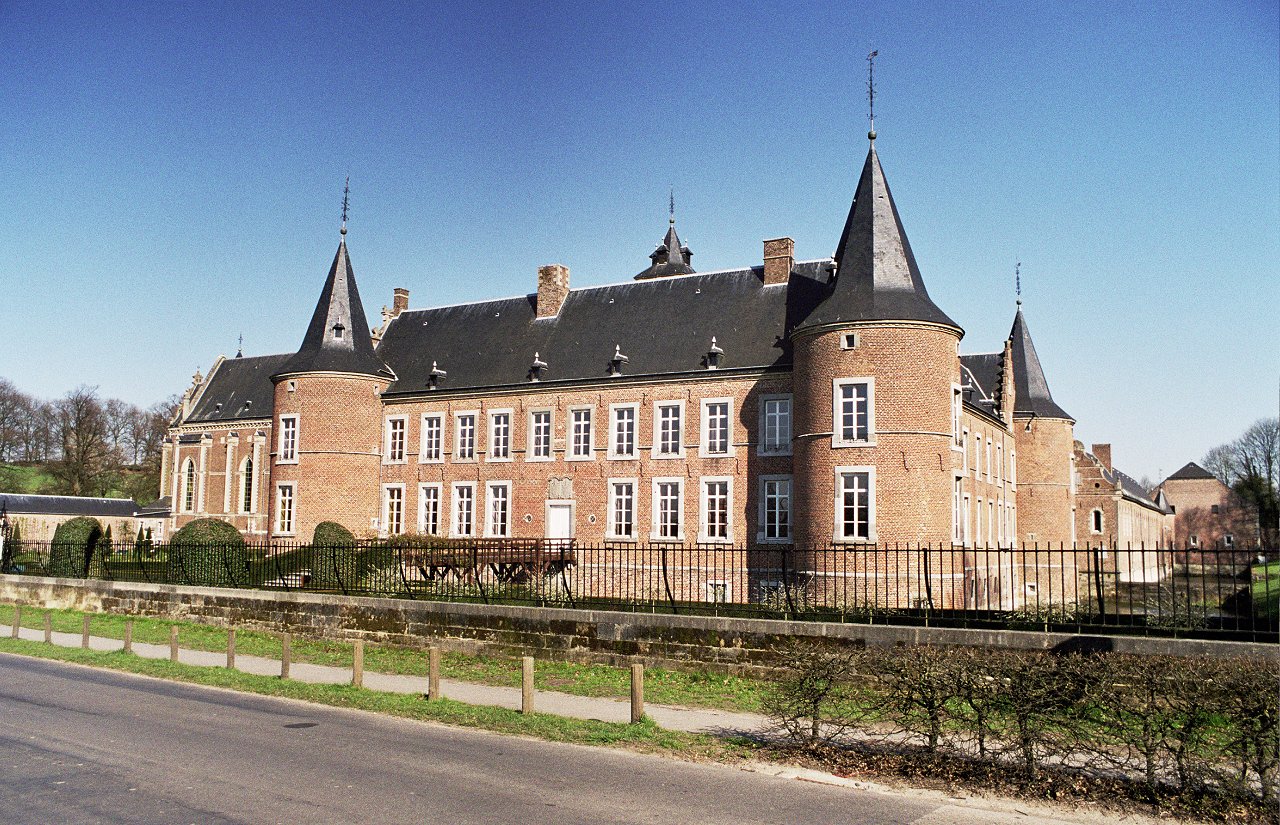
Jonckholt Castle
Jonckholt Castle, locally known as Kasteel van Jonckholt, is a notable late medieval site located in the serene forested area north of the village of Hoelbeek, within the Limburg province in the Flemish region of Belgium. This castle's history reflects the evolution from a modest medieval farmstead to a fortified stone castle, illustrating the defensive architectural trends of the 14th century.
Early occupation and initial construction
The earliest known occupation of the Jonckholt site dates back to approximately 1200 AD. Originally, the site featured a farmstead constructed using wood, marl, and silex, materials typical for rural buildings of the period. This farm was strategically positioned on an artificially raised patch of land adjacent to the Meers Creek, providing natural protection and access to water.
Significantly, the farm was surrounded by a moat and accessible via a drawbridge, indicating an early concern for defense and control of access. This setup was common in medieval agrarian sites that required protection from both wildlife and human threats.
Transformation into a fortified castle
At the beginning of the 14th century, the wooden structures were replaced with a more permanent stone fortification. The castle was designed as a square stone fortification featuring circular towers at the corners. These towers were equipped with loopholes, narrow vertical slits that allowed defenders to shoot arrows or crossbow bolts while remaining protected.
The fortification was further enhanced by a double moat and an earthen defensive wall, which together formed a formidable barrier against attackers. This combination of water and earthworks was a common defensive strategy in the late medieval period, reflecting the military architectural advances of the time.
Abandonment and later use
Despite its strong defensive features, Jonckholt Castle was abandoned around the middle of the 16th century for reasons that remain unclear. This abandonment coincided with a period of significant political and military change in the region, which may have rendered the castle obsolete or strategically unnecessary.
In the 17th century, the site was repurposed as a quarry for building materials. Stones and other materials from Jonckholt Castle were used in the construction of nearby Groenendaal Castle, indicating the practical reuse of medieval building resources in later periods.
Archaeological remains and current state
Today, Jonckholt Castle exists primarily as an archaeological site with limited visible structures remaining above ground. Visitors to the site can see the black stones scattered on the grass, which mark the locations of post holes uncovered during archaeological excavations. These post holes reveal the layout of the original farm buildings and provide insight into the site's early medieval occupation.
The castle's remains are freely accessible, situated in a quiet, lush green forest setting that offers a peaceful environment for visitors interested in medieval history and archaeology. While the physical structures are minimal, the site's historical significance as a transition from a fortified farmstead to a stone castle remains important for understanding regional medieval architecture.
Architectural features and defensive elements
The design of Jonckholt Castle reflects typical late medieval defensive architecture with its square layout and circular towers. The use of stone construction marked a significant advancement from the earlier wooden structures, providing greater durability and protection.
The double moat surrounding the castle served as a critical defense mechanism, complicating any direct assault on the walls. The earthen defensive wall added an additional layer of protection, absorbing impact and preventing easy scaling by attackers.
Loopholes in the towers allowed defenders to maintain a defensive position while firing upon enemies, a common feature in castles designed to withstand sieges during the medieval period.
Historical context and regional significance
Jonckholt Castle's location in Limburg placed it within a region that experienced frequent territorial disputes and shifting political control during the late medieval period. Castles such as Jonckholt played a role in local defense and control of land, serving both military and administrative functions.
The abandonment of Jonckholt in the 16th century aligns with broader changes in military technology and political structures, which led to the decline of many small fortifications in favor of larger, more modern defensive complexes.
Visiting jonckholt castle today
Visitors to Jonckholt Castle can explore the site without restrictions, enjoying the natural surroundings and the subtle archaeological traces that hint at its medieval past. While the castle does not offer extensive ruins or restored buildings, its peaceful location and historical importance make it a point of interest for enthusiasts of medieval architecture and history.
The site is ideal for those interested in archaeology and the evolution of medieval fortifications, providing a tangible connection to the region's past through the preserved landscape and excavated features.
Frequently asked questions (FAQ)
- How do I get to Jonckholt Castle?
- Jonckholt Castle is located in a forest north of Hoelbeek village in Limburg, Belgium. It can be reached by local roads leading to Jonckholtpad, with parking available nearby.
- What can I see at Jonckholt Castle today?
- Today, visitors can see the archaeological remains marked by black stones indicating post holes of the original farm buildings. The site is mostly an open landscape with no standing structures but offers a peaceful forest setting.
- When was Jonckholt Castle built?
- The castle was transformed into a stone fortification in the early 14th century, with earlier wooden farm structures dating back to around 1200 AD.
- Is Jonckholt Castle open to the public?
- Yes, Jonckholt Castle is freely accessible to the public year-round, with no entrance fee. Visitors can explore the site at their own pace.
- Why was Jonckholt Castle abandoned?
- The castle was abandoned in the mid-16th century for reasons not clearly documented, possibly due to changes in military strategy or political shifts in the region.
Information
Address
Jonckholtpad, Belgium
Loading map...
Visitor reviews
No reviews yet. Been here? Write the first review and help other travelers!
Write the first reviewVisited this castle? Share your experience
Your review helps other travelers and adds first-hand knowledge to our encyclopedia.