Jegenstorf Castle
Jegenstorf Castle is a significant historic monument located in the municipality of Jegenstorf, in the canton of Bern, Switzerland. The castle's origins date back to the 12th century when the Lords of Jegenstorf, vassals of the Dukes of Zähringen, established the initial fortification. This early structure consisted primarily of a large, square keep or castle tower, which formed the core of the medieval stronghold. The original defensive perimeter likely included wooden palisades, a common feature in early medieval fortifications.
Medieval origins and architectural evolution
During the High Medieval period, the castle underwent significant architectural transformations. By the 13th and 14th centuries, the initial wooden defenses were replaced with robust stone curtain walls, enhancing the castle's defensive capabilities. The castle expanded to include a corner tower, a housing wing, and a central courtyard, enclosed by a double moat filled with water, which was a strategic feature to deter attackers. This layout reflected typical medieval castle design focused on defense and control over the surrounding territory.
Transition of ownership and political significance
In the early 14th century, shortly before the extinction of the original Lords of Jegenstorf, the Erlach family acquired the herrschaft (lordship) of Jegenstorf. However, the castle itself remained outside their control until the late 14th or early 15th century due to the division of the Jegenstorf holdings. Through a series of political marriages and purchases, Johann von Erlach (1474–1539) consolidated control over the castle, the village, and the surrounding court by 1519. That same year, Johann von Erlach was appointed Schultheiss of Bern, marking the castle's importance in regional governance. The Erlach family maintained possession until 1584.
Baroque transformation and later ownership
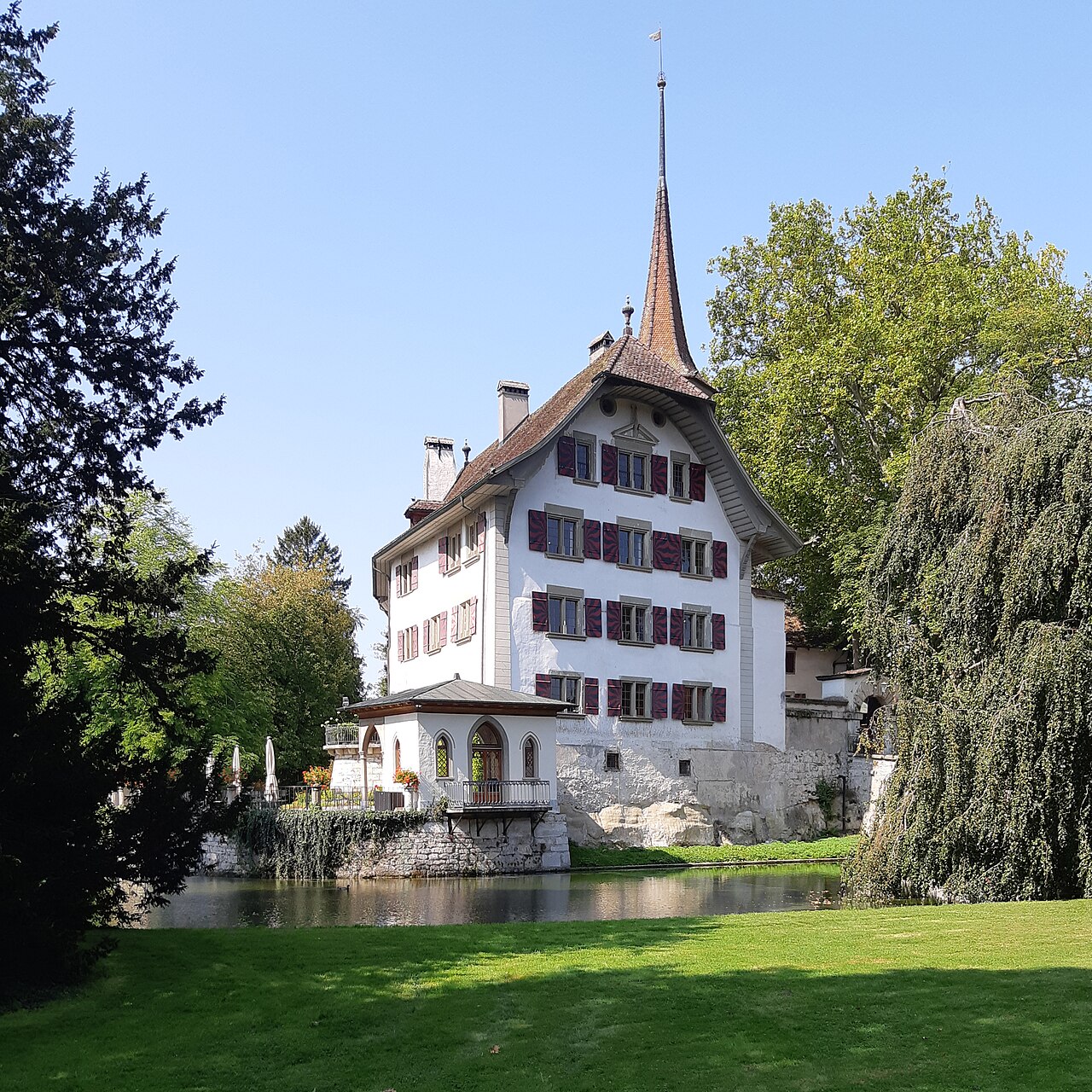
After passing through the hands of the von Bonstetten family (1584–1675) and the von Wattenwyl family (1675–1720), the castle was reacquired by Albrecht Friedrich von Erlach in 1720. Under his direction, the castle was extensively renovated and expanded, transforming it from a medieval fortress into a baroque manor house. The old medieval tower was rebuilt as a baroque tower house, and three additional corner towers were constructed to complement the original south-eastern tower, creating a symmetrical quadrangle around the original keep. A connecting hallway linked the towers, and the main northern entrance was enhanced with a grand staircase, balcony, and decorative carvings. The south and east facades received elegant triangular pediments, reflecting the baroque style's emphasis on grandeur and symmetry.
Interior decoration and artistic features
The castle's interior saw significant refurbishment in the early 20th century (1913–1915) under Arthur Albert Vinzenz von Stürler. Among the notable features is the dining room, decorated with allegorical paintings originally created by Joseph Werner in 1690 for Reichenbach Castle, depicting the affairs of Katharina Perregaux-von Wattenwyl. The castle also houses several 18th-century masonry heaters, including two covered with distinctive blue glazed tiles signed and dated 1723 by Urs Johann Wiswalt. The Herkulessaal (Hercules hall) on the first upper story contains a 17th-century statue of Hercules battling the Hydra, highlighting the castle's blend of art and history.
Surrounding grounds and later history
The castle is set within a large park featuring an 18th-century orangery and a neo-Gothic pavilion built in 1890. This pavilion is adorned with a statue of Minerva, carved by Johann Friedrich I Funk in 1773, adding classical artistic elements to the landscape. The castle was spared damage during the 1798 French invasion, maintaining its historical fabric.
20th-century preservation and military use
In the 20th century, after passing through the Stürler family, the castle was acquired by a preservation association following the death of Arthur Albert Vinzenz von Stürler in 1934. Notably, during World War II, on 9 October 1944, General Henri Guisan, the supreme commander of the Swiss Army, established his command post at Jegenstorf Castle. He was provided with two rooms in the castle's south-west wing for personal use, while much of the army's General Staff relocated to nearby Burgdorf. This military use underscores the castle's strategic and symbolic importance even in modern times.
Museum and cultural significance today
Since 1955, Jegenstorf Castle has served as the village museum, operated by a foundation dedicated to its preservation and public accessibility. The museum showcases the castle's rich history, architectural evolution, and cultural heritage, offering visitors insight into the life and times of the noble families who shaped the region. The castle's well-preserved baroque architecture, combined with its medieval origins and artistic interiors, make it a valuable cultural landmark in the canton of Bern.
Jegenstorf Castle exemplifies the architectural and historical layers typical of Swiss noble residences, evolving from a medieval fortress into an elegant baroque manor, while retaining elements from each period. Its continuous occupation, careful preservation, and adaptation for public use ensure that it remains a significant site for understanding Swiss history and architecture.
Frequently asked questions (FAQ)
- How do I get to Jegenstorf Castle?
- Jegenstorf Castle is located in the town of Jegenstorf in the canton of Bern, Switzerland. It is accessible by car and public transport, with local bus connections from Bern and nearby towns. The castle is within walking distance from the town center.
- What is the historical significance of Jegenstorf Castle?
- Jegenstorf Castle dates back to the 12th century and has been associated with notable noble families such as the Lords of Jegenstorf and the Erlach family. It played a role in regional governance and was a strategic site during various historical periods, including World War II when General Henri Guisan used it as his command post.
- Can I visit the interior of Jegenstorf Castle?
- Yes, the castle is open to visitors and operates as a museum. The interior features baroque architectural elements, historic rooms like the Hercules hall, and art collections including allegorical paintings and 18th-century masonry heaters. Guided tours are available during opening hours.
- When is the best time to visit Jegenstorf Castle?
- The castle is open from 10:00 to 17:00, Tuesday to Sunday. Visiting during the spring and summer months offers pleasant weather to explore both the castle interiors and the surrounding park and gardens.
- Is Jegenstorf Castle accessible for visitors with mobility issues?
- The castle has made efforts to accommodate visitors with limited mobility, but due to its historic structure, some areas may have limited access. It is recommended to contact the museum in advance to inquire about specific accessibility arrangements.
Information
Opening hours
10:00-17:00, Tuesday to Sunday
Ticket prices
CHF 8 adult, CHF 4 child
Current owner
Preservation foundation
Loading map...
Visitor reviews
No reviews yet. Been here? Write the first review and help other travelers!
Write the first reviewVisited this castle? Share your experience
Your review helps other travelers and adds first-hand knowledge to our encyclopedia.