Jamrud Fort
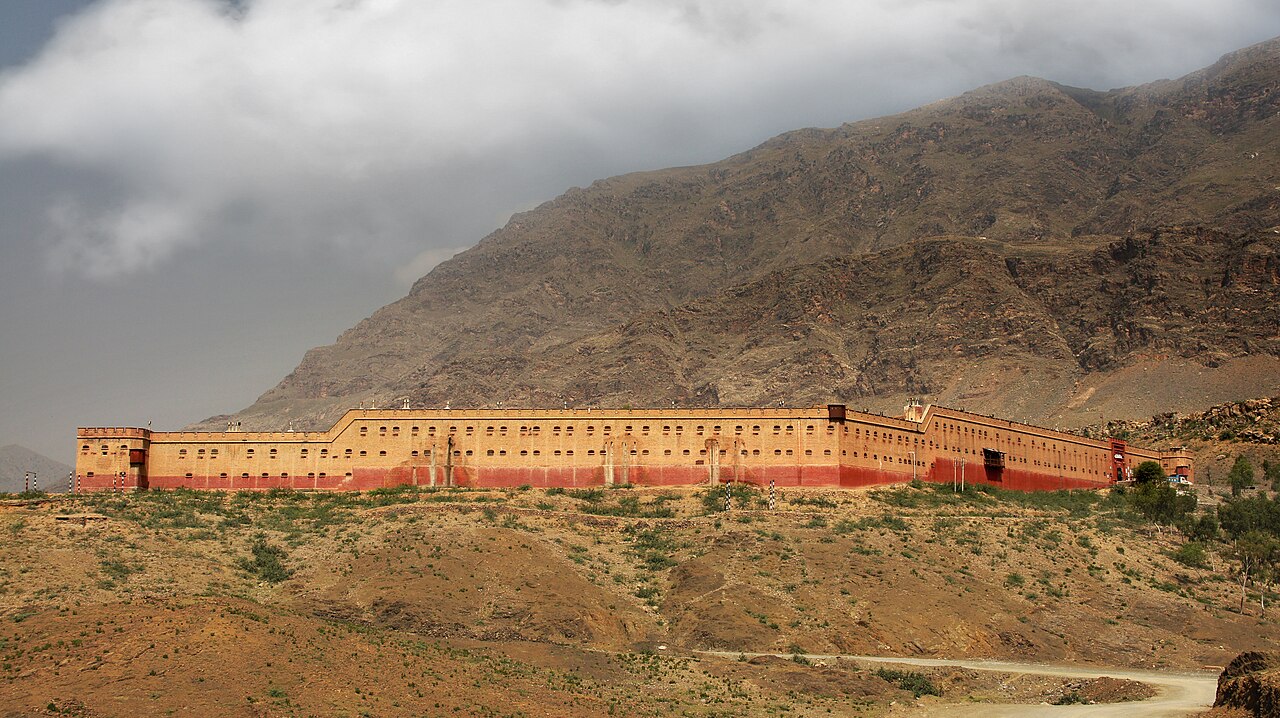
Jamrud Fort, also known as Fatehgarh Fort, is a significant 19th-century bastioned fortress located beside Bab-e-Khyber at the eastern entrance to the Khyber Pass from Peshawar, in the Khyber District of Khyber Pakhtunkhwa, Pakistan. This fort holds a strategic position controlling the historic mountain pass that connects Pakistan to Afghanistan, making it a critical military and trade gateway for centuries.
Historical context and strategic importance
The Khyber Pass has long been a vital corridor for invasions, trade, and cultural exchange between Central Asia and the Indian subcontinent. The construction of Jamrud Fort in the 19th century was part of efforts by the British colonial administration to secure this crucial frontier during the period of the Anglo-Afghan Wars. The fort's location allowed control over movements through the pass, serving both defensive and administrative purposes.
Jamrud Fort was initially built by the Sikh Empire under the leadership of Hari Singh Nalwa in the early 19th century before coming under British control. The fort played a significant role during the First Anglo-Afghan War (1839-1842) and subsequent conflicts, acting as a military outpost and checkpoint.
Architectural features and design
Jamrud Fort is classified as a bastioned fortress, featuring robust defensive walls with multiple bastions or projecting parts designed to provide overlapping fields of fire against attackers. The fort's design reflects military architectural principles of the period, emphasizing strong fortifications to withstand artillery assaults.
The fort is constructed primarily of stone and mortar, with thick walls and a rectangular layout. It includes guard towers, gates, and internal structures such as barracks and storage facilities. Its proximity to the Khyber Pass necessitated a design that could sustain prolonged sieges and control the narrow mountain route effectively.
Defensive structures
The bastions at Jamrud Fort are positioned to cover all approaches, allowing defenders to repel attackers from multiple angles. The fort's walls are punctuated with embrasures for cannon and musket fire, illustrating the adaptation to contemporary military technology of the 19th century.
Internal layout
Inside the fort, there are quarters for soldiers and officers, as well as storage rooms for ammunition and supplies. The internal courtyard served as a muster area and facilitated communication within the garrison. The fort's design balances defensive needs with functional living spaces for its occupants.
Role in regional history and conflicts
Jamrud Fort has witnessed several military engagements, particularly during the British colonial period. Its strategic location made it a focal point during the Anglo-Afghan Wars and subsequent tribal uprisings in the region. The fort's control was essential for maintaining British influence over the volatile frontier areas.
Following the decline of British colonial power, the fort came under Pakistani administration and remains a symbol of the region's turbulent history. It continues to be a point of interest for historians and military scholars studying frontier defense and colonial military architecture.
Current condition and preservation
Today, Jamrud Fort is partially preserved and stands as a historical monument near the Khyber Pass. While some sections have suffered from weathering and neglect, efforts have been made to maintain its structural integrity. The fort attracts visitors interested in military history and the heritage of the Khyber region.
Its location near the Bab-e-Khyber gateway also makes it accessible to tourists traveling through the area, providing insight into the military and cultural history of this important frontier.
Visiting information and accessibility
Visitors to Jamrud Fort can explore the exterior fortifications and some internal areas, although access may be limited due to preservation concerns and security considerations. The fort is reachable from Peshawar and is often included in tours of the Khyber Pass region.
While there are no formal visitor facilities inside the fort, local guides offer historical explanations and context. The best time to visit is during the cooler months to avoid the intense summer heat of the region.
Frequently asked questions (FAQ)
- What is the historical significance of Jamrud Fort?
- Jamrud Fort, built in the 19th century, is a key historical site that played a crucial role in the defense of the Khyber Pass. It was constructed by the British to control trade and military movements, showcasing the strategic importance of the region throughout history.
- When was Jamrud Fort built?
- Jamrud Fort was completed in 1837 under the supervision of the British military engineer, Major James Abbott. It has since served as a significant military and administrative post in the region.
- How do I get to Jamrud Fort?
- Jamrud Fort is located near Peshawar, making it accessible by road. Visitors can take a taxi or drive from Peshawar, which is approximately 20 kilometers away, and follow signs to the fort.
- What are the opening hours of Jamrud Fort?
- Jamrud Fort is generally open to visitors from 9 AM to 5 PM daily. However, it is advisable to check for any updates or changes in hours before your visit.
- Can I take photographs inside Jamrud Fort?
- Yes, visitors are allowed to take photographs inside Jamrud Fort. However, it is recommended to be respectful of the site and avoid using flash photography in sensitive areas.
- Is it possible to explore the fort on my own?
- While visitors can explore Jamrud Fort independently, guided tours are available for a more informative experience. Local guides can provide insights into the fort's history and architecture.
- What is the best time to visit Jamrud Fort?
- The best time to visit Jamrud Fort is during the cooler months, from October to March, when the weather is pleasant for outdoor exploration. Summers can be hot and uncomfortable for sightseeing.
- Are there any nearby attractions to visit?
- Yes, nearby attractions include the historic Khyber Pass and the picturesque Landi Kotal. These sites complement a visit to Jamrud Fort and offer additional insights into the region's rich history.
- What are the ticket prices for visiting Jamrud Fort?
- Entry to Jamrud Fort is typically free for local visitors, while a nominal fee may be charged for foreign tourists. It's best to check with local authorities for the most current pricing information.
Photo gallery

Information
Current owner
Government of Pakistan
Loading map...
Visitor reviews
No reviews yet. Been here? Write the first review and help other travelers!
Write the first reviewVisited this castle? Share your experience
Your review helps other travelers and adds first-hand knowledge to our encyclopedia.