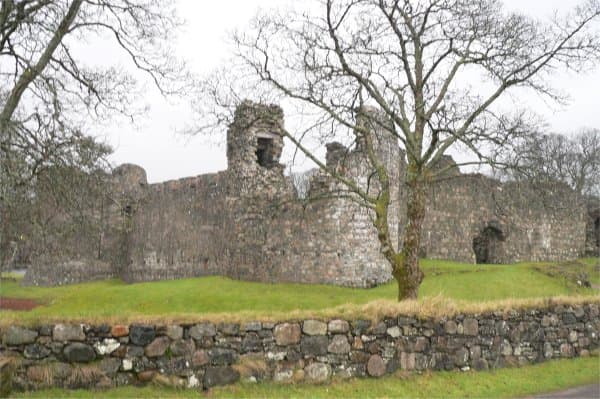
Inverlochy Castle Ruins
Inverlochy Castle stands as a remarkable example of a 13th-century Scottish fortress, located near Fort William in the Scottish Highlands. Constructed around 1280 by the influential 'Red' Comyns, lords of Badenoch and Lochaber, the castle was strategically positioned to control the southern end of the Great Glen. Its location on a natural defensive site by the River Lochy provided a commanding view and protection, making it a key stronghold during the High Medieval period.
The castle’s architecture reflects the typical High Medieval military design with a compact, rectangular plan surrounded originally by a moat, now lost to time. The castle's walls and towers remain substantially intact despite centuries of conflict and decay, offering valuable insight into medieval fortification techniques. Inverlochy Castle is classified as archaeological ruins, preserving the remnants of its stone curtain walls, towers, and gatehouses that once formed a formidable defense system.
Historical significance and battles
Inverlochy Castle is notably the site of two significant battles that shaped Scottish history. The first Battle of Inverlochy in 1431 saw the forces of Alexander MacDonald defeat the royal army, asserting the power of the Lord of the Isles. More famously, the second Battle of Inverlochy in 1645 during the Scottish Civil Wars was a decisive victory for the royalist Earl of Montrose over the forces of the Campbell chief, the Duke of Argyll. This battle underscored the castle’s strategic importance and its role in the turbulent conflicts of 17th-century Scotland.
Architectural features and layout
The castle’s design features a rectangular curtain wall enclosing a courtyard with strong defensive towers at the corners, typical of High Medieval Scottish castles. The walls, constructed of local stone, are thick and robust, designed to withstand sieges. Although the original moat has disappeared, the castle’s position on a raised natural platform by the river enhanced its defenses. The surviving structures include remnants of the gatehouse and several towers, which would have housed garrisons and served as lookout points.
Defensive advantages
Inverlochy’s location at the western end of the Great Glen provided excellent control over the surrounding landscape and the key route through the Highlands. The proximity to the River Lochy created a natural barrier on one side, reducing the need for extensive man-made defenses. The castle’s position allowed it to monitor and control movement along this vital corridor, which was crucial for military and trade purposes.
Later history and decline
After its active military use during the Civil Wars of the 1640s, Inverlochy Castle was gradually abandoned. In 1654, Oliver Cromwell’s forces constructed a timber fort nearby, which was later replaced by the stone Fort William in 1690, named after King William III. The surrounding settlement initially named Maryburgh after Queen Mary II, eventually adopted the name Fort William. This shift marked the decline of Inverlochy’s military importance.
In the 19th century, a new Inverlochy Castle was built in a Victorian chateau style in nearby Torlundy by the Hobbs family. This later structure has been converted into a luxury hotel, distinct from the medieval ruins but sharing the historic name.
Preservation and public access
Today, Inverlochy Castle is managed by Historic Environment Scotland and is accessible to the public as a significant heritage site. Visitors can explore the ruins and appreciate the castle’s medieval architecture and its role in Scottish history. The castle’s setting near Fort William and along the route of the old Military Road built by General Wade adds to its historical context and visitor appeal.
Despite its ruined condition, Inverlochy Castle remains a powerful symbol of Scotland’s medieval past and the turbulent history of the Highlands. Its preservation as an archaeological site allows for ongoing study and public education about Scotland’s feudal era, clan conflicts, and military architecture.
Frequently asked questions (FAQ)
- How do I get to Inverlochy Castle from Fort William?
- Inverlochy Castle is located just a few miles from Fort William and can be reached by car or on foot via local roads and walking paths. The old Military Road built by General Wade passes near the castle, offering a scenic route for visitors.
- What is the historical significance of Inverlochy Castle?
- Inverlochy Castle was built in the 13th century and was the site of two important battles, including the 1645 victory of the Earl of Montrose during the Scottish Civil Wars. It played a key role in controlling the Great Glen and regional power struggles.
- Can visitors explore the castle ruins?
- Yes, the castle ruins are open to the public and managed by Historic Environment Scotland. Visitors can walk around the site and view the remaining walls, towers, and gatehouse foundations.
- Is there an entrance fee to visit Inverlochy Castle?
- There is no entrance fee to visit Inverlochy Castle as it is an open archaeological site maintained by Historic Environment Scotland.
- When is the best time to visit Inverlochy Castle?
- The best time to visit Inverlochy Castle is during the late spring to early autumn months when the weather is milder and the surrounding landscape is lush and accessible for walking.
Photo gallery

Information
Sources & official resources
Verify the information above using these authoritative references.
Loading map...
Visitor reviews
No reviews yet. Been here? Write the first review and help other travelers!
Write the first reviewVisited this castle? Share your experience
Your review helps other travelers and adds first-hand knowledge to our encyclopedia.



